


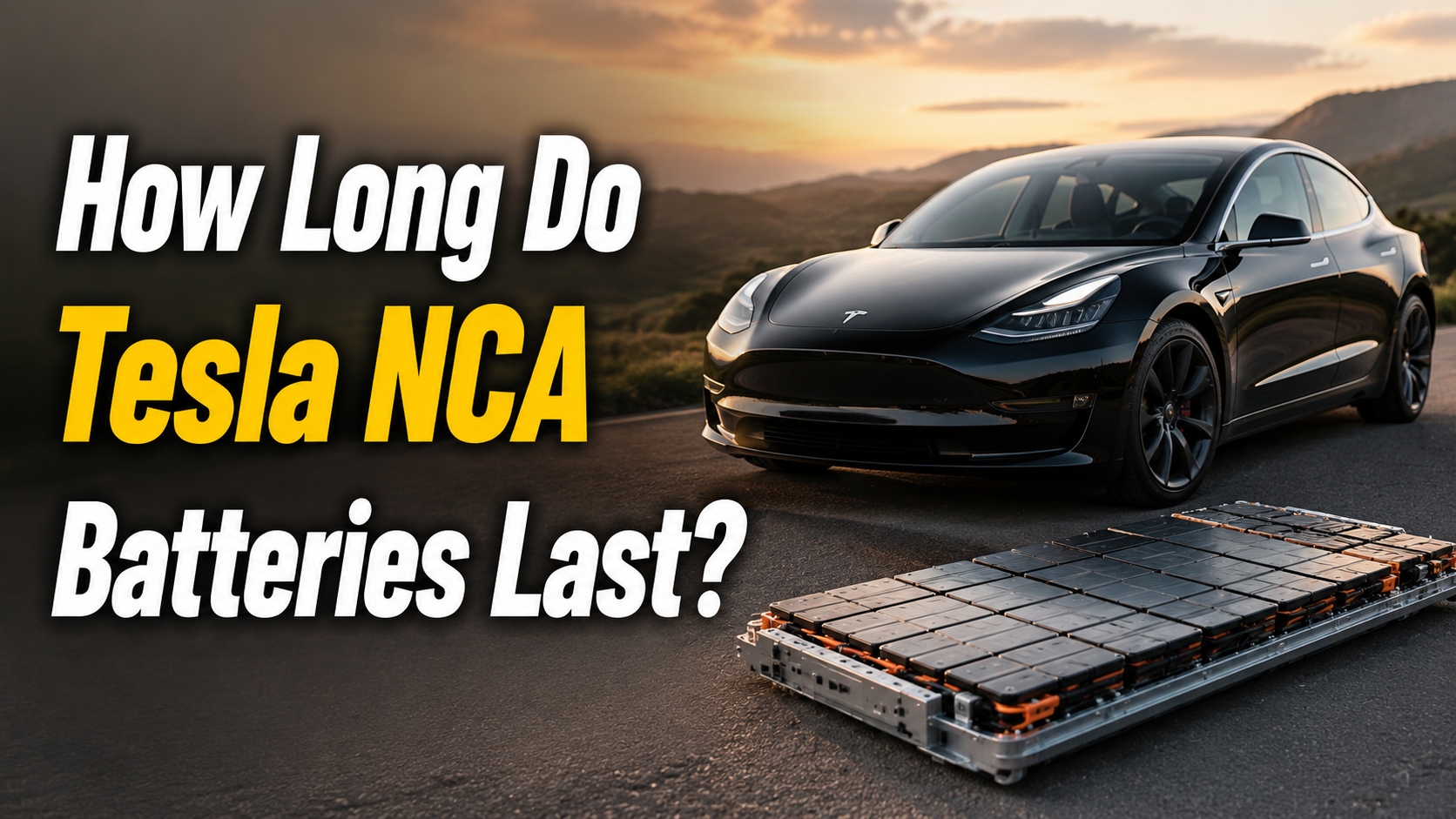
Tesla NCA batteries typically last around 300,000 to 500,000 miles, which for most drivers means well over a decade of use. In terms of capacity, they hold up better than many people expect: fleet data shows the average Tesla loses only about 10 to 15% of its capacity by 200,000 miles. So the practical answer is that the battery will very likely outlast your ownership of the car. The catch is that NCA chemistry rewards good habits, and a few simple ones make a real difference to how long it stays healthy.
- The short answer: how long do Tesla NCA batteries last?
- What is an NCA battery, and which Teslas use it?
- How Tesla NCA batteries degrade over time
- Why NCA lasts as long as it does
- Tesla’s battery warranty and the 70% floor
- What a replacement costs if you ever need one
- How to make a Tesla NCA battery last longer
- NCA vs LFP: does chemistry change how long it lasts?
- Conclusion
- Frequently asked questions
- Related Articles
The short answer: how long do Tesla NCA batteries last?
In everyday terms, a Tesla NCA battery is built to last the life of the car. Tesla designs its packs for roughly 300,000 to 500,000 miles, or somewhere in the range of 10 to 20 years, depending on the model, climate, and how the car is driven and charged. Most owners will replace the whole car long before the battery is worn out.
Capacity fades slowly rather than failing suddenly. Real-world data from large fleets shows Tesla batteries losing only about 1 to 2% of range per year in the early years, and still holding above 80% of their original capacity at 150,000 to 200,000 miles. A battery reaches what the industry calls end of life at about 70% capacity, and for a well-treated NCA pack that point often sits beyond a decade of normal driving.
What is an NCA battery, and which Teslas use it?
NCA stands for nickel-cobalt-aluminum, the chemistry used in the positive electrode of many Tesla batteries. It is prized for high energy density, which is a fancy way of saying it packs a lot of range into a given weight and size. That is why Tesla has leaned on it for long-range and performance vehicles.
Historically, most Teslas sold in the US used NCA cells. The early Model S and Model X used small cylindrical 18650 cells with NCA chemistry, and later Model 3 and Model Y Long Range and Performance versions moved to larger 2170 cells using closely related nickel-based chemistry. The trade-off with NCA is that its high energy density comes with a little more sensitivity, especially to sitting at a very high charge, which shapes the care advice later in this guide.
This matters because how long your battery lasts depends partly on which chemistry is under the floor. If you drive a Long Range or Performance Tesla, you very likely have a nickel-based pack that benefits from the 80% charging habit. The base Model 3 and Model Y, by contrast, moved to a different chemistry called LFP, which is covered near the end.
How Tesla NCA batteries degrade over time
Tesla NCA batteries degrade in a predictable, front-loaded pattern: fast at first, then much slower. Understanding this curve is the key to not panicking over an early dip in range. Here is roughly how capacity fades with mileage for a typical pack.

| Mileage | Rough capacity left | What it means |
| 25,000 to 50,000 mi | About 90% to 95% | Fastest drop happens early, then slows |
| 100,000 mi | About 88% to 92% | Still well within normal |
| 200,000 mi | About 85% to 90% | Averages around 10 to 15% loss |
| End of usable life (~70%) | 70% | Often beyond a decade of driving |
The most important thing to notice is that degradation is not a straight line. The steepest drop happens in the first 25,000 to 50,000 miles, when a new battery settles and can shed a few percent fairly quickly. After that, the curve flattens out and capacity fades much more gently for the rest of the battery’s long life.
This is why a small range drop in the first year is completely normal and not a sign of a problem. Owners often see a few percent gone early, then watch the number barely move for years. Independent analyses of large Tesla fleets back this up, with average losses landing around 10 to 15% at 200,000 miles, and many cars doing even better than that.
Reassurance: losing a few percent of range in the first year is normal, expected behavior for an NCA pack, not a fault. The curve flattens fast, so early loss does not predict the same rate later.
Why NCA lasts as long as it does
Tesla NCA packs last so long mainly because of how carefully the battery is managed and cooled. The raw chemistry is energy-dense but sensitive, so the engineering around it does the heavy lifting to keep it healthy for years.
Active liquid cooling. Tesla runs coolant through the pack to hold the cells in a healthy temperature range. Heat is the biggest enemy of battery life, and keeping the pack cool dramatically slows the calendar aging that would otherwise wear it down. This is a major reason Tesla packs outlast air-cooled batteries in hot climates.
A smart battery management system. The car’s software constantly balances the cells, manages charging, and keeps the pack inside safe limits. It also holds back a small buffer of capacity you never see, which cushions the usable range from the raw degradation happening underneath.
Thousands of cycles of headroom. NCA cells are rated for a large number of charge cycles, on the order of what it takes to cover hundreds of thousands of miles. Combined with the buffer and cooling, that gives the pack a long working life before it reaches the 70% mark.
The takeaway is that the long lifespan is not luck. It comes from Tesla surrounding a sensitive chemistry with cooling and software that protect it, which is also why the way you charge and park the car still matters on top of all that engineering.
Tesla’s battery warranty and the 70% floor
Tesla backs its batteries with an 8-year warranty that guarantees at least 70% capacity, which tells you how confident the company is in their lifespan. The exact mileage cap depends on the model.
| Model | Warranty | Capacity floor |
| Model S / Model X | 8 yr / 150,000 mi | 70% |
| Model 3 / Y Long Range or Performance | 8 yr / 120,000 mi | 70% |
| Model 3 / Y Standard Range | 8 yr / 100,000 mi | 70% |
The warranty covers the battery and drive unit for eight years or the mileage cap, whichever comes first, and promises the pack will keep at least 70% of its original capacity over that period. If it drops below 70% within the warranty window from normal use, Tesla repairs or replaces it. Coverage follows the car rather than the first owner, which is valuable if you are buying used.
One practical note: normal gradual fade above 70% is not a warranty claim, even if you wish you had more range. In real life, very few packs fall below 70% inside the warranty period, so most owners never use this coverage. You can confirm the exact terms for a specific car through Tesla’s official vehicle warranty page, which is tied to the car’s VIN.
What a replacement costs if you ever need one
If a Tesla NCA pack ever does need replacing outside warranty, it is a significant expense, though most owners never reach that point. Reported out-of-warranty replacement costs vary widely with the model and pack size, ranging from roughly a few thousand dollars for a module-level repair up to well over ten thousand for a full high-capacity pack, with parts and labor combined.
Two things soften this. First, Tesla often repairs at the module level rather than swapping the entire pack, which can cost far less than a full replacement. Second, because the battery usually lasts the life of the car, the vast majority of owners sell or retire the vehicle before a replacement is ever on the table. Treat the replacement cost as a worst-case number, not an expected one.
How to make a Tesla NCA battery last longer
Because NCA chemistry is sensitive to high charge and heat, a handful of habits meaningfully extend its life. None of them are demanding, and Tesla’s software makes most of them easy.
- Charge to about 80 to 90% for daily use. This is the single most important habit for an NCA pack. Set your daily charge limit in the range Tesla labels for everyday use, and save 100% for the days you actually need the full range for a long trip.
- Avoid leaving it sitting at 100% or near empty. A full NCA battery does not like resting at 100% for long periods, and neither does it like sitting near empty. If you charge to full for a trip, try to set off soon after rather than letting it sit topped up.
- Protect it from heat. Heat ages the battery faster than almost anything else. Park in shade or a garage when you can in hot weather, and rely on the car’s thermal management by keeping it plugged in during extreme temperatures.
- Use Superchargers when you need them, not for everything. Fast charging is fine and convenient, and occasional use has only a small effect. For daily charging, slower Level 2 charging at home is gentler on the pack.
- Do not sweat small early range loss. Fighting normal early degradation with extreme habits is not worth it. Sensible daily charging and heat care matter far more than obsessing over a percent here or there.
- Keep the software updated. Battery-management improvements arrive through Tesla’s software updates, so staying current helps the car look after the pack.
NCA vs LFP: does chemistry change how long it lasts?
Yes, the chemistry changes both how long the battery lasts and how you should treat it. Tesla now uses two main chemistries, and knowing which you have changes your charging routine.
NCA and similar nickel-based packs (Long Range and Performance models) are energy-dense for maximum range, but they prefer a daily charge limit around 80% and are more sensitive to sitting full. They still last the life of the car with good habits.
LFP, or lithium iron phosphate (used in many Standard Range Model 3 and Model Y cars), is more tolerant. Tesla actually recommends charging LFP packs to 100% regularly, and this chemistry generally shrugs off the high-charge stress that nickel packs dislike, often with an even flatter degradation curve.
Neither is simply better. NCA gives you more range for the weight, LFP gives you a more relaxed charging routine and strong longevity. What matters for lifespan is matching your habits to your chemistry: charge nickel packs to about 80% daily, and feel free to charge LFP to full. If you are not sure which you have, your car’s charging screen and owner information will tell you, since the recommended daily limit differs between them.
Conclusion
Tesla NCA batteries last a long time, roughly 300,000 to 500,000 miles or well over a decade, and typically lose only about 10 to 15% of their capacity by 200,000 miles. Degradation is fast at first and then slow, so early range loss is normal and not a warning sign.
Tesla’s 8-year, 70% warranty backs all this up, and most owners never come close to needing a replacement. To get the most life from an NCA pack, charge to around 80% for daily driving, keep it out of extreme heat, and lean on slower home charging. Do that, and the battery will almost certainly outlast your time with the car.
Frequently asked questions
How many miles does a Tesla NCA battery last? About 300,000 to 500,000 miles for most packs, which is well beyond the mileage most cars ever reach. Real fleet data shows only around 10 to 15% capacity loss by 200,000 miles, so the battery usually outlasts the rest of the car.
What percentage should I charge my Tesla NCA battery to? Around 80% for daily use, saving 100% for long trips. NCA chemistry does not like sitting at a full charge for long, so a daily limit near 80% is the single best habit for keeping the pack healthy over the years.
Is it normal for a Tesla to lose range in the first year? Yes. NCA batteries degrade fastest early on, so losing a few percent of range in the first year is expected and not a fault. The curve flattens quickly, and capacity then fades very slowly for the rest of the battery’s life.
Does Supercharging wear out an NCA battery faster? Only slightly. Occasional Supercharging has a small effect and is perfectly fine. For everyday charging, slower Level 2 charging at home is gentler, but you do not need to avoid fast charging on trips.
How long is the Tesla battery warranty? Eight years, with a mileage cap of 150,000 miles for Model S and X, 120,000 for Long Range and Performance Model 3 and Y, and 100,000 for Standard Range, all guaranteeing at least 70% capacity retention during that period.
Related Articles
How Long Does a Motorcycle Battery Last?
How Long Does a 5000mAh Battery Last?