


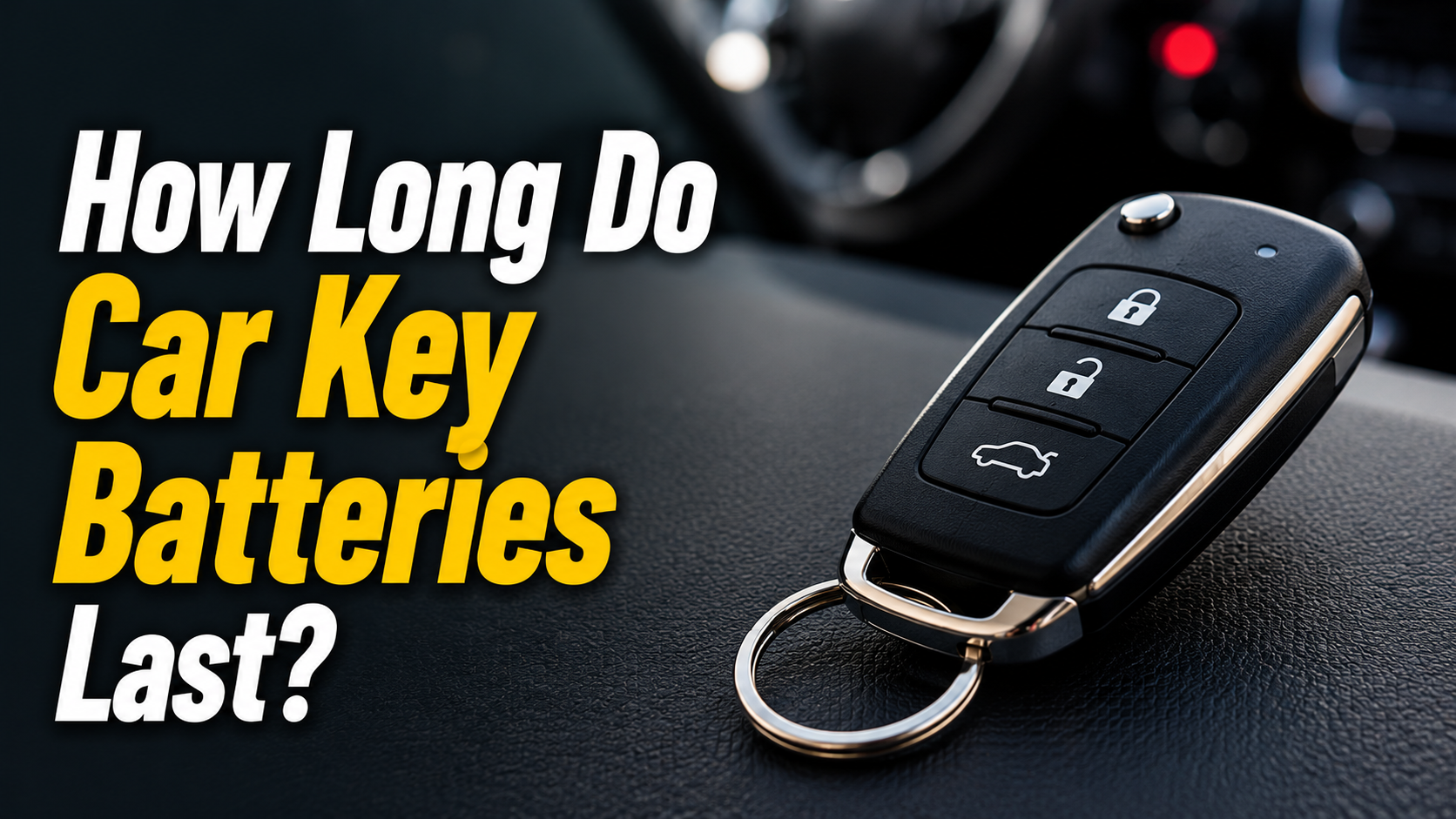
A car key fob battery usually lasts about 2 to 4 years, with most falling in the 2 to 3 year range under normal use. The exact time depends on how often you press the buttons, whether your car uses keyless entry that keeps the fob talking to the car, and where you store it. The good news is that a dying fob battery gives you plenty of warning, and swapping it yourself takes a few minutes and a cheap coin cell. Here is how long to expect, how to spot a weak battery, and how to replace it.
- The short answer: how long do car key batteries last?
- Why key fob batteries last as long as they do
- Signs your key fob battery is dying
- What affects how long a key fob battery lasts
- What type of battery does a car key use?
- How to replace a car key battery
- What if the fob is dead and you’re locked out?
- A quick safety note on coin cell batteries
- How to make a key fob battery last longer
- Conclusion
- Frequently asked questions
- Related Articles
The short answer: how long do car key batteries last?
For most cars, a key fob battery lasts around two to three years, and often up to four. Fob batteries are tiny coin cells, and the remote only sips a little power each time you use it, so they run a long time before fading. A remote you use a few times a day will typically get a couple of years out of a fresh battery without any fuss.
There is a fair amount of spread, though. A fob you barely use can go longer, while a keyless smart key that constantly listens for the car, or one you use for remote start many times a day, can wear its battery down closer to the two-year mark or sooner. Treat two to three years as a good moment to think about a proactive swap, rather than waiting to be caught out.
Why key fob batteries last as long as they do
Key fob batteries last so long because the remote does very little work. Most of the time the fob just sits in your pocket doing nothing, and when you press a button it sends a brief, low-power radio signal to the car. That signal takes a tiny amount of energy, so a small coin cell can supply thousands of button presses over its life.
The exception is a proximity or smart key, the kind that unlocks the car as you walk up and lets you start it with a button. That type stays partly awake, listening for the car or broadcasting a signal, so it draws a little power continuously rather than only when you press a button. This is why keyless smart keys tend to go through batteries a bit faster than a basic press-button remote.
Signs your key fob battery is dying
A weak fob battery almost always warns you before it quits completely. Catching these signs early lets you replace it on your own schedule instead of getting stranded. Watch for:
- Shorter range. You have to stand closer to the car for the lock or unlock to work, when it used to work from across the parking lot. This is often the first and clearest sign.
- Needing multiple presses. The doors only respond after you press the button two or three times, or press it harder.
- Inconsistent response. The fob works sometimes and not others, or there is a noticeable delay between the press and the locks reacting.
- A dashboard warning. Many modern cars show a message like ‘Key Fob Battery Low’ or ‘Key Battery Low’ on the dashboard. That is your cue to replace it soon.
- Trouble starting a push-button car. On keyless cars, a weak fob may not be detected reliably, so you get an occasional ‘Key Not Detected’ message, especially in cold weather.
If you see any of these, the fix is almost always a fresh battery, not a new fob. Replacing it early is smart, because a fob that only works when held against the door handle is about to fail entirely and lock you out.
What affects how long a key fob battery lasts
Two identical fobs can post very different battery lives, because a handful of factors speed up or slow down the drain. Knowing them helps you get the most out of each battery.
- How often you use it. More button presses and more remote-start use mean faster drain. A lightly used fob lasts longer than one worked hard every day.
- Keyless (proximity) vs basic remote. Smart keys that always listen for the car use more power than a simple lock-unlock remote, so they tend to need batteries sooner.
- Where you store the fob. Leaving the key close to the car, for example on a hook just inside the garage wall, can keep a keyless fob constantly active as it senses the vehicle, draining it faster. Storing it farther away can help.
- Temperature. Cold weather reduces the usable output of coin cells, so a fob that seems weak only in winter may be struggling with the cold rather than truly dead. Heat is worse for the battery over time, so a fob baking in a hot car ages faster.
- Battery quality. A fresh, name-brand lithium coin cell from a reputable maker outlasts a cheap or old one. A battery close to its own expiry date will not last as long once fitted.
- The fob’s design. Some fobs simply draw more power or use a smaller battery than others, which is why lifespan varies between car brands and models.
What type of battery does a car key use?
Almost all car key fobs use a flat 3-volt lithium coin cell, and the most common by far is the CR2032. The exact one your fob needs is usually printed on the old battery and listed in your owner’s manual. Here are the types you are most likely to meet.
| Battery | Thickness | Often found in |
| CR2032 | 3.2 mm | Many Honda, Toyota, Ford, Nissan, Subaru fobs (most common) |
| CR2025 | 2.5 mm | Slimmer fobs, some Mercedes, Mazda, VW |
| CR2016 | 1.6 mm | Older or very thin fobs |
| CR2450 | 5.0 mm | Some larger smart keys |
The numbers in the code describe the size: the first two digits are the diameter in millimetres and the last two are the thickness. So a CR2032 is 20mm across and 3.2mm thick, while a CR2025 is the same width but thinner at 2.5mm.
Important: do not substitute a different thickness just because it fits. A CR2032 and a CR2025 look almost identical, but the 0.7mm difference can stop the fob closing properly or cause weak contact. Always match the exact code printed on the old battery.
The safest approach is to open the fob and read the code stamped on the battery itself before buying a replacement. If you cannot read it, your owner’s manual or a battery guide by your car’s year, make, and model will tell you the right one.
How to replace a car key battery
Replacing a key fob battery is a quick, cheap job you can almost always do yourself in a few minutes, no dealership needed. Here is the general process, which covers most fobs.
- Confirm the right battery first. Check the code on the old battery, in the manual, or by your car’s make and model, and buy that exact coin cell. Guessing the size is the most common mistake.
- Open the fob. Most fobs pop apart at a seam, open after you slide out the hidden emergency key, or have a tiny screw. Use a plastic pry tool, a coin, or a small flat blade at the seam. A plastic tool is gentler on the case than a metal screwdriver.
- Note how the old battery sits. Before removing it, look at which way up it is, since the correct orientation (which side faces up) varies between fobs. A quick phone photo makes this foolproof.
- Swap in the new battery. Lift out the old cell and press the new one in the same orientation. Try not to touch the flat faces with bare fingers, since finger oils can shorten battery life; hold it by the edge or use a cloth.
- Close it and test. Snap the fob back together until it clicks shut, then test every button by locking and unlocking the car. Most cars keep the fob’s programming through a battery change, so it should just work.
If the fob still does not respond after a fresh, correctly fitted battery, the issue may be the fob itself, corrosion on the contacts, or a programming glitch, and that is when a dealer or locksmith can help.
What if the fob is dead and you’re locked out?
A completely dead fob does not have to leave you stranded, because carmakers build in backups. Nearly every smart key hides a physical metal key inside the fob, released by a small latch or button. You can pull it out and use it to unlock the driver’s door by hand.
Starting a push-button car with a dead fob is also usually possible. Many vehicles let you start the car by holding the dead fob against a specific spot, often the start button or the steering column, while pressing the brake, which lets the car read the fob’s chip at very close range. The exact method varies by car, so it is worth checking your owner’s manual once so you know the trick before you ever need it.
A quick safety note on coin cell batteries
Coin cell batteries are a serious swallowing hazard for young children, so handle the old and new ones carefully. If swallowed, a coin cell can cause severe internal burns within a couple of hours and can be life-threatening.
Keep new and used coin cells well away from children, and if a battery compartment on any device will not close securely, stop using it until it can. If you think a child has swallowed a coin cell, seek emergency medical help immediately.
When you replace a fob battery, do not leave the old one lying around, and take it to a battery recycling drop-off rather than the household trash. Coin cells are small, but they still belong in proper battery recycling.
How to make a key fob battery last longer
You cannot change how a fob is designed, but a few habits help each battery go the distance:
- Store the fob away from the car when it is parked at home, especially a keyless smart key, so it is not constantly sensing the vehicle.
- Do not leave the fob in a hot car or in direct sun, since heat ages the battery faster.
- Use a fresh, name-brand lithium coin cell, and check it is not close to its own expiry date when you buy it.
- Avoid touching the flat faces of the new battery with bare fingers when fitting it, as skin oils can reduce its life.
- Replace proactively at the first sign of shorter range, rather than pressing the button harder and waiting for it to fail completely.
If you are not sure which battery your car uses or how your specific fob opens, your vehicle’s owner’s manual is the most reliable source, and many carmakers publish the same instructions online, such as this Tesla key fob battery replacement guide, as an example of the level of detail to look for.
Conclusion
Car key fob batteries last about two to four years, most commonly two to three, with keyless smart keys and heavy remote-start use landing at the shorter end. The battery warns you before it dies, through shorter range, needing multiple presses, or a dashboard alert, so replace it at the first sign rather than waiting to be locked out. Buy the exact coin cell your fob uses, usually a CR2032, note the old battery’s orientation, and the swap takes a few minutes. Keep coin cells away from children, and you will keep your key working reliably for years.
Frequently asked questions
How often should I change my car key battery? Every two to three years is a good rule, or sooner if you notice the signs of a weak battery. Many people replace it proactively at that point to avoid being caught out, since a fresh coin cell is cheap and the swap is quick.
What are the signs of a dying key fob battery? Reduced range so you must stand closer to the car, needing to press the button several times, inconsistent response, a ‘Key Battery Low’ dashboard message, or a push-button car that struggles to detect the fob, especially in cold weather.
What battery does my car key use? Most use a 3-volt lithium coin cell, usually a CR2032, though some use a CR2025, CR2016, or CR2450. Open the fob and read the code on the old battery, or check your owner’s manual, and match it exactly rather than guessing.
Do I need to reprogram my key fob after changing the battery? Usually not. Most cars keep the fob’s programming through a battery change, so it works right away. A few models may need a quick resync if the remote does not respond, which your manual will explain.
Can I start my car if the key fob battery is dead? Usually yes. Most fobs hide a physical key to unlock the door, and many push-button cars let you start the engine by holding the dead fob against the start button or a marked spot while pressing the brake. Check your manual for the exact method.
Related Articles
How Long Do Tesla NCA Batteries Last? Lifespan, Mileage & Care Guide
How Long Does a Motorcycle Battery Last?