


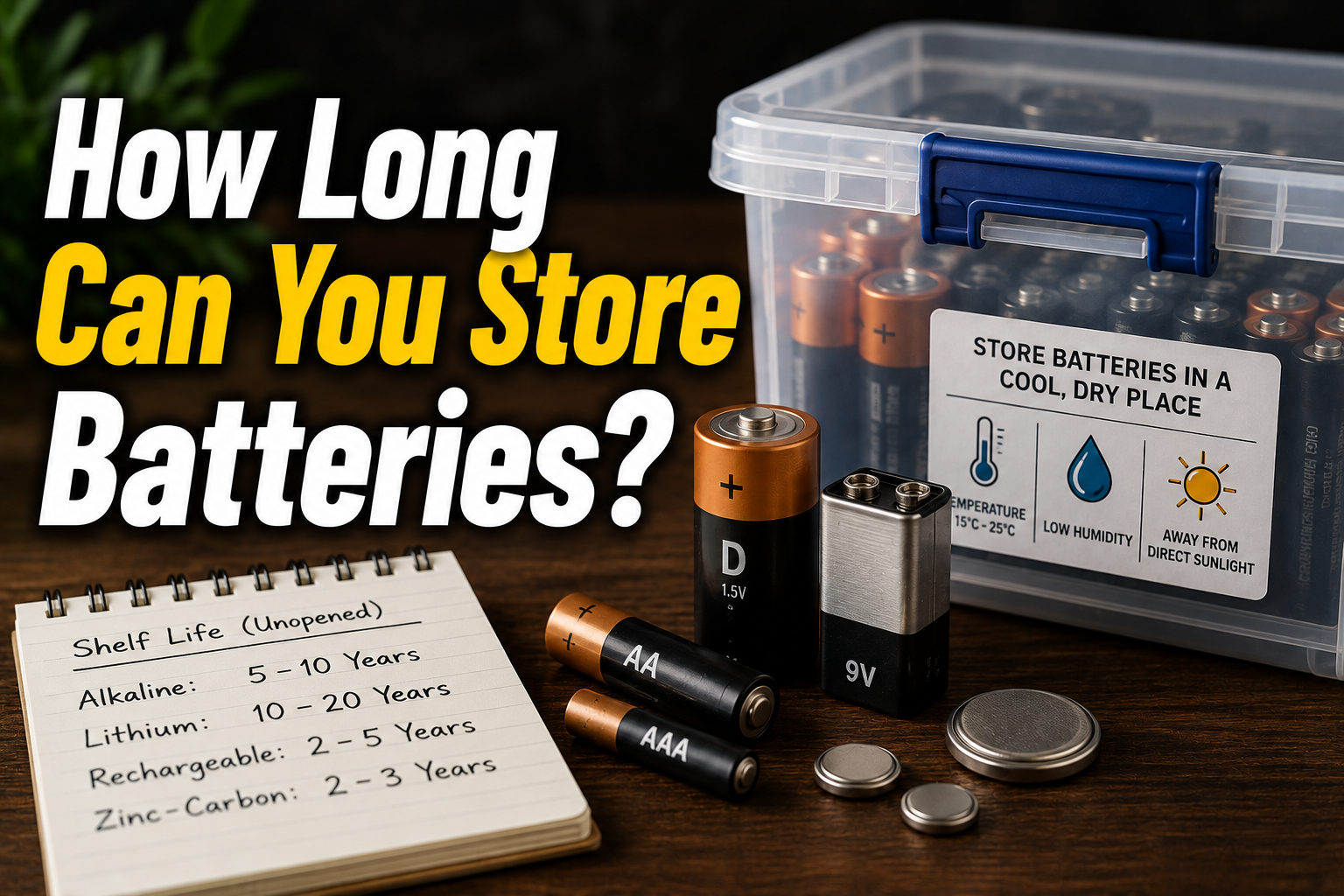
Unused batteries last 5 to 15 years in storage, depending on the type. A sealed pack of primary lithium cells can sit in a drawer for over a decade. Alkaline AAs give you 5 to 10 years. Rechargeables are the short end of the scale, closer to 3 to 5 years. The single biggest factor you control is where and how you keep them, so a little care buys you years of extra life.
So, how long can you store batteries?
The honest answer is that it depends on chemistry, but the ranges are easy to remember. Every battery slowly loses charge on its own, even sitting still. This is called self-discharge, and it is why a battery you bought years ago can feel flat when you finally reach for it. Heat speeds that process up. A cool, dry spot slows it right down.
Here is the quick version. Primary lithium cells, the kind in a good camera battery or a smoke alarm, hold up for 10 to 15 years. Standard alkaline cells last 5 to 10 years unopened. Rechargeable batteries, whether lithium-ion or NiMH, are built for daily cycling rather than long naps, so plan on 3 to 5 years of idle storage before they need attention. Car batteries are the odd one out and want regular charging, which we will get to.
Quick takeaway: Buy for how long you need to store. Primary lithium for the emergency kit you touch once a decade, alkaline for everyday drawers, and rechargeables for things you use often.
Battery shelf life by type
Different chemistries age at different rates. This table lines up the common types, how long they keep, and the charge level to store them at. Use it as your at-a-glance reference.
| Battery type | Typical storage life | Best storage charge | Common uses |
| Alkaline (AA, AAA, C, D, 9V) | 5 to 10 years | Full, as bought | Remotes, toys, flashlights |
| Primary lithium (AA, coin cells) | 10 to 15 years | Full, as bought | Cameras, smoke alarms, key fobs |
| Lithium-ion (rechargeable) | Best after 2 to 3 years idle | About 40 to 50 percent | Phones, laptops, tools |
| NiMH (rechargeable AA, AAA) | 3 to 5 years | Any charge, top up before use | Chargeable household cells |
| Sealed lead-acid (car, backup) | Up to about 2 years | Full, recharge periodically | Cars, UPS units, mobility gear |
A few things stand out. Primary lithium wins on pure shelf life, which is why it shows up in devices you rarely service. Rechargeables trade storage life for the ability to be topped up hundreds of times. And lead-acid needs the most hands-on care of the lot.
What makes stored batteries go bad?
Three things quietly eat away at a battery in storage: temperature, self-discharge, and leakage. Understanding them makes every storage rule below make sense.

Heat is the main enemy. Warmth speeds up the chemical reactions inside a cell, which drains charge and causes permanent capacity loss. The damage is real: a lithium-ion cell stored for a year at 40 percent charge holds about 96 percent of its capacity at room temperature, but drops to roughly 85 percent if kept at 40°C (104°F). The recommended storage temperature for most batteries is around 15°C (59°F), based on data from
Battery University, a widely used technical reference on battery care. Cool is good. Freezing is not, and we will cover that.
Self-discharge is constant. Even disconnected, a battery loses a small amount of charge over time. Lithium-ion cells shed a few percent a month. Alkaline and primary lithium cells lose charge far more slowly, which is what gives them their long shelf life.
Leakage is the one that ruins your gear. As alkaline cells age past their prime, they can vent a potassium hydroxide paste that corrodes battery contacts and can wreck a device. This is why you pull batteries out of anything you will not use for months. A leaked cell in a flashlight or remote can cost you the whole item, so the cell you saved is never worth the device you lose.
How to store batteries so they last?
Good storage is simple and costs nothing. Follow these rules and you will reach the top of each shelf-life range instead of the bottom.
- Keep them cool and dry. A closet or cupboard at normal room temperature is ideal, aiming for around 50 percent humidity. Skip the garage, the attic, and any windowsill that catches sun.
- Leave them in the original packaging. Unopened packs keep cells from touching metal or each other. If the pack is open, a plastic battery case works just as well.
- Stop the terminals from touching metal. Loose batteries rolling around with coins or keys can short out and even heat up. This matters most for 9V batteries, whose terminals sit side by side. A strip of tape over the terminals is cheap insurance.
- Do not mix old and new, or different types. Keeping fresh and used cells together leads to confusion and, once installed together, faster draining. Store by type and by age.
- Never freeze them. Freezing can change the internal structure of a cell and does not extend life for normal household batteries. Room temperature is the target, not the fridge.
- Keep them away from children and pets. Coin cells especially are a serious swallowing hazard, so store them high and sealed.
Storing rechargeable batteries and lithium-ion
Rechargeables play by slightly different rules, and the charge level you store them at really matters. Unlike an alkaline cell you store full, a lithium-ion battery is happiest sitting at a partial charge.
Store lithium-ion at about 40 to 50 percent charge. A cell kept full while in storage ages faster and loses more capacity than one held around the middle. That is why a phone or laptop you plan to shelf for months should be at roughly half charge, not 100 percent, before it goes away.
Do not let them drain to empty and sit there. A lithium-ion cell left deeply discharged for a long time can slip into a protective sleep mode, and if it drops too low it may not be safe to recharge. For long storage, check it every six to nine months and top it back up toward half.
Avoid storing them in the charger. Leaving rechargeables sitting on a charger long term is not the same as safe storage. Charge to about half, unplug, and shelve them in a case.
NiMH rechargeables are more forgiving on charge level but self-discharge faster, so expect to give them a top-up charge before you use a pack that has been idle for months.
Storing a car battery
A car battery is a sealed lead-acid unit, and it wants to be used. Left sitting, it slowly self-discharges, and a lead-acid battery that stays low develops sulfation, a buildup that permanently cuts its capacity.
For short storage, the best move is to drive the car for about 30 minutes now and then to keep the battery charged. For longer storage, take the battery out, keep it in a cool dry place off a concrete floor, and either recharge it every few weeks or connect a maintainer (a trickle charger) that holds it topped up.
A sealed lead-acid battery stores for up to about two years this way, but only if you keep it charged. Let it sit flat and its life shrinks fast. If you check just one thing, check the voltage: a healthy 12V battery reads around 12.6V at rest, and anything drifting toward 12.4V or lower is asking for a charge.
How to tell if a stored battery is still good?
Before you trust an old battery in an important device, give it a quick check. Most problems are visible or measurable in seconds.
Look for warning signs first. Any swelling, white crusty corrosion, leaking paste, or a rotten smell means the battery goes straight to recycling, not into your device. Wipe up any leaked material carefully and keep it off your skin and eyes.
Check the printed date. Most packs carry a “best by” or expiry date. A cell past that date is not automatically dead, especially if it was stored well, but it is a sign to test before relying on it.
Test the voltage. A cheap multimeter or a dedicated battery tester tells you fast whether a cell still has useful charge. A fresh 1.5V alkaline reads close to 1.5 to 1.6V; one sitting near 1.2V or below is on its way out.
When a battery is spent or damaged, recycle it rather than binning it. Many hardware and electronics stores have free drop-off boxes, and it keeps hazardous material out of landfill.
Conclusion
Store unused batteries in a cool, dry, sealed spot and they will keep for years: 10 to 15 for primary lithium, 5 to 10 for alkaline, and 3 to 5 for rechargeables. Keep lithium-ion around half charge, pull cells out of idle devices to avoid leaks, and give car and rechargeable batteries an occasional top-up. Do that, and a battery you tuck away today will still be ready when you need it.
Frequently asked questions
Do batteries expire if you never use them?
Yes. All batteries slowly self-discharge and age even in storage. Good storage slows it down, so a well-kept alkaline cell often works fine past its printed date, while a poorly stored one may not.
Can I store batteries in the fridge or freezer?
No, this is a myth. A cool cupboard at room temperature is ideal. Freezing can damage the internal structure and does not extend life for normal household batteries.
Should I store batteries loose or in packaging?
Keep them in the original pack or a plastic battery case. This stops terminals from touching metal or other cells, which prevents short circuits and slow draining.
What charge should I store a lithium-ion battery at?
Around 40 to 50 percent. A half-charged cell ages more slowly than a full one and avoids dropping so low that it becomes unsafe to recharge. Top it up every six to nine months.
How do I know if an old battery is still safe to use?
Check it visually and electrically. Any swelling, leaking, or corrosion means recycle it. Otherwise, a quick voltage test with a multimeter tells you whether it still holds a useful charge.
Related Articles
Do Rechargeable Batteries Go Bad? Signs and Causes
Do Lithium Batteries Leak? What to Know
Do Garage Openers Have Batteries? Full Answer
Does a Wireless Charger Damage Your Battery? What Actually Matters