



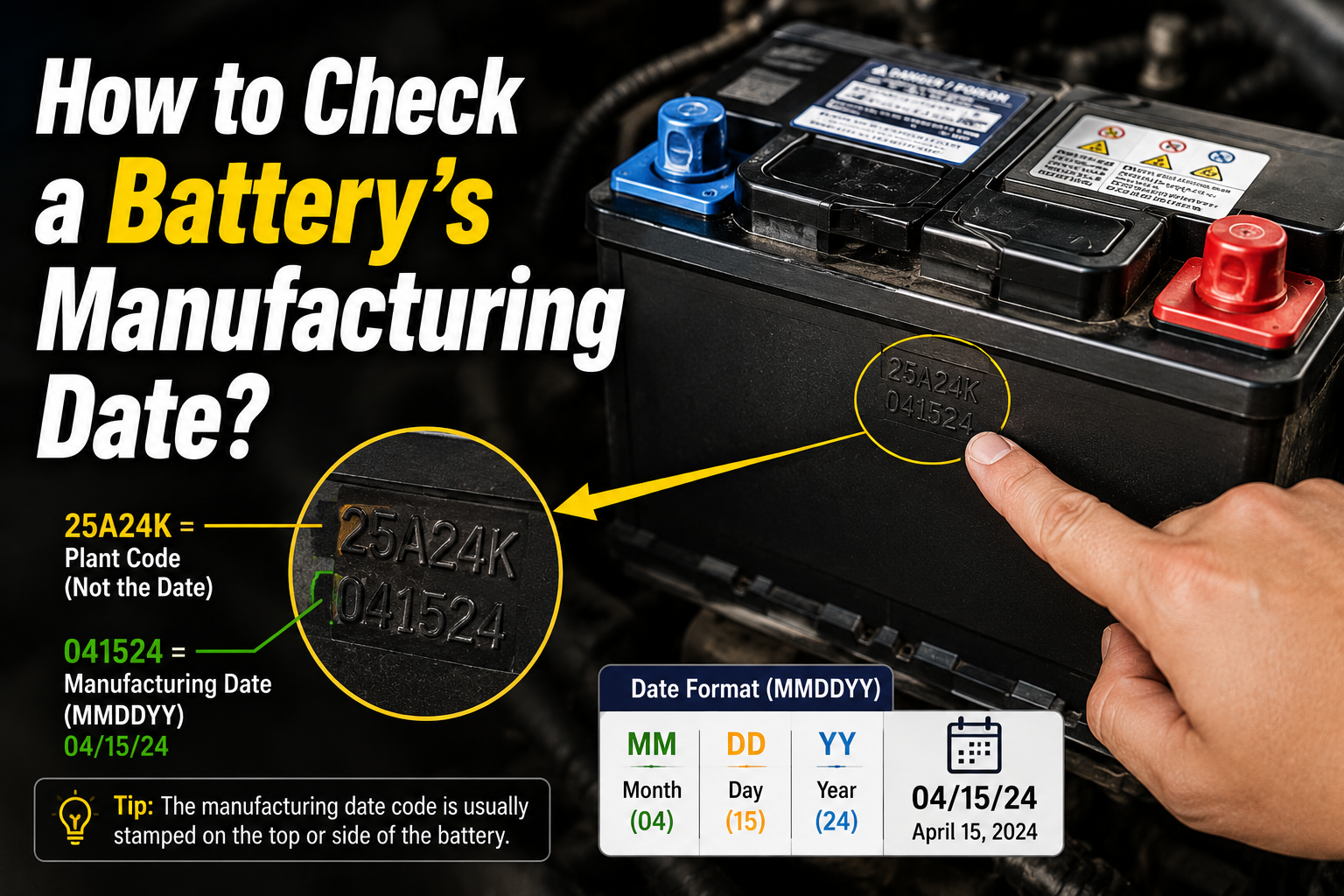
To check a battery’s manufacturing date, find the code printed or stamped on the case. On most batteries it is short: a letter that stands for the month and a number for the year. A letter A means January, B means February, and so on, while the digit is the last number of the year. So a code reading C4 means the battery was made in March 2024.
Where that code sits and exactly how it reads depends on the type of battery. This guide gives you the one key that unlocks most of them, then walks through car, household, and device batteries one by one so you can date whichever you are holding.
The one code that unlocks most batteries
Across nearly every battery brand, the month is written as a letter and the year as a number. The letters run A through M for January through December, and here is the part that catches people out: the letter I is usually skipped, because it looks too much like the number 1. That is why December can land on M rather than L. Keep this table handy and you can decode most codes on sight.
| Letter | Month | Letter | Month |
| A | January | G | July |
| B | February | H | August |
| C | March | J | September |
| D | April | K | October |
| E | May | L | November |
| F | June | M | December |
The year is almost always a single digit, the last number of the year, so a 4 means 2024 and a 5 means 2025. On its own that leaves a little ambiguity, a 4 could in theory be 2014, but the battery’s overall condition and where you bought it usually make the decade obvious. Some newer batteries use two digits for the year, which removes the doubt entirely.
Try a worked example. Say the code reads K3. Look up K in the table and you get October, and the 3 is the year, so the battery was made in October 2023. If instead you see 3K, do not panic; some brands put the year first, so it means the same thing, October 2023. The rule holds either way: find the character that is a letter between A and M, and that is your month; the number beside it is the year.
The key to remember: letter equals month (A is January, and I is skipped), number equals the year’s last digit. C4 is March 2024.
How to read a car battery’s date?
Car batteries carry their date in one of two places, and it pays to check both. Start with a sticker, then look for a stamped code if there is no sticker or you cannot read it.

The round sticker. Many batteries have a small round or rectangular sticker on the top or side showing the month and year in plain numbers, like 3/24 for March 2024, or with a month letter, like C/24. This is the manufacturing date, not the day you bought it.
The stamped code. If there is no sticker, look for an alphanumeric code hot-stamped or engraved into the plastic case, usually on the top edge or side. The first two characters carry the date. It might read C4 or 4C, month then year or year then month, but either way the letter is the month and the number is the year. The characters after that identify the factory, shift, and day, which you can ignore.
Brands vary a little. Some, like Interstate, engrave a longer code where the first couple of characters are a supplier code and the date follows, so read past the first two if the start looks like letters that are not a month. When in doubt, the letter that matches A through M is your month.
How to read AA, AAA, and 9V batteries?
Household batteries usually print their date, or an expiry, on the label or near the flat negative end. The catch is that the big brands each use their own system, so the same-looking code can mean different things.
- A clear date. The easiest ones simply print something like 2028 or an EXP date on the wrapper. For alkaline cells this is often an expiry, typically several years ahead of manufacture, since they lose a few percent of charge a year just sitting on a shelf.
- A Julian code. Some brands use a day-of-year number from 1 to 365, sometimes with a year digit. A code starting 172 would point to the 172nd day of the year, around late June.
- A letter-number code. Others use the familiar month letter and year digit, or a year letter, so it is worth a quick check of that brand’s chart if the code is not obvious.
Because the systems differ, the safest move with a household battery is to note whether the printed date is far in the future (likely an expiry) or close to now (likely manufacture), and to buy the freshest stock you can find.
How to read phone and laptop batteries?
Lithium-ion packs from phones, laptops, and power tools usually print their date on the foil wrapper or a label on the cell itself, often tucked under the outer casing. On a phone you would need to remove the back cover to see it, which is not worth doing on a sealed modern phone.
Many of these use a plain year-month-day format, so 220304 reads as the 4th of March 2022. Others use a letter for the month in the same A-through-M pattern. If you can see the cell, look for a six-digit run of numbers or a short letter-number code, and read it the same way as the others. Lithium cells have a long shelf life, often ten years or more, so their date matters less for freshness and more for knowing when a tired pack is simply old.
Manufacturing date vs in-service date
This is the point that confuses people most, so it is worth being clear. The manufacturing date is when the battery was built. The in-service date is when it was sold and put to work, which is what a warranty counts from.
Car batteries often have a second sticker for this, a strip of month abbreviations and years where the seller punches out or marks the month you bought it. If you see AU and 8 highlighted, that means it went into service in August, and warranty runs from there, not from the manufacturing code. Both dates are useful: the manufacturing date tells you how fresh the battery was when you bought it, and the in-service date tells you how long your warranty has left.
A quick check when buying: a battery made many months before you buy it has already been aging on the shelf. Prefer the freshest manufacturing date on offer.
What does the age actually tell you?
Knowing the date is only useful if you know what to do with it. Age is one of the biggest factors in whether a battery is still worth trusting.
Most car batteries last three to five years, and heat shortens that. A battery approaching or past five years old is on borrowed time even if it still starts the car, so the date is your cue to test it before it strands you. When buying new, avoid one that has already sat on the shelf for a year or more, since that shelf time counts against its life.
This is exactly why the manufacturing date matters at the point of purchase, not just years later. A battery does not start aging the day you install it; it starts aging the day it is built. Two batteries on the same shelf can differ by a year in manufacturing date, and the older one has already given up some of its life to sitting there. Reading the code before you pay lets you pick the freshest one and effectively get more service for the same money.
Household alkaline cells lose a small amount of charge every year, so a pack made years ago will not last as long as fresh stock, even unused. Lithium packs age more slowly but still fade, and an old device battery that no longer holds a charge is often simply worn out by time rather than faulty.
Whatever the battery, pair the date with a quick physical look. Swelling, leaks, a rotten-egg smell, or corrosion mean replace it now, regardless of age. For more on turning a car battery’s code into its true age, J.D. Power’s guide to a car battery’s age lays out the same method with examples.
Conclusion
Checking a battery’s manufacturing date comes down to finding the code and reading it with one simple key: a letter for the month, with I skipped, and a digit for the year. On a car battery, check the round sticker first, then the stamped code.
On household and lithium batteries, look on the wrapper or near the negative end, and watch for the brand’s own format. Keep the manufacturing date separate from the in-service date, and use the age to judge whether it is time to test or replace. A ten-second check can save you from a battery that is older than it looks.
Frequently asked questions
Where is the manufacturing date on a car battery? Usually on a round sticker on the top or side, or hot-stamped into the plastic case near the top edge. The first two characters carry the date: a month letter and a year digit.
What does a code like C4 mean on a battery? The letter is the month and the number is the year, so C4 means March 2024. Remember the letter I is skipped, so the months run A through M for January to December.
Is the date code the manufacturing date or the expiry? On car batteries it is the manufacturing date, not an expiry. On alkaline AA cells the printed date is often an expiry instead. Check whether the date is far in the future, which points to an expiry.
How do I know how old my phone battery is? The date is printed on the cell wrapper, often under the back cover, usually as a year-month-day number like 220304 for March 2022. On sealed phones it is rarely worth opening up to check.
How old is too old for a battery? Most car batteries should be tested or replaced by three to five years. Alkaline cells fade slowly over years, and any battery that is swollen, leaking, or corroded should be replaced right away whatever its age.
Related Articles
Can a Bad Starter Drain a Battery?
Can a Battery Be Too Dead to Jump? When a Jump Works and When It Won’t
Can Lithium Batteries Freeze? What Cold Really Does
Can an Alternator Kill a Battery?