


If you’ve ever had your trolling motor die halfway through a fishing trip, you already know that “how long do trolling motor batteries last” is really two separate questions. One is about service life — how many years or charge cycles the battery survives before it needs replacing.
- Battery Lifespan vs. Runtime: Know the Difference First
- How Long Do Trolling Motor Batteries Last, by Chemistry?
- Flooded Lead-Acid Batteries: 2–3 Years
- AGM Batteries: 3–5 Years
- Gel Batteries: 3–6 Years
- Lithium (LiFePO4) Batteries: 8–10+ Years
- How Long Will a Trolling Motor Battery Run on One Charge?
- 12V vs. 24V vs. 36V Systems: Does Voltage Change Runtime?
- Lithium vs. Lead-Acid: What You Actually Get Over Time
- 7 Factors That Shorten Trolling Motor Battery Life
- How to Extend Both Runtime and Lifespan
- Signs Your Trolling Motor Battery Needs Replacing
- Frequently Asked Questions
- The Bottom Line
- Related Articles
The other is about runtime — how many hours it powers your motor on a single charge. Mixing these two up is the single biggest source of confusion for boat owners shopping for a new battery, so this guide tackles both, with real numbers you can use to plan your next trip and your next purchase.
Battery Lifespan vs. Runtime: Know the Difference First
Before diving into numbers, it helps to separate the two ideas clearly:
- Lifespan is how long the battery itself remains useful — typically measured in years or in charge cycles (one full cycle equals discharging and recharging 100% of the battery’s capacity, whether that happens in one session or spread across several trips).
- Runtime is how many hours the battery can power your trolling motor on a single full charge, which depends on the motor’s current draw and the battery’s usable capacity.
A battery can have a five-year lifespan but only run your motor for three hours per outing — those are two completely different specs, and a good battery comparison should never conflate them.
How Long Do Trolling Motor Batteries Last, by Chemistry?
Service life varies dramatically depending on the battery chemistry inside the case. Here’s what to expect from each type under normal use and reasonably good maintenance.
Flooded Lead-Acid Batteries: 2–3 Years
The most affordable option up front, flooded lead-acid batteries typically last two to three years before capacity drops off noticeably. They’re vulnerable to sulfation if left partially discharged, require periodic water top-offs, and lose life quickly if repeatedly drained below 50% capacity.
AGM Batteries: 3–5 Years
Absorbed glass mat (AGM) batteries are sealed, maintenance-free, and more resistant to vibration than flooded batteries, making them a popular step up for boaters who don’t want to babysit electrolyte levels. Expect three to five years of service with a properly matched charger.
Gel Batteries: 3–6 Years
Gel batteries use an immobilized electrolyte and can handle deep cycling reasonably well, but they’re picky about charging voltage. Use a charger profile designed specifically for gel batteries, or you’ll shorten their life considerably.
Lithium (LiFePO4) Batteries: 8–10+ Years
LiFePO4 batteries are the clear standout for longevity. Rated for several thousand charge cycles rather than a few hundred, a quality lithium trolling motor battery commonly lasts eight to ten years — sometimes longer — with virtually no maintenance. The trade-off is a higher purchase price, though the math often favors lithium once you account for how few times you’ll need to replace it (more on that below).
| Battery Type | Typical Lifespan | Maintenance | Best For |
|---|---|---|---|
| Flooded Lead-Acid | 2–3 years | High (water levels, terminals) | Budget-conscious, occasional use |
| AGM | 3–5 years | Low | Moderate use, vibration resistance |
| Gel | 3–6 years | Low | Deep cycling, stable environments |
| LiFePO4 (Lithium) | 8–10+ years | Minimal | Frequent anglers, long trips |
How Long Will a Trolling Motor Battery Run on One Charge?
This is the question most anglers actually care about when they’re staring at the forecast for Saturday’s trip. Runtime comes down to a simple relationship between how much usable energy your battery holds and how much current your motor pulls.
The Runtime Formula
Usable capacity (Ah) ÷ average motor current draw (A) = estimated runtime (hours)
For example, a 100Ah battery delivering 90 usable amp-hours, paired with a motor drawing an average of 20A, gives you:
90Ah ÷ 20A ≈ 4.5 hours of runtime.
Runtime by Motor Speed Setting
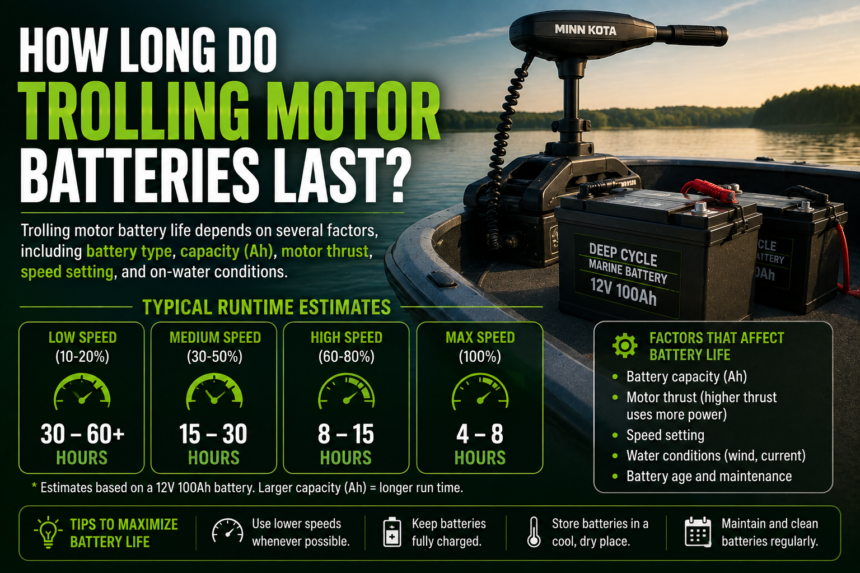
Most trolling motors don’t draw a constant current — draw increases sharply as you move up through the speed settings. Using typical current-draw figures for common 12V freshwater trolling motors like those from Minn Kota, MotorGuide, and Newport Vessels, here’s roughly what to expect:
| Speed Setting | Approx. Current Draw | 100Ah Battery Runtime |
|---|---|---|
| Low (1–2) | 8–12A | 8–11 hours |
| Medium (3–4) | 20–25A | 4–4.5 hours |
| High (5, max thrust) | 40–50A | 2–2.5 hours |
Practical takeaway: Most fishing trips involve a mix of speeds — cruising to a spot at higher power, then holding position or trolling slowly at low power. A realistic all-day estimate for a 100Ah lithium battery on a mixed-use trip is 5–8 hours, while a comparable lead-acid battery (with its lower usable capacity) typically delivers 2.5–4 hours before needing a recharge.
12V vs. 24V vs. 36V Systems: Does Voltage Change Runtime?
Higher-voltage systems don’t automatically mean longer runtime — they mean more stored energy, which is a different thing. The real comparison is watt-hours (energy), not volts alone:
Watt-hours = voltage × amp-hours
| System | Example Battery | Approx. Stored Energy |
|---|---|---|
| 12V | 100Ah | ~1,280 Wh |
| 24V | 100Ah | ~2,560 Wh |
| 36V | 100Ah | ~3,840 Wh |
A 24V battery bank stores roughly twice the energy of an equivalent 12V setup, and a 36V bank stores about three times as much. However, 24V and 36V trolling motors are typically larger and more powerful, so they also consume more watts per hour.
The net effect is that a bigger motor on a bigger boat doesn’t necessarily run three times as long just because it’s wired at 36V — it depends on how the added power is actually used. If you’re comparing two specific systems, divide total watt-hours by the motor’s average wattage draw rather than assuming voltage alone tells the story.
Lithium vs. Lead-Acid: What You Actually Get Over Time
Two “100Ah” batteries are not created equal. A lead-acid battery’s rated capacity is measured at a low, steady discharge rate — closer to what a trolling motor demands only at its lowest setting.
At higher currents, voltage sag and the Peukert effect mean a lead-acid battery delivers noticeably less than its rated capacity, and most owners limit regular use to about 50% of that rating anyway to avoid shortening its life. LiFePO4 batteries hold their voltage far more steadily under load and can safely use 80–90% of their rated capacity.
| 100Ah Lead-Acid | 100Ah LiFePO4 | |
|---|---|---|
| Realistic usable capacity | ~40–50Ah | ~80–90Ah |
| Runtime at 20A draw | ~2–2.5 hours | ~4–4.5 hours |
| Typical lifespan | 2–3 years | 8–10+ years |
| Approx. replacements over 10 years | 3–4 | 0–1 |
When you run the numbers over a decade of ownership, a single lithium battery often costs less per year of service than repeatedly replacing lead-acid batteries — even though the upfront price tag is higher. It’s worth running this cost-per-year math against your own usage before buying on sticker price alone.
7 Factors That Shorten Trolling Motor Battery Life
- Deep, repeated discharges. Draining a lead-acid battery below 50% regularly accelerates wear; lithium tolerates deeper discharge but still benefits from a reserve.
- Heat and cold extremes. Both hot storage and freezing temperatures reduce usable capacity and long-term health.
- Mismatched chargers. Using a charging profile meant for a different chemistry (especially on gel or AGM batteries) causes premature failure.
- Corroded or loose connections. Cable and terminal resistance causes voltage drop, making the motor cut out early even when the battery has energy left.
- Saltwater exposure. Saltwater accelerates terminal corrosion and connector wear far faster than freshwater use — rinse and inspect connections after every saltwater trip.
- Excess boat weight and prop fouling. A loaded-down boat or a prop tangled with weeds forces the motor to draw more current for the same speed, draining the battery faster and stressing it over time.
- Improper off-season storage. Storing a battery fully discharged, or leaving a lead-acid battery sitting for months without a maintenance charge, is one of the most common — and most avoidable — causes of early failure.
How to Extend Both Runtime and Lifespan
Charging habits
- Recharge lead-acid batteries once they hit around 50% rather than waiting for a full drain.
- Use a charger matched to your battery’s chemistry and its recommended amperage — too-fast charging generates heat and stress, especially on lead-acid and gel batteries.
- Avoid leaving lithium batteries at 100% charge for extended idle periods; many owners store them around 50–80% charge when not in regular use.
Winterization and storage
- Clean terminals and check for corrosion before storing for the season.
- Store batteries in a cool, dry space — extreme garage or shed temperatures shorten life.
- Give lead-acid batteries a maintenance or trickle charge every few weeks during storage; LiFePO4 batteries hold their charge far longer in storage but should still be checked periodically.
Wiring and setup
- In multi-battery banks, keep batteries matched in age and capacity — mixing an old battery with new ones in series or parallel drags down the whole bank’s performance.
- Use properly sized cables for your run length; undersized cable is a common, overlooked cause of voltage drop and reduced runtime.
On-the-water habits
- Run at lower speed settings whenever the conditions allow — moving from setting 5 to setting 3 can roughly double your runtime.
- Keep the prop clear of weeds and debris, which forces the motor to work harder for the same output.
- Minimize unnecessary weight on board when runtime is a priority.
Signs Your Trolling Motor Battery Needs Replacing
- Runtime has dropped noticeably compared to when the battery was new
- The battery reaches “full charge” quickly but drains much faster than it used to
- Voltage sags sharply under normal load, or the motor cuts out at higher speeds
- The case is swollen, cracked, or leaking
- Terminals get unusually hot during use or charging
- A load or capacity test shows significant capacity loss compared to the rated spec
Age alone isn’t a reliable signal — a lightly used battery can outlast its “typical” lifespan, while a poorly maintained one can fail well ahead of schedule. When in doubt, a simple load test tells you more than the calendar does.
Frequently Asked Questions
How long do trolling motor batteries last on average? Flooded lead-acid batteries typically last 2–3 years, AGM and gel batteries 3–6 years, and quality LiFePO4 lithium batteries 8–10+ years, depending on charging habits, storage, and depth of discharge.
How long will a 100Ah trolling motor battery run? At a moderate 20A draw, a 100Ah lithium battery generally runs about 4–4.5 hours, while a 100Ah lead-acid battery typically runs about 2–2.5 hours due to lower usable capacity.
Does a 24V trolling motor battery last longer than a 12V one? Not automatically. A 24V battery bank stores roughly twice the energy of an equivalent 12V setup, but 24V motors are usually larger and draw more power, so the runtime advantage depends on the specific motor and battery combination — compare watt-hours, not just voltage.
How can I make my trolling motor battery last longer? Avoid deep discharges, use a charger matched to your battery’s chemistry, keep terminals clean and connections tight, store the battery properly in the off-season, and run at lower speed settings when you don’t need maximum thrust.
Is lithium worth it for a trolling motor battery? For most frequent boaters, yes. Lithium batteries deliver roughly double the practical runtime of an equivalent lead-acid battery and last three to four times as long, which often makes them the lower-cost option over a decade of ownership despite the higher upfront price.
What kills a trolling motor battery fastest? Chronic deep discharging, storing a battery in a discharged state, using the wrong charger, and letting corrosion build up on terminals are the most common causes of premature battery failure.
The Bottom Line
How long your trolling motor battery lasts really depends on two things: the chemistry you choose and how well you take care of it. Lead-acid batteries are budget-friendly but demand more maintenance and deliver shorter runtime, while LiFePO4 lithium batteries cost more upfront but typically pay for themselves in longevity and performance over time.
Whichever type you own, the fastest way to get more life out of it — both in hours per charge and years of service — is simple: avoid deep discharges, charge it correctly, keep your connections clean, and store it properly in the off-season.
Ready to get more time on the water? Compare your motor’s amp draw at your usual speed setting against the runtime tables above, and use that number — not just the Ah rating on the box — to pick the battery that actually fits how you fish.
Related Articles
How to Put Out a Lithium Battery Fire Safely?
Can a Car Battery Recharge Itself? The Truth Explained