


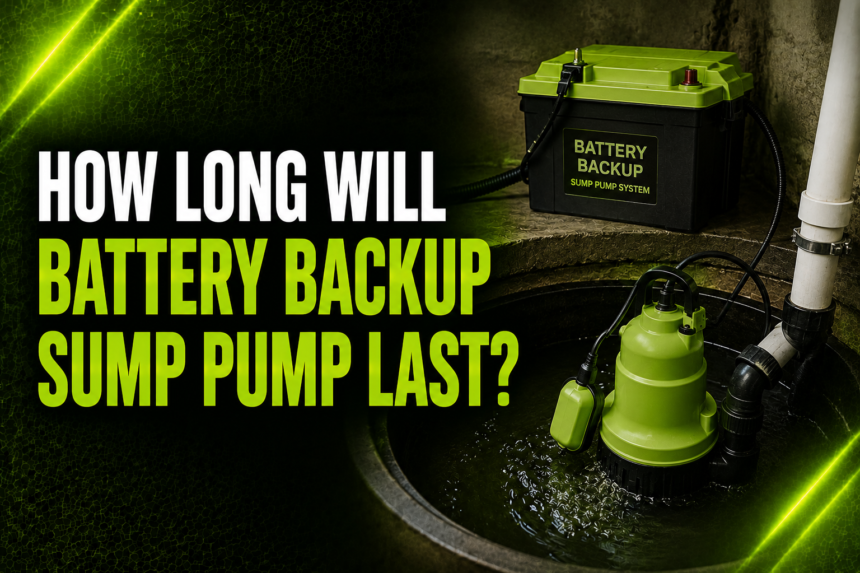
If you’ve ever stood at the top of your basement stairs during a blackout, listening to rain hammer the windows and wondering whether your sump pump backup will hold out until morning, you already know why this question matters. How long will a battery backup sump pump last? The honest answer is: it depends on two very different things — how many years the battery itself will function, and how many hours it can run continuously once a storm actually knocks out your power.
- Quick Answer: Battery Life vs. Runtime
- Battery Lifespan by Type: How Many Years Will It Last?
- Lead-Acid (Wet Cell) Batteries: 3–5 Years
- AGM (Absorbent Glass Mat) Batteries: 4–7 Years
- Lithium Iron Phosphate (LiFePO4): 8–12+ Years
- How Long Will It Actually Pump During a Power Outage?
- Typical Runtime: 5–10 Hours Continuous, 1–3 Days Intermittent
- The Math: How to Calculate Your Own Runtime
- What Changes the Number
- How Much Battery Capacity Do You Actually Need?
- What Shortens Battery Life (and How to Avoid It)
- 6 Ways to Make Your Backup Battery Last Longer
- Signs Your Backup Battery Needs Replacing
- Battery Backup vs. Other Backup Options
- Frequently Asked Questions
- Final Thoughts
- Related Articles
Most homeowners only think about this the moment the lights go out, which is exactly the wrong time to find out their battery is undersized or three years past its prime. This guide breaks down both sides of the lifespan question with real numbers, shows you how to calculate your own expected runtime, and gives you a maintenance routine that can add years to your system’s life.
Quick Answer: Battery Life vs. Runtime
Before diving into details, here’s the short version:
- Shelf/service life (how many years the battery lasts sitting in your basement): 3–5 years for standard lead-acid, 4–7 years for AGM, and 8–12+ years for lithium iron phosphate (LiFePO4).
- Runtime during an outage (how long it can pump continuously on one charge): typically 5–10 hours of continuous pumping, or 1–3 days of intermittent pumping during a normal storm cycle.
The exact number for your home depends on your battery’s amp-hour (Ah) rating, your pump’s horsepower, how often the float switch triggers, and the battery’s age. We’ll walk through how to estimate your own numbers below.
Battery Lifespan by Type: How Many Years Will It Last?
Not all backup batteries are built the same, and the chemistry inside determines both how long the battery survives in storage and how gracefully it ages. Here’s a side-by-side look at the three most common options homeowners choose between.
Lead-Acid (Wet Cell) Batteries: 3–5 Years
Lead-acid batteries are the most affordable and widely used option, similar in construction to a car battery. They use liquid electrolyte and lead plates that gradually degrade even when the battery sits unused. Expect to check water levels periodically and top off with distilled water, since letting the plates run dry accelerates failure. Cost is low upfront, but you’ll likely replace it twice as often as a lithium option.
AGM (Absorbent Glass Mat) Batteries: 4–7 Years
AGM batteries are a sealed, maintenance-free version of lead-acid technology. Because the electrolyte is absorbed into a fiberglass mat rather than sloshing around as liquid, AGM batteries resist vibration, won’t leak if tipped, and typically outlast standard wet-cell batteries by a couple of years. They cost more upfront but need essentially zero upkeep.
Lithium Iron Phosphate (LiFePO4): 8–12+ Years
LiFePO4 batteries are the newest and longest-lasting option on the market. Rather than measuring life in years alone, manufacturers rate them in charge cycles — often 2,000 to 4,000+ cycles while retaining 80% or more of original capacity.
In practical terms, that means a lithium battery installed today could realistically still be protecting your basement a decade from now, with no watering, no corrosion, and consistent power delivery even as it ages. The tradeoff is a higher purchase price, though the lower total cost of ownership often makes up for it over 10 years.
| Battery Type | Typical Lifespan | Maintenance | Upfront Cost | Best For |
|---|---|---|---|---|
| Lead-Acid | 3–5 years | Regular water top-offs | Low ($) | Budget-conscious homeowners, mild climates |
| AGM | 4–7 years | Minimal | Medium ($$) | Most homeowners wanting low maintenance |
| LiFePO4 (Lithium) | 8–12+ years | None | High ($$$) | Long-term reliability, extreme temperature areas |
How Long Will It Actually Pump During a Power Outage?
Once the power actually goes out, the question changes from “how many years” to “how many hours before my basement floods.” Here’s what determines that number — and how to estimate it for your own setup.
Typical Runtime: 5–10 Hours Continuous, 1–3 Days Intermittent
A fully charged, healthy backup battery generally provides 5 to 10 hours of continuous pumping. But most storms don’t require continuous pumping — the float switch cycles on and off as water rises and falls in the pit. Under that more realistic intermittent pattern, a good battery can stretch protection out to 1 to 3 days, which covers the vast majority of outages.
The Math: How to Calculate Your Own Runtime
You don’t have to guess. Battery runtime comes down to a simple relationship between your battery’s amp-hour (Ah) rating and your pump’s amp draw:
Estimated runtime (hours) = Battery Ah rating ÷ Pump amp draw
For example, a 75 Ah battery paired with a pump drawing roughly 10 amps under load would give you a rough estimate of 7.5 hours of continuous run time (in practice, expect somewhat less due to voltage drop and battery efficiency losses, often called the “Peukert effect”).
If your battery is rated in watt-hours instead of amp-hours, divide by your pump’s wattage instead. Your pump’s amp or wattage draw is usually printed on its nameplate or listed in the owner’s manual — a 1/3 HP pump generally draws more current (and drains a battery faster) than a 1/4 HP pump.
What Changes the Number
- Pump horsepower: A 1/3 HP pump moves more water per minute but draws significantly more current than a 1/4 HP pump, shortening runtime.
- Battery amp-hour rating: Higher-Ah batteries (75–100 Ah marine/deep-cycle batteries are common) simply hold more energy to begin with.
- Cycling frequency: Homes on a high water table or with poor grading may see the float switch trigger every few minutes, draining the battery faster than a home where it activates a few times per hour.
- Battery age: A 5-year-old lead-acid battery may only deliver 20–30% of the runtime it had when new, even if it still “turns on.”
- Water volume per cycle: Larger sump pits and higher inflow rates mean the pump runs longer per cycle, consuming more energy each time.
How Much Battery Capacity Do You Actually Need?
This is the sizing question most articles skip entirely — and it’s the one that matters most before a storm, not during one.
- Check your region’s typical outage duration. Midwest thunderstorm outages often resolve within a few hours, while ice storms in the Northeast or hurricane remnants along the Gulf and Southeast coasts can knock out power for 2–4 days or longer. If you live in a hurricane- or ice-storm-prone area, size your battery (or add a second one) for multi-day protection, not just an overnight event.
- Know your pump’s horsepower and amp draw. This is on the nameplate.
- Estimate your pit’s cycling frequency. If you don’t know, run your primary pump for an hour during a heavy rain and count how many times it cycles.
- Choose a battery (or battery bank) sized for at least 2x your expected outage length, since real-world runtime is always shorter than the manufacturer’s best-case rating.
If you routinely see multi-day outages, consider pairing your battery backup with a portable generator or whole-home standby generator as a second layer of protection — batteries are excellent for the first 24–48 hours, but a generator removes the runtime ceiling entirely for extended events.
What Shortens Battery Life (and How to Avoid It)
Four factors do most of the damage to backup batteries over time:
- Extreme temperatures. Basements that get very hot in summer or near-freezing in winter accelerate chemical breakdown, especially in lead-acid batteries. A climate-controlled installation location extends life significantly.
- Humidity and moisture exposure. Damp environments corrode terminals and connections, increasing resistance and reducing charging efficiency.
- Deep, frequent discharges. Repeatedly draining a battery close to empty (rather than recharging promptly after use) wears down internal components faster than shallow, occasional use.
- Neglected maintenance. Skipping water top-offs on lead-acid batteries, letting corrosion build on terminals, or leaving a battery on a low-quality charger all shorten effective lifespan.
6 Ways to Make Your Backup Battery Last Longer
- Test it annually, not just when a storm is forecast. Unplug your primary pump, let the backup take over, and confirm it clears the pit properly. Do this every spring before storm season.
- Clean terminals regularly. A baking-soda-and-water mix removes corrosion; dry thoroughly and keep connections snug.
- Maintain proper water levels (lead-acid only). Check monthly and top off with distilled water — never tap water, which introduces minerals that degrade the plates.
- Store and install in a stable environment. Aim for a dry, temperature-controlled space rather than a damp, unheated corner of the basement.
- Use the correct charger and avoid overcharging. A smart charger designed for your battery chemistry prevents both undercharging and the slow damage caused by constant overcharging.
- Replace proactively, not reactively. Don’t wait for a “Replace Battery” alarm during a storm. Mark your calendar for the battery’s expected end-of-life and swap it out before you actually need it.
Signs Your Backup Battery Needs Replacing
- Beeping alarms or a warning light on the control panel indicating low charge or failure to hold voltage
- Visible swelling, bulging, or leaking around the battery case — a genuine safety hazard that calls for immediate replacement
- A voltage reading under 12.1V at rest, measured with a basic multimeter (a fully charged 12V lead-acid battery should read close to 12.6–12.8V)
- Noticeably shorter runtime than when the battery was new — if a test run that used to clear the pit in minutes now takes much longer, capacity has degraded
- The battery is past its typical lifespan window for its chemistry (3–5 years for lead-acid, 4–7 for AGM, 8+ for lithium), even if it seems to be working fine
Battery Backup vs. Other Backup Options
Battery backups aren’t the only way to protect your basement. Water-powered backup pumps run off municipal water pressure and never run out of “charge,” but they require adequate municipal water pressure and typically pump at a lower rate than a full-size electric pump.
Standby generators eliminate runtime limits altogether but cost significantly more and require professional installation and fuel management. For most homeowners, a well-sized battery backup — sometimes paired with a generator for extended outages — offers the best mix of affordability, reliability, and ease of maintenance.
Frequently Asked Questions
How long does a sump pump battery backup last on a full charge? Most fully charged backup batteries provide 5 to 10 hours of continuous pumping, or roughly 1 to 3 days of intermittent protection during a typical storm cycle, depending on battery capacity and pump horsepower.
How often should I replace my sump pump backup battery? Lead-acid batteries typically need replacement every 3 to 5 years, AGM batteries every 4 to 7 years, and lithium (LiFePO4) batteries can often go 8 to 12 years or more before replacement.
Can I tell if my backup battery is dying before a storm hits? Yes. Test it annually by disconnecting your primary pump and running the backup manually, check the voltage with a multimeter (under 12.1V suggests aging), and watch for warning alarms, slower pump response, or visible corrosion.
Does a battery backup work if my main pump completely fails? Yes. A battery backup system operates independently of your primary pump and will automatically activate when water levels rise, regardless of whether the primary pump failed due to a power outage or a mechanical issue.
Is a lithium battery worth the extra cost for a sump pump backup? For most homeowners, yes. While lithium batteries cost more upfront, their significantly longer lifespan (often double or triple that of lead-acid) and stable performance in extreme temperatures usually make them cheaper over a 10-year period, with far less maintenance.
How many gallons can a battery backup sump pump move on one charge? This varies by pump and battery size, but many standard systems can move somewhere in the range of a few thousand gallons on a single charge before the battery depletes — check your specific pump’s flow rate (gallons per hour) and multiply by your estimated runtime for a rough figure.
Final Thoughts
So, how long will a battery backup sump pump last? In terms of years, expect 3–5 years from lead-acid, 4–7 from AGM, and 8–12+ from lithium. In terms of runtime during an actual outage, plan on 5–10 hours of continuous pumping or 1–3 days of intermittent protection — provided the battery is properly sized, well-maintained, and not past its prime. The homeowners who get caught off guard aren’t usually the ones with a “bad” battery; they’re the ones who never tested it, never calculated whether it was sized for their pump and pit, or waited too long to replace it.
Don’t wait for the next storm warning to find out where your system stands. Test your backup pump today, check your battery’s age and voltage, and if it’s approaching the end of its expected lifespan, replace it now — before the forecast, not during it.
Related Articles
Car Battery Smells Like Rotten Eggs?
How Much Does a Car Battery Weigh? Complete Guide
Why Is My Car Battery Smoking? Causes & Fixes (2026)
How to Change Fire Detector Battery: A Complete Step-by-Step Guide