



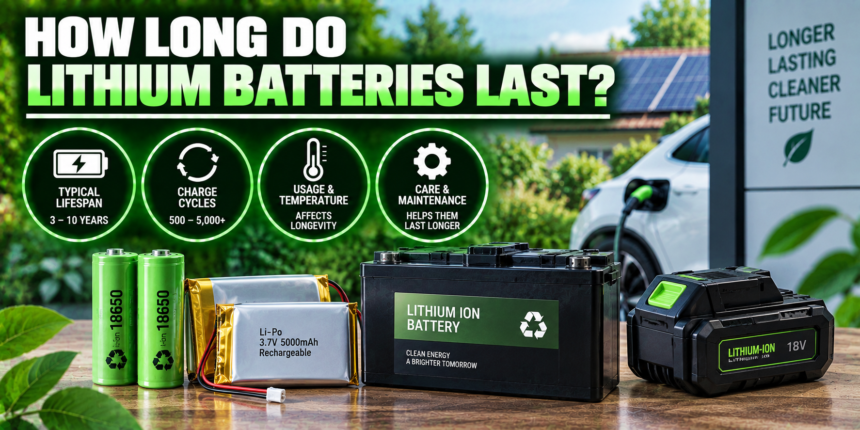
Most lithium batteries last somewhere between 3 and 20 years, and that huge range exists because the phrase covers four very different products. A phone battery is usually finished at 3 to 5 years. An electric car pack is built to run 15 to 20. A home storage battery is sold with a 10 year warranty and often outlives it. A single-use lithium AA can sit in a drawer for two decades before you even open the packet. What sets the number is not the brand on the label. It is how often the battery gets cycled, how hot it gets, and how long it sits at a full charge.
- Every lithium battery runs on two clocks
- How long each type lasts?
- How long does a phone or laptop battery last?
- How long does an electric car battery last?
- How long does a home or solar battery last?
- How long do single-use lithium batteries last?
- What actually wears a lithium battery out?
- How to make yours last longer?
- Conclusion
- Frequently asked questions
- How many years does a lithium battery last?
- Is it bad to charge a lithium battery to 100 percent?
- Do lithium batteries go bad if you do not use them?
- How do I know when a lithium battery needs replacing?
- Do lithium batteries last longer than alkaline?
- Related Articles
Every lithium battery runs on two clocks
The first is cycle aging. One cycle means using an amount of energy equal to the battery’s full capacity, and it can be spread over days. Running a phone from 100 percent down to 50 twice counts as one cycle, not two. Each cycle takes a tiny slice of usable capacity away for good.
The second is calendar aging. A lithium cell loses capacity even when nothing is drawing from it, because the chemistry keeps reacting slowly on its own. A pack left in a hot car ages faster than an identical one used gently in a cool room.
Whichever clock runs out first ends the battery. A phone dies of cycles, because it gets charged every day. A backup battery in a rarely used device dies of calendar age, having barely been cycled at all. The usual finish line is 80 percent of original capacity, though a cell keeps working well past that point.
How long each type lasts?
| Battery | Typical working life | Rated cycles |
| Phone | 3 to 5 years | 500 to 1,000 |
| Laptop | 3 to 5 years | 300 to 1,000 |
| Power tool pack | 3 to 5 years | 300 to 500 |
| Electric car pack | 15 to 20 years | 1,000 to 3,000 |
| Home or solar storage | 10 to 15 years | 3,000 to 6,000 |
| Single-use lithium AA | Up to 20 years in storage | Not rechargeable |
| Lithium coin cell (CR2032) | 1 to 5 years in a device | Not rechargeable |
Two things explain the spread. Chemistry is one: home batteries use lithium iron phosphate, which is built for cycle life, while phones use cobalt-rich cells built for energy in a small space. Duty is the other. A phone gets a full cycle a day. A car pack gets one every few days at most, spread across a battery twenty times the size.
How long does a phone or laptop battery last?
Three to five years for most people, and the cycle count explains why.
iPhone 14 models and earlier are built to hold 80 percent of their original capacity after 500 full cycles. iPhone 15 and later are rated for 1,000 cycles at that same threshold. Charging daily gets you to 500 cycles in under two years and 1,000 in closer to three. Most Android phones sit in the 500 to 800 range, and laptops run anywhere from 300 to 1,000 depending on the model.
Capacity does not fall in a straight line. Phones often shed a few percent in the first few months, then settle into a slow decline. Below roughly 80 percent you start to feel it: shorter days, steeper drops in cold weather, and sometimes a phone that shuts off at 20 percent because the aged cell cannot deliver the burst of current the processor asks for.
A battery swap costs a small fraction of a new phone or laptop and resets the capacity clock completely. It is the cheapest upgrade most people never make.
How long does an electric car battery last?
Longer than most drivers expect, and usually longer than the car wrapped around it. The average electric car pack loses about 2.3 percent of its capacity per year. At that rate it still holds around 82 percent of its original range after eight years, which on a 300 mile car is roughly 245 miles.
Charging habits move that number more than mileage does. Cars that lean heavily on DC fast charging above 100 kW degrade at about 3 percent a year. Cars charged mostly on slower AC power manage about 1.5 percent, leaving them near 88 percent after eight years. A hot climate adds roughly 0.4 percent a year on top of whatever else is happening.
The 20 to 80 percent charging rule matters less than the charging power does. Capacity loss only accelerates when a car spends more than 80 percent of its total time parked at a nearly full or nearly empty charge. Charging to 100 percent the night before a long drive costs almost nothing.
Outright replacement is rare on a modern car. In the United States the pack carries a legal minimum warranty of 8 years or 100,000 miles, and replacement rates on cars built from 2022 onward are running below half a percent.
How long does a home or solar battery last?
Ten to fifteen years is the working figure. Most are sold with a ten year warranty that guarantees at least 70 percent of the original capacity at the end of the term, and many keep going well past it.
Home storage almost always uses lithium iron phosphate, the longest-lived lithium chemistry in common use. LFP cells are rated for 3,000 to 6,000 full cycles, and the better packs go higher. A battery that cycles once a day reaches 3,000 cycles in a little over eight years, so a well-installed system normally arrives at its warranty date with capacity in hand.
Placement makes a real difference. A battery in a shaded garage or a temperature-controlled cabinet ages far more slowly than one bolted to a sunlit exterior wall. And the warranty date is not a death date. A pack sitting at 70 percent still stores 70 percent, which for most households is still a useful night of backup power.
How long do single-use lithium batteries last?
These are a different product, and their life is measured in shelf life rather than cycles.
Lithium AA and AAA cells hold their charge for up to 20 years in storage, against about 10 years for a standard alkaline AA. The 9V lithium version manages about 10. That gap is why lithium is the sensible choice for smoke alarms, emergency flashlights, and anything you want to load once and forget about.
Lithium coin cells such as the CR2032 keep their charge for around 10 years on a shelf, losing roughly 1 percent a year to self-discharge. Inside a device the answer depends entirely on what the device does. A car key fob may run 4 or 5 years on one cell. A tracker that reports its position all day may flatten the same cell in twelve months.
None of these can be recharged, and trying is a fire risk. Coin cells are also a serious swallowing hazard for small children, so they belong out of reach and in a battery recycling bin rather than a kitchen drawer.
What actually wears a lithium battery out?
Four things do most of the damage.
- Heat. The biggest single factor. Reactions inside the cell speed up as temperature rises, so a phone left on a dashboard or charged under a pillow ages faster than one kept cool.
- Sitting at a full charge. A cell held at 100 percent is under constant chemical stress. Long spells at full ages it more than the act of charging does.
- High-power fast charging. Pushing energy in quickly creates heat and strains the electrodes. Now and then is fine. As a default it is expensive.
- Deep discharges and long spells at empty. Draining to zero and leaving it can drop the cell below a safe voltage, and a deeply discharged lithium cell can become unsafe to recharge.
Cold behaves differently. It temporarily cuts how much energy the battery can deliver, which is why phones die quickly in winter, but it does not cause the permanent damage that heat does. Charging a lithium battery below freezing is the exception, and most devices block it for that reason.
How to make yours last longer?
- Keep it cool. No dashboards, no direct sun, no charging under bedding or a closed laptop bag.
- Use the charge limit. Many phones and most electric cars can be capped at 80 percent, which cuts the hours the cell spends at full.
- Charge slowly when time allows. Overnight on a normal charger is gentler than a 15 minute top-up, and there is no point fast charging a phone that will then sit on a desk for eight hours.
- Store at about half charge. Putting a spare pack or a device away for months? Leave it near 50 percent rather than full or empty, and check it once or twice a year.
- Do not run it flat and forget it. The odd low charge is harmless. A cell left at zero for weeks may never come back.
- Replace the battery, not the device. A swap costs far less than new hardware and restores the capacity you paid for.
Conclusion
Three to five years for a phone or laptop, ten to fifteen for a home battery, fifteen to twenty for a car pack, and up to twenty on a shelf for a single-use lithium cell. Which end of the range you land on depends far less on the brand than on heat and charging habits. Keep the battery cool, keep it off a permanent 100 percent, and save fast charging for when you actually need it.
Frequently asked questions
How many years does a lithium battery last?
Three to five years in a phone or laptop, 10 to 15 in a home storage system, and 15 to 20 in an electric car. Single-use lithium AA cells hold their charge for up to 20 years in storage before you ever use them.
Is it bad to charge a lithium battery to 100 percent?
Not occasionally. What ages the cell is sitting at 100 percent for long stretches. Charging fully before a trip is fine. Leaving a device plugged in at full charge for days at a time is the habit worth changing.
Do lithium batteries go bad if you do not use them?
Yes. Calendar aging carries on whether the battery is used or not, so an unused pack still loses capacity every year. Storing it at around 50 percent charge somewhere cool slows that loss considerably.
How do I know when a lithium battery needs replacing?
Around 80 percent of original capacity you start noticing shorter run times, and phones report this figure under battery health. Swelling, unusual heat, or a device shutting down at 20 percent means replace it straight away.
Do lithium batteries last longer than alkaline?
In storage, yes, by a wide margin: about 20 years against 10 for an alkaline AA. In use they also hold their voltage better in cold weather and in devices that draw heavy current, such as cameras and flashlights.
Related Articles
How Often Do Car Batteries Need to Be Replaced?
How to Change Battery Terminals: A Step-by-Step Guide
Can a Battery Be Too Dead to Jump? When a Jump Works and When It Won’t