


For most drivers, no. For a specific set of jobs, absolutely.
- What you are paying for?
- The colour tops
- Where an Optima genuinely earns the money?
- Where it does not?
- The reliability question
- If you buy one, treat it correctly
- What to buy instead?
- Conclusion
- Frequently asked questions
- Are Optima batteries worth the extra money?
- What is the difference between Optima RedTop and YellowTop?
- How long do Optima batteries last?
- Can I charge an Optima with a normal battery charger?
- Where are Optima batteries made?
- Related Articles
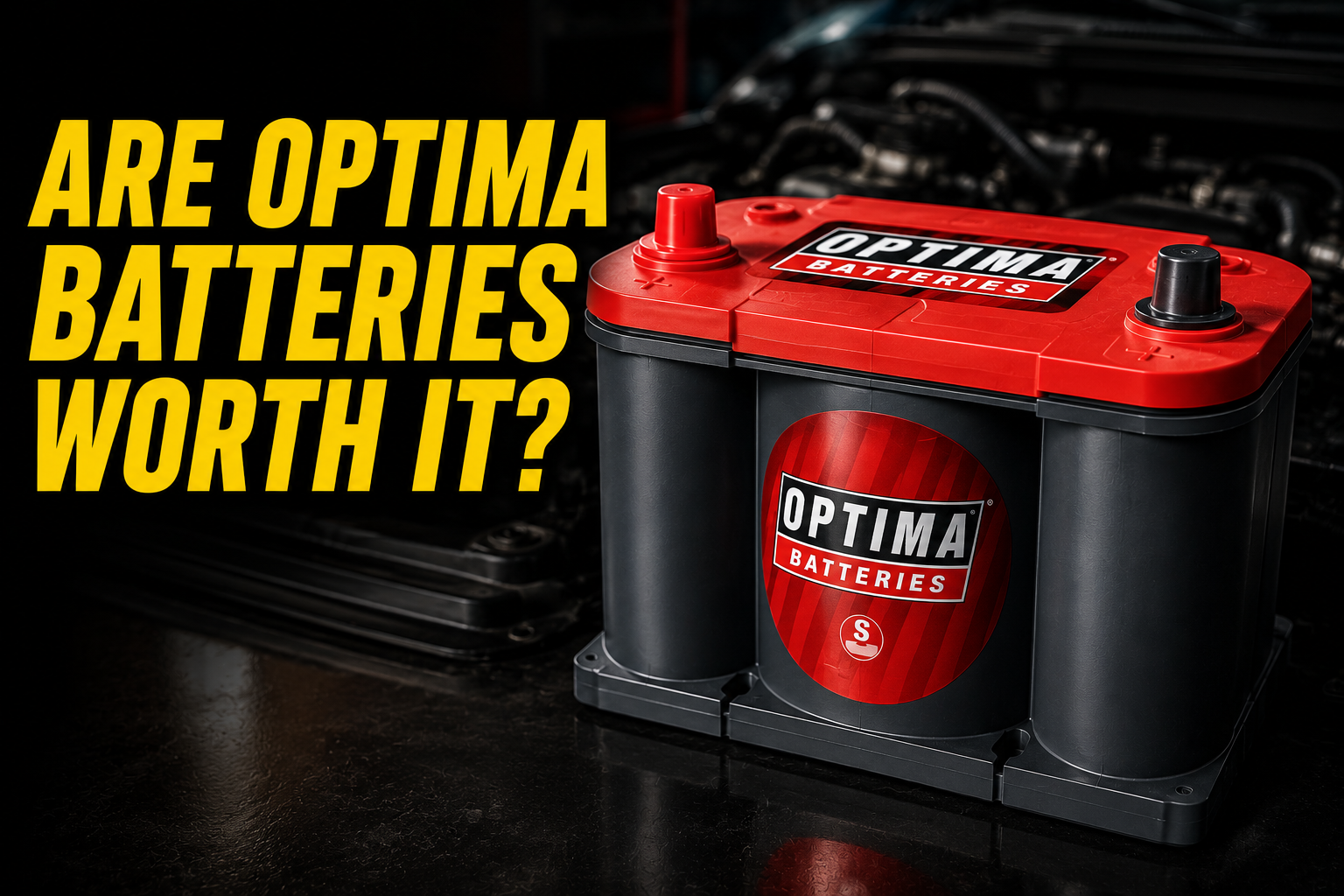
An Optima Battery costs roughly $280 to $350 depending on size and colour, against $150 to $220 for a good conventional battery and $200 to $260 for a mainstream AGM. That is a real premium, and what it buys is not a longer life in an ordinary car. It buys resistance to physical abuse.
So the question is not whether Optima makes a good battery. It does. The question is whether the thing it is good at is a thing your vehicle actually does.
What you are paying for?
Optima’s difference is structural rather than chemical. Both an Optima and a mainstream AGM are absorbed glass mat batteries: the acid is held in a glass mat rather than sloshing about as free liquid, which is what makes them sealed, non-spillable and mountable in positions a flooded battery cannot handle.
The difference is the shape. A conventional AGM uses flat plates stacked in a rectangular case. Optima winds two thin plates of high-purity lead into a tight cylinder, then fits six of those cylinders into the case, which is why the top looks like a six-pack. The company calls it SpiralCell.
Winding the plates does two useful things. It puts them under constant compression, so they cannot flex, crack or shed material when the battery is shaken. And a cylinder is structurally rigid in a way a stack of flat plates is not. Optima rates the result at 15 times the vibration resistance of a conventional flooded battery, and AutoZone’s description of the design sets out how the wound cells are compressed and sealed into a one-piece case.
That is the whole proposition. Everything else Optima offers, the sealed case, the mounting flexibility, the tolerance of deep discharge, is standard AGM behaviour available from several manufacturers for less money.
Check the numbers before you assume it is more battery
Worth doing the arithmetic, because a premium price does not automatically mean premium specifications.
A RedTop in group size 35 delivers around 720 cold cranking amps with roughly 90 to 100 minutes of reserve capacity, for about $280. Mainstream AGMs in the same group size frequently match or beat both figures for $60 to $100 less. On raw output per dollar, Optima often loses.
That is not a flaw in the product. It reflects what the design is optimised for. Winding plates into cylinders costs internal volume, so a spiral battery fits less plate area into the same box than a flat-plate design does. You are trading a little capacity for a lot of structural durability.
Which brings the decision back to the same place: if you need the durability, that trade is excellent value. If you do not, you are paying more for less.
The colour tops
Four versions, and picking the wrong one accounts for a lot of disappointment.
| Model | Built for | Typical use |
| RedTop | Starting only | Standard vehicles, hot rods, trucks with a working alternator |
| YellowTop | Dual purpose, starting and deep cycle | Winches, car audio, added electronics, vehicles that sit |
| BlueTop | Marine and RV | Dark grey case starts, light grey case is dual purpose |
| OrangeTop | Powersports | Side-by-sides, motorcycles, quads |
The distinction that matters is RedTop versus YellowTop. A RedTop is a starting battery. It delivers a large burst of current and expects the alternator to refill it immediately. Ask it to run accessories with the engine off and repeatedly drain it, and it will not last, because it was never built for cycling.
A YellowTop is designed for exactly that duty. If you have a winch, a serious audio install, a fridge, a light bar or anything else that draws heavily with the engine off, the YellowTop is the one worth considering and the RedTop is the wrong purchase.
Where an Optima genuinely earns the money?
Four situations, and they have vibration or cycling in common.
Off-road and rough-surface use. Corrugated tracks, rock crawling, farm and construction work. This is the case Optima was built for and the one where the spiral design does something a flat-plate battery cannot match. A conventional battery on washboard gravel sheds active material from the plates until it shorts internally.
Marine. Constant pounding, damp, awkward mounting angles and a duty cycle that mixes starting with running accessories at anchor.
Deep cycle plus starting from one battery. A genuine dual-purpose battery is unusual, and the YellowTop is one of the few that does both properly rather than compromising at both.
Unusual mounting. Sealed and non-spillable means it can go on its side or in a cabin, which occasionally solves a packaging problem nothing else does.
If your vehicle does one of those things, the premium is defensible and the battery will probably outlast the alternative.
Where it does not?
In an ordinary car, driven on ordinary roads, the case is much weaker.
Vibration resistance is worth nothing if your battery never gets shaken. A commuter car sits in a padded tray with a hold-down clamp and experiences almost none of the abuse the spiral design defends against. You are paying a substantial premium for a feature your use case does not activate.
Heat is the other issue. In hot climates, battery life is governed mostly by temperature, and AGM construction does not exempt a battery from that. A premium battery in Phoenix will not reach the life it would in Michigan, and the extra money does not buy a longer life so much as a shorter distance to fall.
There is a broader point worth understanding about the market. Most aftermarket batteries sold in the United States come from three manufacturers: Clarios, which supplies more than half the market, Stryten and East Penn. Optima is a Clarios brand. So are many store-brand AGMs sitting on the same shelf for considerably less, built in the same industrial ecosystem to the retailer’s specification.
Consumer Reports, which runs independent life, reserve capacity and cold weather testing, puts it plainly in its car battery buying guide: there is significant variation in which battery performs best from year to year and from size to size, which makes simple recommendations by brand impossible. That applies to Optima as much as to anyone. Brand is a weaker predictor of performance than most buyers assume.
One practical catch: fit and availability
The cylindrical construction has a physical consequence. Optima cases do not match the profile of a conventional rectangular battery, even within the same group size designation, and the terminals sit differently.
That occasionally causes trouble. Factory hold-down brackets designed to clamp the top edge of a rectangular case may not grip properly, some vehicles have covers or heat shields that will not close over the raised cell tops, and cable runs are sometimes tight. None of it is insurmountable, but it can mean buying a different hold-down or doing without a heat shield you should probably keep.
Optima’s range is also narrower than the mainstream brands, so the group size your car needs may simply not be available. Check fitment properly before ordering rather than assuming a group number guarantees it will drop in.
The reliability question
This deserves a straight answer rather than a dodge, because it is the thing people are really asking.
Optima was originally made in Colorado. Production moved to a dedicated Clarios plant in Monterrey, Mexico, and reports of early failures became more common afterwards. Whether the product genuinely changed is difficult to establish from consumer reports alone, since they are self-selecting and the brand’s reputation invites scrutiny that cheaper batteries escape.
What can be said with more confidence is that a significant share of early Optima failures trace back to charging. An AGM battery needs a charger with an AGM mode. Connecting a deeply discharged AGM to an old high-output flooded charger, or leaving it on a charger with no automatic cutoff, drives off electrolyte that a sealed battery cannot replace. The battery is then dead and looks like a warranty case. This is not unique to Optima, but Optima owners are more likely to be running winches and audio systems, which means more deep discharges and more charging.
Real-world life reports for current production cluster around three to five years for a RedTop and four to six for a YellowTop. Those are respectable numbers. They are not, on their own, better than a well-chosen mid-price AGM.
The RedTop carries a three-year free replacement warranty, which is competitive but not exceptional at this price. Compare it against what the alternatives offer before deciding.
If you buy one, treat it correctly
Three things determine whether you get the life you paid for.
- Use an AGM-capable charger. This is not optional. A charger without an AGM setting will either undercharge it permanently or cook it.
- Do not run a RedTop as a deep cycle battery. If you are draining it with the engine off, you needed the YellowTop.
- Fit the hold-down. The vibration resistance is a margin of safety, not a licence to leave the clamp off.
Beyond that, the ordinary rules apply. Keep it charged, avoid leaving it flat, and check the charging system if it fails early.
What to buy instead?
If your driving is ordinary, the sensible alternatives are a mainstream AGM such as those sold under the Interstate, DieHard Platinum, Duralast Platinum or NAPA labels, or a well-rated conventional flooded battery if your car did not come with AGM. Expect to pay meaningfully less for similar service life on a car that does not shake its battery to pieces.
If you need serious cycling or extreme conditions but not extreme vibration, flat-plate AGMs from Odyssey and East Penn’s Deka Intimidator line are direct competitors, with Odyssey generally costing more and Deka generally costing less.
And whatever you choose, match the group size, meet the specified cold cranking amps, fit the same chemistry the car came with, and check the date code for fresh stock. Those four things affect your outcome more than the badge does.
Conclusion
Optima batteries are worth it if your vehicle vibrates hard, gets deeply cycled, or needs a sealed battery in an awkward position. In those roles the spiral design does something flat plates cannot. In a normal car on normal roads, you are paying 50 to 100 percent more for a durability feature that never gets used, and a mid-price AGM will serve you just as well. Buy the YellowTop if you cycle it, the RedTop only if you do not, and use an AGM charger either way.
Frequently asked questions
Are Optima batteries worth the extra money?
Only if you need what they are good at. For off-road, marine, heavy vibration or genuine deep cycling, yes. For an ordinary commuter car, a mid-price AGM offers similar service life for considerably less, because the vibration resistance you are paying for is never called on.
What is the difference between Optima RedTop and YellowTop?
The RedTop is a starting battery built for a big burst of current with immediate recharging. The YellowTop is dual purpose and designed to be deeply discharged and recharged repeatedly, which is what you need for winches, audio systems and added electronics.
How long do Optima batteries last?
Reports for current production cluster around three to five years for a RedTop and four to six for a YellowTop. Longer lives are common in cool climates with correct charging, and short lives usually trace back to charging an AGM with an unsuitable charger.
Can I charge an Optima with a normal battery charger?
Only if it has an AGM mode. An older high-output flooded charger, or any charger without automatic cutoff, can drive off electrolyte that a sealed battery cannot replace. This is one of the most common causes of early failure.
Where are Optima batteries made?
At a dedicated Clarios plant in Monterrey, Mexico, which produces Optima batteries exclusively. Production was originally based in Colorado, and the relocation is the source of much of the debate about whether current quality matches the brand’s older reputation.
Related Articles
Can an Alternator Kill a Battery?
Can a Car Battery Die While Driving?
Can a Bad Starter Drain a Battery?
Can a Battery Be Too Dead to Jump? When a Jump Works and When It Won’t