


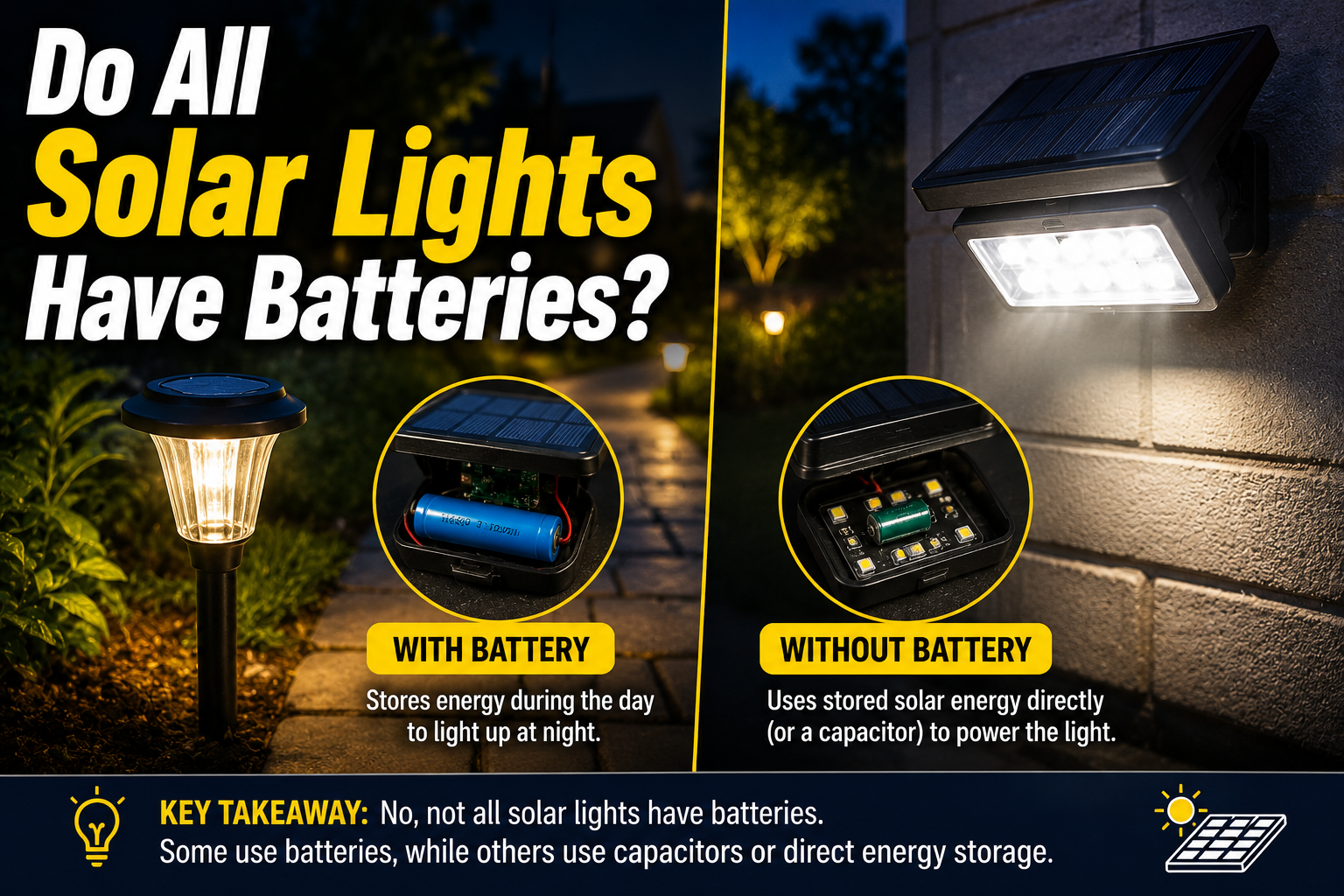
Almost all solar lights have batteries, and for a simple reason: a solar light needs somewhere to keep the energy it collects during the day so it can shine at night. That store of energy is nearly always a small rechargeable battery.
- Why a solar light needs a battery?
- The exceptions worth knowing
- What kind of battery is inside?
- Rechargeable, not disposable: an important distinction
- When and how to replace the battery?
- Picking a better battery for your lights
- Conclusion
- Frequently asked questions
- Do solar lights really need batteries to work?
- Can I use normal (disposable) batteries in solar lights?
- What kind of batteries do solar lights use?
- How often do solar light batteries need replacing?
- Are there any solar lights without a battery?
- Related Articles
There are a handful of exceptions, like decorative lights that only glow while the sun is on them, or a few designs that use a capacitor instead of a battery, but if you own a solar light that lights your path or garden after dark, it almost certainly has a rechargeable battery inside. The more useful question is usually what kind of battery it is and when to replace it, which this guide covers too.
So the honest answer is ‘essentially yes, with a couple of footnotes.’ Any solar light meant to work after sunset has to save daytime energy for later, and a rechargeable battery is how it does that. Below, we explain why the battery is essential, walk through the rare exceptions so nothing is left vague, and cover the battery types and replacement tips that actually matter day to day.
Why a solar light needs a battery?
The battery is what makes a solar light useful after dark. A solar light has a small solar panel on top, made of photovoltaic cells, that turns sunlight into electricity during the day. But that electricity is only being generated while the sun is shining, which is exactly when you do not need the light. Without a way to store it, all that energy would simply be wasted the moment the sun set.
The battery solves this by acting like a small power bank. Through the day, the panel charges the battery, banking the sun’s energy. Once it gets dark, a light sensor notices the drop in daylight and switches the LED on, drawing from the stored charge to light your garden or path through the evening. In the morning, the cycle starts over. Remove the battery from that picture and a solar light could only work in daylight, which defeats the whole point.
This daily charge-and-discharge cycle is also why the battery is the part that wears out first. Every full day of sun-then-dark is one cycle, and rechargeable batteries can only handle so many cycles before they hold less energy than they used to. That is why a solar light that once glowed all night might, after a couple of years, fade out by midnight.
The panel and the LED are often still fine; it is the battery that has aged. Understanding this makes solar lights far less mysterious: when performance drops, the battery is usually the first thing to check, not the last.
The simple logic: the panel makes power by day, but you need light by night. The battery bridges that gap, storing the day’s energy so the light has something to run on after dark.
The exceptions worth knowing
To answer the question honestly, there are a few cases where a solar light might not have a conventional battery. They are the exceptions that prove the rule:
- Daytime-only decorative lights. A small number of novelty solar items are designed to glow only while the panel is in the sun, as a decorative effect. Because they never run at night, they do not strictly need to store energy, so some skip a real battery.
- Capacitor-based designs. Instead of a chemical battery, some solar lights use a supercapacitor to hold the charge. A capacitor still stores energy, so the light works at night, but technically it is not a ‘battery.’ These are less common in cheap garden lights.
- Hybrid or mains-charged lights. Some lights marketed as ‘solar’ can also be charged from a wall outlet or a USB cable. These still contain a battery, but the sun is not the only way to fill it.
Even with these exceptions, the takeaway holds: the vast majority of solar lights you will buy for lighting an outdoor space at night contain a rechargeable battery. If a light works after sunset, it is storing energy somehow, and that store is almost always a battery.
What kind of battery is inside?
Solar lights use rechargeable batteries, and a few chemistries are common depending on the light’s size and quality. Here is how they compare:
| Battery type | Where it is used | Typical lifespan |
| NiCd (nickel-cadmium) | Older lights; being phased out (toxic cadmium) | About 1 to 2 years |
| NiMH (nickel-metal hydride) | The standard for most garden and path lights | About 1 to 2 years |
| Li-ion (lithium-ion) | Brighter lights with sensors or higher output | About 2 to 4 years |
| LiFePO4 (lithium iron phosphate) | Premium lights, streetlights, harsh climates | About 3 to 5+ years |
For most small garden and pathway lights, NiMH is the everyday standard, having largely replaced the older NiCd because it holds more charge and avoids toxic cadmium.
Brighter security or flood lights, and larger systems like solar streetlights, tend to use lithium-based batteries, with LiFePO4 prized for lasting far longer and coping better with heat and cold. A helpful overview of solar light batteries from Anker breaks down these chemistries in more detail.
Rechargeable, not disposable: an important distinction
Here is a point that trips people up: the battery in a solar light is a rechargeable one, not the throwaway kind. This matters, because a common mistake is to open a solar light, see an AA-sized cell, and replace it with an ordinary disposable alkaline battery. That is the wrong move.
Solar lights are built to recharge their battery a little every single day, and disposable alkaline batteries are not designed to be recharged. Putting one in a solar light can cause it to leak, overheat, or damage the fixture, and it will not hold up to the daily charging cycle.
So while a solar light does have a battery, it needs a rechargeable one of the correct type. You can occasionally pop a matching disposable cell in for a quick test to see whether the LED still works, but it should never be left in as a long-term solution.
Key rule: only use rechargeable batteries in a solar light, never disposable alkaline ones. The light charges the battery daily, and alkalines are not made for that, so they can leak or ruin the fixture.
When and how to replace the battery?
Because the battery is rechargeable, it does not last forever, and a worn-out battery is the single most common reason a solar light stops working well.
Most solar light batteries last somewhere between one and five years depending on the chemistry, with NiMH toward the shorter end and LiFePO4 the longest. If your lights have grown dim or stopped lasting through the night, a tired battery is the likely culprit, not the light itself.
Replacing it is usually straightforward. In broad strokes: turn the light off, open the battery compartment (often held by a few small screws), note the battery’s type, voltage, and capacity printed on it or inside the case, and swap in a matching rechargeable battery of the same specifications.
Then let the light charge in full sun for a day or two before judging the result. Always match the type, voltage, and size the manufacturer specifies, since the wrong battery can damage the light’s circuitry. If the light still fails with a fresh, correct battery, the LED or electronics may have reached the end of the road.
Before you replace anything, it is worth ruling out the simple causes, because a dim solar light is not always a dead battery. A panel coated in dust, pollen, or grime lets in far less sunlight, so a quick wipe can restore brightness on its own.
A light placed in a spot that has become shaded, perhaps by a plant that grew over the summer, may simply not be getting enough sun to charge fully. And a light left switched off, or one with a small on/off tab still in place from the packaging, will not charge at all. Checking these first can save you the cost of a battery you did not actually need, and it is the kind of thing the quick answers online rarely mention.
Picking a better battery for your lights
When it is time to replace a battery, you can often improve your lights by choosing wisely rather than just grabbing the cheapest cell. A few pointers:
- Match the basics first. The replacement must be rechargeable and share the same chemistry family, voltage, and size as the original. That is non-negotiable for safe operation.
- Higher capacity means longer runtime. Within the same type and voltage, a battery with a higher mAh rating stores more energy, so your lights can run longer into the night.
- Think about your climate. In very hot or very cold regions, LiFePO4 batteries hold up far better than NiMH, keeping performance steadier through temperature swings, though they cost more.
- Buy quality from a known brand. Cheap, no-name rechargeables often underperform their stated capacity and fade fast, so a slightly pricier reputable cell usually pays off in longer life.
Getting the battery right is most of what keeps solar lights performing year after year. Pair a good battery with a clean panel and enough daily sun, and the lights will do the rest.
Conclusion
So, do all solar lights have batteries? For any light meant to shine after dark, the answer is essentially yes: it stores the day’s energy in a rechargeable battery so it can light your space at night.
The rare exceptions, daytime-only decorations and a few capacitor-based designs, do not change the everyday rule. What matters most in practice is using the right kind of battery, always rechargeable, never disposable alkaline, and replacing it when your lights dim, matching the type and voltage.
Do that, and choose a good battery for your climate, and your solar lights will keep glowing reliably for years. A good result is knowing your lights store their power in a rechargeable battery and keeping that battery healthy.
Frequently asked questions
Do solar lights really need batteries to work?
Yes, if they light up at night. The battery stores energy the panel collects by day so the light can run after dark. Without it, a solar light could only work in daylight, which defeats its purpose.
Can I use normal (disposable) batteries in solar lights?
No. Solar lights recharge their battery daily, and disposable alkaline batteries are not built for that. They can leak or damage the light. Always use rechargeable batteries of the correct type; a disposable cell is fine only for a quick test.
What kind of batteries do solar lights use?
Most small garden lights use rechargeable NiMH (or older NiCd) batteries, usually 1.2 volts. Brighter lights and larger systems often use lithium-ion or LiFePO4 batteries, which store more energy and last longer, especially in extreme temperatures.
How often do solar light batteries need replacing?
Typically every one to five years, depending on the chemistry. NiMH tends to last one to two years, while LiFePO4 can reach three to five years or more. Dimming lights or shorter runtime usually signal a worn battery.
Are there any solar lights without a battery?
A few. Purely decorative lights that glow only in daylight may skip a battery, and some designs use a capacitor instead. But nearly all solar lights meant to work at night store their energy in a rechargeable battery.
Related Articles
How to Connect Two Batteries in Parallel: A Step-by-Step Guide
How to Check a Battery’s Manufacturing Date?
Can Lithium Batteries Freeze? What Cold Really Does