


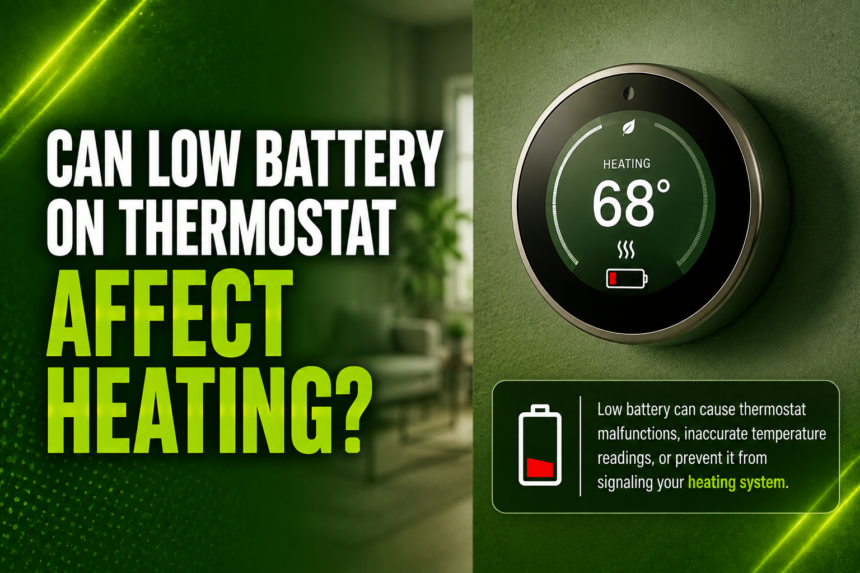
Yes — a low battery on your thermostat can absolutely affect heating, and in some cases, it can stop your furnace or boiler from turning on altogether. Your thermostat isn’t just a temperature display; it’s the control center that sends the electrical signal telling your heating system when to fire up. When its battery runs low, that signal can weaken, become inconsistent, or fail completely, leaving you with a cold house even though nothing is technically “broken” with your furnace.
- How a Low Thermostat Battery Affects Your Heating System
- 7 Signs Your Thermostat’s Low Battery Is Affecting Your Heat
- How to Replace Your Thermostat’s Batteries (Step by Step)
- How Often Should You Replace Thermostat Batteries?
- What If New Batteries Don’t Fix the Heating Problem?
- Do All Thermostats Use Batteries?
- Frequently Asked Questions
- Conclusion
- Related Articles
If you’ve noticed your heat cutting in and out, running late, or not kicking on at all, a dying thermostat battery is one of the simplest — and most overlooked — explanations. Below, we’ll walk through exactly how this happens, the warning signs to watch for, how to fix it, and when the problem points to something bigger than a battery.
How a Low Thermostat Battery Affects Your Heating System
Most thermostats — smart or standard — use low-voltage electrical signals to communicate with your furnace, boiler, or heat pump. When you set a temperature, the thermostat sends a small electrical call for heat through the system’s control wiring. That signal tells the furnace’s control board to ignite the burner (or, in an electric or heat pump system, to start the heating cycle).
Batteries power the thermostat’s internal processor, display, and in many models, the relay that actually completes this signal. When the battery voltage drops too low:
- The thermostat’s internal processor can behave erratically, sending incomplete or delayed signals
- The display may dim, flicker, or go blank, meaning you can’t even confirm your settings
- Programmed schedules can reset or fail to trigger on time
- In battery-dependent systems (not hardwired with a C-wire), the thermostat may lose enough power to send a call for heat at all
The result is a furnace that either doesn’t turn on, cycles on and off unpredictably (called short-cycling), or runs but doesn’t reach your set temperature. It’s a common cause of “my furnace won’t turn on” service calls that turns out to be a $10 fix rather than a costly repair.
Why This Matters More in Winter
During cold snaps, your heating system runs more frequently and for longer stretches, which puts extra demand on your thermostat’s battery-powered components. A battery that was “fine” in October can fail by December simply from more frequent use. This is exactly why HVAC technicians recommend checking thermostat batteries at the start of every heating season — not just when a problem shows up.
7 Signs Your Thermostat’s Low Battery Is Affecting Your Heat
Not every heating problem is battery-related, but these signs point strongly in that direction:
- Furnace won’t turn on at all, even though the thermostat display still shows a set temperature
- Blank, dim, or flickering thermostat screen — often the earliest and clearest warning
- Heat turns on and off repeatedly (short-cycling) instead of running a full, steady cycle
- Thermostat display shows a “low battery” icon or message (common on digital and smart models)
- Room temperature doesn’t match the thermostat’s reading, so the system heats unevenly or shuts off too early
- Programmed schedule stops working — the heat doesn’t adjust at the times you set
- Smart thermostat drops offline or disconnects from Wi-Fi/app control, since low battery voltage can interrupt wireless communication before it fully drains
If you’re seeing two or more of these at once, check the batteries before you call for HVAC service — it takes less than five minutes and could save you a service fee.
How to Replace Your Thermostat’s Batteries (Step by Step)
- Turn off the thermostat’s system switch (or simply proceed — most residential thermostats are low-voltage and safe to work on without shutting off power).
- Gently remove the thermostat faceplate from its wall mount or base plate. Most models snap or slide off; check your manual if it doesn’t release easily, since some brands use small side clips.
- Locate the battery compartment, usually on the back of the faceplate or inside the base unit.
- Remove the old batteries and note the type and quantity — most residential thermostats use two AA or AAA alkaline batteries, though some smart thermostats use a 3V lithium coin cell as a backup alongside a C-wire connection.
- Insert fresh batteries, matching polarity (+/-) exactly as marked in the compartment.
- Reattach the faceplate and wait 30–60 seconds for the thermostat to power back on and reconnect (smart models may take a minute longer to reconnect to Wi-Fi).
- Test your heat by adjusting the temperature a few degrees above the current room temperature and confirming the furnace or boiler kicks on within a minute or two.
Tip: Replace both (or all) batteries at the same time, even if only one seems dead. Mixing an old and new battery causes uneven power output and shortens the life of the fresh one.
How Often Should You Replace Thermostat Batteries?
Most residential thermostat batteries last 8 to 12 months under normal use. As a simple rule, replace them:
- At the start of heating season (typically September–October)
- At the start of cooling season (typically April–May)
- Immediately if your display dims, flickers, or shows a low-battery indicator
Setting a recurring reminder tied to daylight saving time changes (spring forward/fall back) is an easy way to stay on schedule, since most people already associate that date with checking smoke detector batteries.
What If New Batteries Don’t Fix the Heating Problem?
If you’ve replaced the batteries and your heat still isn’t working correctly, the battery likely wasn’t the only issue — or wasn’t the issue at all. At that point, consider these next steps:
- Check your thermostat settings. Confirm it’s set to “Heat” mode (not “Cool” or “Off”) and the fan is set to “Auto” rather than “On.”
- Check your circuit breaker and furnace switch. A tripped breaker or a furnace service switch left off can mimic thermostat symptoms.
- Inspect your air filter. A severely clogged filter can cause a furnace to overheat and shut down as a safety measure, which can look like a thermostat problem.
- Reset the thermostat. Many models have a reset button or a hold-to-restart sequence described in the manual.
- Rule out wiring issues. Loose, corroded, or disconnected low-voltage wires behind the thermostat can cause identical symptoms to a dead battery — dim display, no call for heat, erratic cycling.
- Call a licensed HVAC technician if the furnace still won’t respond. At that point, the issue may be with the furnace’s control board, ignition system, or a wiring fault that requires professional diagnosis.
Do All Thermostats Use Batteries?
Not necessarily. There are three common setups:
- Battery-only thermostats rely entirely on AA/AAA batteries for power. These are the most vulnerable to the issues described above.
- Hardwired thermostats connect to a “C-wire” (common wire) that draws continuous low-voltage power from the HVAC system itself, eliminating battery dependence entirely.
- Hybrid thermostats (common on many smart models like Nest, Ecobee, and Honeywell) use a C-wire as the primary power source but keep a battery as backup power in case of a wiring issue or power interruption. On these units, a dying backup battery is less likely to cause total failure but can still cause Wi-Fi drops, display issues, or delayed reconnection after a power blip.
If you’re unsure which type you have, check your thermostat’s settings menu (smart models often display power source) or look behind the faceplate for a wire labeled “C” connected to a terminal.
Frequently Asked Questions
Can a low thermostat battery stop my furnace from turning on completely? Yes. If your thermostat relies solely on battery power (no C-wire backup), a battery too weak to send a reliable signal can prevent the call for heat from ever reaching your furnace’s control board, leaving the system completely unresponsive.
Will my smart thermostat still work if the battery dies? It depends on your setup. If your smart thermostat is hardwired with a C-wire, it will typically keep running on that power even if the backup battery dies, though you may see a low-battery alert. If it relies on battery power alone, a dead battery can cause it to shut down or lose its settings.
Why does my thermostat screen look fine but my heat still won’t turn on? A dim or flickering screen is an early symptom, but voltage can drop low enough to disrupt the internal relay before the display goes completely blank. The screen can appear normal while the unit still can’t reliably complete a call for heat.
What type of batteries do most thermostats use? Most residential models use two AA or AAA alkaline batteries. Some smart thermostats also include a 3V lithium coin-cell backup battery in addition to AA/AAA cells or a C-wire connection — check your model’s manual to confirm.
Can a low battery cause my energy bills to go up? Yes. A struggling thermostat can misread room temperature, run your furnace longer than necessary, or cycle inconsistently, all of which waste energy and drive up heating costs even though your home may still feel unevenly heated.
Is it normal for thermostat batteries to die faster in winter? Yes. Increased heating demand means your thermostat communicates with your furnace more frequently, which draws more power from the battery. It’s common for batteries to wear out faster during peak heating months than during milder seasons.
Conclusion
A weak thermostat battery is a small, inexpensive part with an outsized effect on your home’s comfort — it can cause your furnace to short-cycle, miss its schedule, misread the temperature, or fail to turn on entirely. The good news is that it’s also one of the easiest heating problems to rule out: check for a dim display, low-battery alert, or erratic cycling, swap in a fresh set of batteries, and test your system.
If your heat still isn’t responding correctly after a battery change, the issue likely lies in your wiring, settings, or furnace itself, and it’s time to bring in a licensed HVAC technician for a full diagnosis. Either way, don’t let a two-dollar battery leave you guessing about a cold house — check it first, before you assume the worst about your heating system.
Related Articles
Can a Car Battery Recharge Itself? The Truth Explained
How Long Does a Double A Battery Last? Full Guide
How to Put Out a Lithium Battery Fire Safely?