


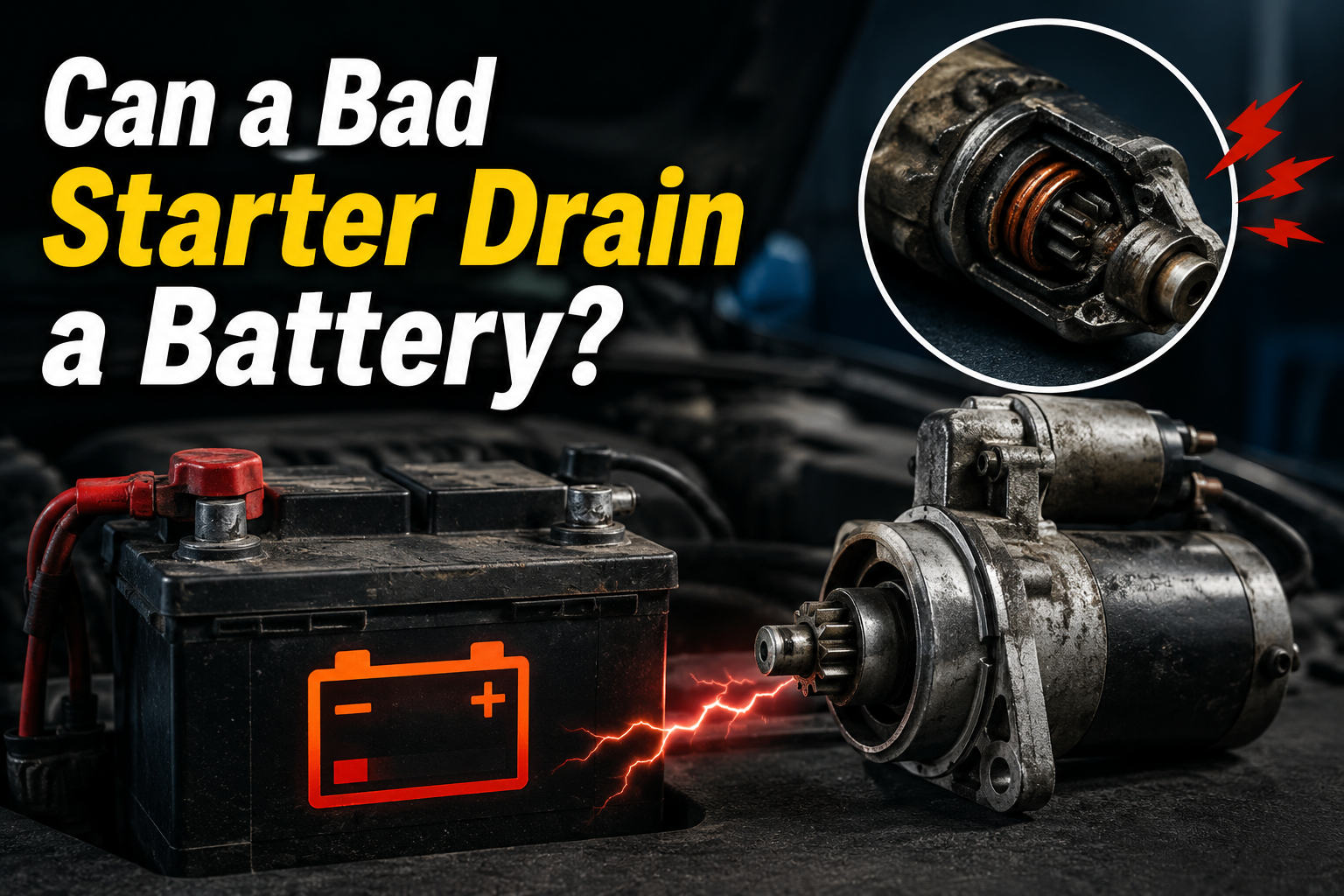
Yes, a bad starter can drain a battery, but only in a few specific situations, and it is not the usual reason a battery goes flat. A failing starter drains power in two main ways: it pulls too much current every time you crank the engine, or a stuck part keeps a tiny current flowing even after the car is off. If your battery keeps dying overnight, the starter is rarely the first thing to blame. Here is how to tell what is really going on.
- How the starter and battery work together?
- The three ways a bad starter drains a battery
- When cranking uses too much power?
- The one that drains a parked car: a stuck solenoid or internal short
- Why a dead battery usually is not the starter?
- Starter vs battery vs alternator: how to tell them apart
- How to test whether the starter is draining your battery?
- How to prevent starter-related battery drain?
- Conclusion
- Frequently asked questions
- Related Articles
How the starter and battery work together?
The starter is an electric motor with one job: spin your engine fast enough to get it running. When you turn the key or press the start button, a small signal current flows to the starter solenoid, which is a heavy-duty electrical switch. The solenoid then connects the battery straight to the starter motor and lets a huge burst of current through.
That burst is large. A starter can pull well over 250 amps for the second or two it takes to fire the engine. The battery is built to hand over that kind of power in a short pulse, and once the engine catches, the solenoid disconnects and the starter stops drawing anything. From that point on, the alternator takes over and keeps the battery charged while you drive.
So in normal use the starter only touches the battery for a moment, then lets go completely. Problems start when either that moment costs too much power, or the starter never fully lets go.
The three ways a bad starter drains a battery
A starter can pull down a battery in three main ways. Two happen while you are trying to start the car, and one happens silently while the car sits parked. Knowing which one you have points you straight to the fix.
- It draws too much current when cranking. A worn motor fights against extra friction, so each start pulls more power than it should and leaves the battery lower than normal.
- The solenoid sticks and stays engaged. If the solenoid does not release after the engine starts, it keeps feeding current to the starter, which flattens the battery fast.
- An internal short creates a slow leak. Damaged windings or worn insulation inside the motor can let a small current flow even with the ignition off, quietly draining a parked car over hours or days.
The first two show up as hard or failed starts you will notice right away. The third is the sneaky one, because the car may seem fine when running but keeps going dead when it sits.
When cranking uses too much power?
A tired starter motor has to work harder to turn the engine. Bearings wear, brushes wear down, and the shaft can drag. All of that extra resistance means the motor pulls more amps than a healthy one for every single start.
On its own, a little extra draw during a two-second crank will not kill a good battery in one go. The trouble builds up. If the starter is drawing far more than it should, and you make a lot of short trips, the alternator may not have enough time to fully top the battery back up between starts. Over days and weeks, the battery sits lower and lower until one morning it does not have enough left to crank at all.
You may also notice the engine cranking slower than it used to, or the starter getting hot. A slow crank with a healthy, fully charged battery is a strong hint that the starter itself is dragging.
The one that drains a parked car: a stuck solenoid or internal short
This is the scenario people really mean when they ask whether a starter can drain a battery overnight. The answer is yes, and it comes down to a part that will not let go.
If the solenoid sticks in the engaged position, it keeps the battery connected to the starter after the engine is running or even after you switch off. That is a heavy, fast drain, and it often comes with a burning smell or a starter that stays warm. A stuck solenoid can flatten a battery in minutes, not hours.
An internal short is slower and harder to spot. Worn insulation inside the motor lets a small current leak through to ground even when everything is off. This behaves exactly like any other parasitic draw: the car works fine when you drive it, but leave it overnight and the battery is noticeably weaker, and after a couple of days it may be dead. Because the leak is small and constant, most owners blame the battery first.
Rule of thumb: a car that goes flat while parked, with no starter noise, usually has a parasitic draw somewhere. The starter is only one possible source, and often not the first.
Why a dead battery usually is not the starter?
Here is the part most articles skip. A dead battery has many possible causes, and the starter is near the bottom of the list for a car that dies while parked. Before you spend money on a starter, it helps to know the more common suspects.
The most frequent cause of a battery that keeps dying overnight is a parasitic draw from something else: an interior light that stays on, a glovebox or trunk light, a module that will not go to sleep, or an aftermarket accessory wired in wrong. A weak or old battery that can no longer hold a charge is next, especially one that is three to five years old or has been through extreme heat. After that comes a failing alternator that is not recharging the battery properly while you drive.
There is also a classic mix-up worth clearing up. Fast, repeated clicking when you turn the key is almost always a weak battery, not the starter. The clicking is the solenoid trying to engage and releasing again because the battery cannot hold enough voltage under load. A genuine starter failure is more often one solid click, or dead silence, while your dashboard lights stay bright.
Starter vs battery vs alternator: how to tell them apart
These three parts fail in different ways, and the clues are in the sound, the lights, and what happens after a jump start. This quick comparison sorts most cases.
| Sign | Weak battery | Bad starter | Bad alternator |
| Sound at the key | Fast repeated clicking | One solid click, or silence | Normal, until it dies later |
| Dashboard lights | Dim or flickering | Stay bright | Battery light glows while driving |
| Cranking | Slow, dragging | No crank at all | Cranks fine, then stalls |
| After a jump start | Starts and stays running | Often still will not start | Starts, then dies within minutes |
Read it as a set of clues, not proof. Corroded or loose battery terminals, a bad ground strap, or a slipping belt can copy several of these symptoms at once. When the signs point in more than one direction, that is your cue to test rather than guess.
How to test whether the starter is draining your battery?
You can narrow this down with a multimeter and a bit of care. If you are not comfortable working around a live battery, a shop can run these same checks quickly. Work through them in order.
- Charge and test the battery first. A fully charged, healthy battery reads about 12.6 volts with the engine off. If it will not hold a charge or reads low, replace or recharge it before chasing anything else, since a weak battery mimics almost every other fault.
- Watch the voltage while cranking. With a good battery, voltage should stay above about 10 volts during a crank. If it dives well below that and the starter drags, the starter is likely pulling too much current.
- Do a parasitic draw test for a parked-car drain. With everything off and the car fully asleep, put a meter in series with the negative battery cable and read the current. A normal reading is small, usually under 50 milliamps. A higher reading means something is drawing power it should not.
- Isolate the starter. If you see an abnormal draw, have the starter circuit checked specifically. Because the starter connects directly to the battery, an internal short there will show up as parasitic current. This is the step where testing beats guessing.
- Check the solenoid and cables. Feel whether the starter stays hot after shutoff, and do a voltage-drop test on the thick starter cables. High resistance in a cable or a sticking solenoid both point to the starter circuit rather than the battery.
If you want the exact procedure for the parasitic draw check, the Fluke guide to finding parasitic battery drain walks through the meter setup step by step.
How to prevent starter-related battery drain?
Most starter and battery trouble is easier to prevent than to diagnose in a cold parking lot. A few habits keep both parts healthy.
- Keep the battery terminals clean and tight. Corroded or loose connections force the starter to pull harder and can mimic a failing starter.
- Fix a slow crank early. If the engine starts turning over sluggishly with a good battery, get the starter checked before it fails outright or starts overdrawing.
- Address any parasitic draw quickly. A battery that keeps dying overnight is telling you something is awake when it should not be. Track it down instead of just recharging.
- Have the charging system tested with the battery. A weak alternator and a dragging starter can hide behind each other, so test them together.
- Do not ignore warning signs like grinding, a burning smell, or a starter that stays warm. These point to real starter damage that will only get worse.
Conclusion
So, can a bad starter drain a battery? Yes, either by pulling too much current every time you crank, or through a stuck solenoid or internal short that leaks power while the car sits. But a battery that keeps dying overnight is more often a parasitic draw, an aging battery, or a weak alternator, and fast clicking usually means the battery, not the starter. Charge and test the battery first, then check for a parasitic draw, and let the tests point to the real cause before you replace any part.
Frequently asked questions
Can a bad starter drain a battery overnight? Yes, if the solenoid sticks engaged or the motor has an internal short, it can leak current while the car is parked. But an overnight drain more often comes from another parasitic source, so test for that before blaming the starter.
How do I know if it is the starter or the battery? Listen and look. Slow cranking with dim lights and fast clicking points to the battery. One solid click or silence with bright dashboard lights points to the starter. A jump start that holds means the battery was likely the problem.
Will a new battery fix a bad starter? No. A new battery may get you started for a while, but if the starter is drawing too much or leaking current, the new battery will struggle or drain too. Fix the starter to solve the root cause.
How much current should a car draw when parked? Usually under about 50 milliamps once everything has gone to sleep. A reading much higher than that means something is drawing power it should not, which is what a parasitic draw test is for.
Can a bad starter cause clicking but no start? Yes. A single solid click with no crank often means the solenoid engaged but the motor did not turn. Rapid repeated clicking, though, usually means a weak battery rather than the starter.
Related Articles
Are Super Start Batteries Good?
Can a Car Battery Die While Driving?
Can an Alternator Kill a Battery?
Are Optima Batteries Worth It?