


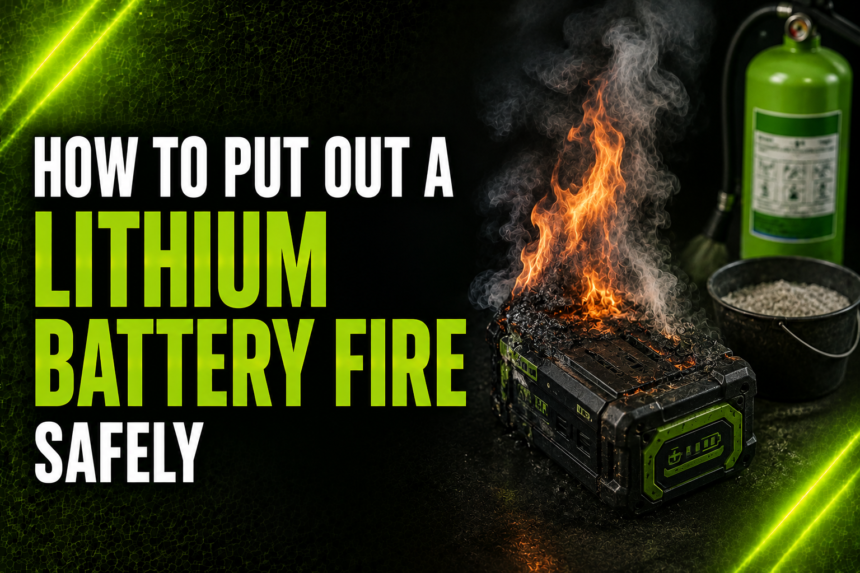
Knowing how to put out a lithium battery fire can mean the difference between a quickly contained incident and a house fire that spreads in minutes. Lithium batteries power nearly everything in modern life — phones, laptops, e-bikes, power tools, and electric vehicles — and when one fails, it doesn’t burn like ordinary paper or wood.
- Why Lithium Battery Fires Are So Dangerous
- Lithium-Ion vs. Lithium-Metal: Why the Difference Matters
- How to Put Out a Lithium Battery Fire: Step-by-Step
- Step 1: Get People Out and Call 911
- Step 2: Cut Power and Isolate the Device, If It’s Safe
- Step 3: Choose the Right Extinguishing Method
- Step 4: Keep Cooling the Area
- Step 5: Watch for Reignition
- What NOT to Do During a Lithium Battery Fire
- How to Handle Fires in Common Lithium Battery Devices
- Phone or Laptop Battery Fire
- E-Bike or E-Scooter Battery Fire
- Electric Vehicle Battery Fire
- Vape or Small Battery Fire
- How to Prevent Lithium Battery Fires
- Frequently Asked Questions
- Conclusion
- Related Articles
It can reach temperatures above 1,000°F, throw off toxic gas, and reignite hours after it appears to be out. This guide walks through exactly what to do (and what not to do) if a lithium battery catches fire, broken down by device type, so you can respond correctly under pressure.
Why Lithium Battery Fires Are So Dangerous
Lithium battery fires behave differently from typical household fires because of what’s actually burning. Inside every cell is a flammable liquid electrolyte, a combustible separator, and metal components — meaning a single battery fire can involve ordinary combustibles, flammable liquids, and energized electrical parts all at once. That combination is part of why generic advice like “just grab a fire extinguisher” often falls short.
What Causes Thermal Runaway
Most lithium battery fires start with a process called thermal runaway. When a cell is damaged, overcharged, exposed to extreme heat, or manufactured with a defect, internal temperatures spike rapidly. That heat triggers a chemical breakdown inside the cell, releasing flammable gas. As pressure builds, the cell vents or ruptures, and the escaping gas often ignites on contact with the battery’s own heat. In a multi-cell pack — like the one in a laptop, e-bike, or EV — that failure can cascade from one cell to the next in a domino effect, which is why these fires can grow so quickly and burn for an extended period.
Warning Signs a Battery Is About to Fail
Catching a problem before ignition is always the safer outcome. Watch for:
- A device that feels unusually hot to the touch, even when not charging
- Swelling, bulging, or a “puffy” battery casing
- A hissing, popping, or crackling sound
- A sweet or acrid chemical smell
- Discoloration, warping, or visible damage to the casing
- Smoke, even in small amounts
If you notice any of these signs, do not attempt to charge, use, or move the device with your bare hands. Set it down on a non-flammable surface away from anything combustible and monitor it from a safe distance.
Lithium-Ion vs. Lithium-Metal: Why the Difference Matters
Not all “lithium batteries” are the same, and the type you’re dealing with changes how you should respond.
More EV News

- Lithium-ion batteries are rechargeable and used in phones, laptops, e-bikes, power tools, and EVs. They don’t contain metallic lithium — the lithium exists in a compound form (like lithium cobalt oxide) combined with a liquid electrolyte.
- Lithium-metal batteries are typically single-use (non-rechargeable), found in items like cameras, watches, and some medical devices. These contain metallic lithium, which reacts more aggressively with water.
This distinction matters because it directly affects which extinguishing agent is safe to use, covered in the next section.
How to Put Out a Lithium Battery Fire: Step-by-Step
If a lithium battery ignites, act quickly but don’t take unnecessary risks. Follow these steps in order.
Step 1: Get People Out and Call 911
Evacuate the immediate area and get everyone — including pets — a safe distance away. Lithium battery fires release toxic and flammable gases before and during ignition, so don’t linger to assess the situation up close. Call 911 immediately, even if the fire seems small. Tell the dispatcher it’s a lithium battery fire so responding firefighters bring the right equipment.
Step 2: Cut Power and Isolate the Device, If It’s Safe
If the burning or smoking device is still plugged in and you can safely reach the outlet or power strip without touching the device itself, unplug it or cut power at the breaker. Never attempt this if it puts you between the fire and an exit, or if flames have already spread beyond the device.
Step 3: Choose the Right Extinguishing Method
- For lithium-ion battery fires: Plain water is actually one of the more effective options for consumer use, applied in large quantities to cool the cells and slow the chain reaction. A standard ABC dry chemical fire extinguisher or a Class B foam extinguisher can also help knock down flames, though neither fully stops thermal runaway inside the pack.
- For lithium-metal battery fires: Do not use water on a fire you know involves metallic lithium — it can react and intensify the fire. Use a Class D fire extinguisher (designed for combustible metals) if one is available. If you don’t have one, evacuate and let trained responders handle it rather than improvising.
- If you’re unsure which type of battery is involved: Treat it with caution, evacuate, and let the fire department make the determination — misapplying an agent can make things worse.
Step 4: Keep Cooling the Area
If you’re able to safely continue applying water to a lithium-ion fire from a distance (for example, with a garden hose from outside), keep doing so even after visible flames go out. The goal is to bring down the temperature of the entire battery pack, not just extinguish surface flames, since neighboring cells can still be heating up internally.
Step 5: Watch for Reignition
This is a step both competitor articles skip, and it matters. Lithium battery fires — especially in multi-cell packs like e-bikes, power tool batteries, and EVs — are notorious for reigniting hours or even a day or two after they appear fully extinguished, as residual heat spreads to undamaged cells. Once firefighters have cleared the scene, keep the device or vehicle outdoors, away from structures and vehicles, and check on it periodically for at least 24 hours.
What NOT to Do During a Lithium Battery Fire
- Don’t pick up or move a swollen, smoking, or burning battery with your bare hands
- Don’t use a CO2 extinguisher as your only response — it can knock down visible flame but won’t cool the cells enough to stop thermal runaway
- Don’t enclose a smoldering device in a sealed container without ventilation, thinking it will smother the fire — pressure can build and cause a rupture
- Don’t assume the fire is over just because you no longer see flames
- Don’t try to fight a large-scale lithium-metal fire without a Class D extinguisher
- Don’t discard a damaged battery in regular household or recycling trash, even after it seems dead
How to Handle Fires in Common Lithium Battery Devices
Phone or Laptop Battery Fire
Small consumer electronics burn fast but are usually manageable. Evacuate the room, close the door behind you if possible to starve the fire of oxygen and limit smoke spread, and call 911. If you can safely reach a fire extinguisher or apply water from a distance without risk, do so — but don’t re-enter a smoke-filled room to retrieve a device.
E-Bike or E-Scooter Battery Fire
E-bike and e-scooter batteries have become one of the fastest-growing causes of residential fires in the U.S., largely due to aftermarket chargers and damaged battery packs. These fires burn especially hot and fast. Evacuate immediately, call 911, and if the bike is near an exit and it’s safe to do so, get it outside rather than letting it burn near escape routes. Never charge e-bikes overnight unattended or block a doorway with one — that single habit is behind a large share of reported incidents.
Electric Vehicle Battery Fire
EV battery fires require significant amounts of water — often thousands of gallons — applied continuously by trained firefighters, and can take considerably longer to fully extinguish than a gasoline vehicle fire. If your EV shows signs of a battery fault (warning lights, unusual smells, smoke from the undercarriage), pull over, get everyone out and away from the vehicle, and call 911 immediately. Never attempt to extinguish an EV fire yourself.
Vape or Small Battery Fire
Vape and small lithium-cell fires are usually caused by physical damage, overcharging, or carrying loose batteries alongside metal objects (keys, coins) that short the terminals. If a vape or loose battery starts smoking, drop it (don’t hold onto it) onto a non-flammable surface away from anything combustible, and keep your distance — these can pop or shoot small projectiles as pressure releases.
How to Prevent Lithium Battery Fires
Prevention is far more effective than knowing how to react after the fact:
- Only use the charger that came with the device, or a manufacturer-approved replacement
- Avoid charging batteries unattended overnight, especially e-bikes and e-scooters
- Don’t charge devices on beds, couches, or carpet — use a hard, non-flammable surface
- Stop using any battery that’s swollen, cracked, or has been dropped or damaged
- Store spare lithium batteries in a fire-resistant case, away from direct sunlight and extreme heat
- Buy batteries and chargers from reputable manufacturers rather than uncertified third-party sellers
- Install smoke detectors in charging areas and consider a fire-resistant charging bag for e-bikes
Frequently Asked Questions
Can you use a regular fire extinguisher on a lithium battery fire? A standard ABC dry chemical extinguisher can help suppress visible flames on a lithium-ion battery fire, but it won’t stop the internal thermal runaway reaction. Continued cooling with water is usually still necessary.
Does water put out a lithium battery fire? For lithium-ion batteries, yes — large amounts of water are one of the most effective ways to cool the cells and slow the reaction. For lithium-metal batteries containing metallic lithium, water can react and should generally be avoided in favor of a Class D extinguisher.
Can a lithium battery fire reignite after it’s out? Yes. Reignition hours or days later is common, especially in multi-cell packs like e-bikes and EVs, because heat can linger in undamaged cells. Keep the device outdoors and monitor it for at least 24 hours after the fire appears out.
What class of fire extinguisher is used for lithium batteries? Lithium-ion fires are typically treated as a mixed Class A, B, and C hazard, often addressed with water, ABC dry chemical, or specialized agents. Lithium-metal fires require a Class D extinguisher designed for combustible metals.
Is it safe to be in a room with a lithium battery fire? No. These fires release toxic and flammable gases, and cells can rupture or shoot sparks unpredictably. Evacuate immediately and call 911 rather than trying to manage the situation up close.
Why do e-bike batteries catch fire more than other batteries? E-bike batteries are large, high-capacity packs that are frequently charged with non-original or damaged chargers, stored improperly, or built with lower-quality cells in aftermarket units — all of which raise the risk of thermal runaway compared to smaller consumer electronics.
Conclusion
Lithium battery fires move fast, burn hot, and don’t behave like ordinary fires — which is exactly why a clear plan matters. The core response is always the same regardless of device: get everyone to safety, call 911, use water on lithium-ion fires (or a Class D extinguisher on lithium-metal fires) only if you can do so safely, and never assume the danger has passed once the flames are out.
Whether it’s a phone charging on your nightstand or an e-bike in your hallway, a little preparation now — the right charger, safe storage, and a working smoke detector — is far easier than fighting a fire later. Take a few minutes today to check your own devices for warning signs and make sure everyone in your household knows these steps before they ever need them.
Related Articles
How Much Does a Car Battery Weigh? Complete Guide
Why Is My Car Battery Smoking? Causes & Fixes (2026)