



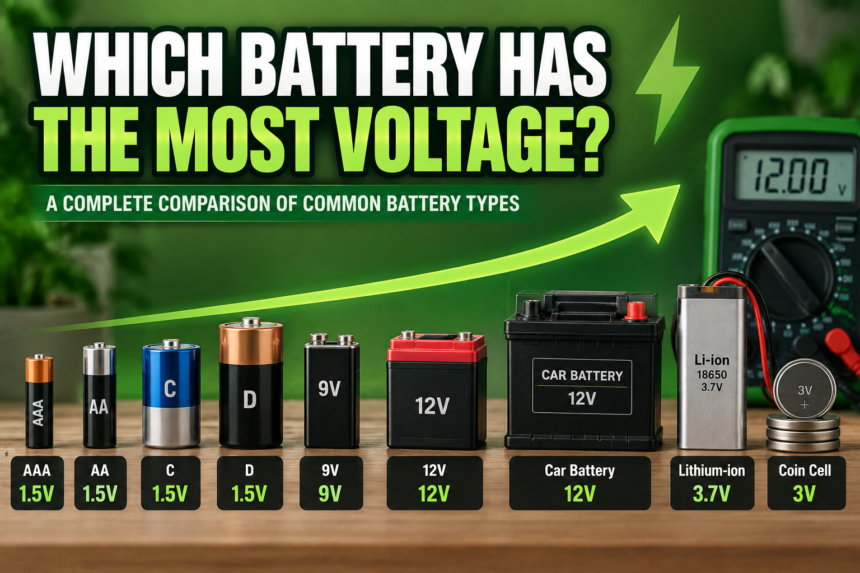
It depends on whether you mean a single cell or a whole battery pack. Among single cells of the common types, lithium wins: a lithium-ion cell puts out about 3.6 to 3.7 volts, more than double a standard 1.5-volt alkaline. But voltage is not really capped by the type of battery.
Any battery’s total voltage comes from wiring cells together in a line, so you can build almost any voltage you want. That is why an electric car battery can reach 400 to 800 volts or more, while the single cells inside it are the same modest 3.6 volts.
So the honest answer has two layers. If you are comparing one cell against another, lithium is the voltage leader among everyday chemistries. If you are asking which finished battery carries the most voltage, the answer is whichever one packs the most cells in series, and there is no fixed ceiling. The rest of this guide gives the exact numbers for each and explains why lithium sits at the top of the per-cell list.
Why voltage is not fixed to a battery type
A battery is just a group of cells, and each cell produces a set voltage based on the chemistry inside it. Line up more cells end to end, a setup called wiring in series, and their voltages add together. Two 1.5-volt cells in series give 3 volts. Four give 6. This is why the same AA-sized alkaline cell shows up in a 1.5-volt remote and inside a 9-volt block that actually holds six tiny 1.5-volt cells.
The cell voltage is fixed by chemistry, but the pack voltage is a design choice. A car’s 12-volt lead-acid battery is six 2-volt cells in a row. A 48-volt lithium battery is a stack of cells wired to hit that target. So when someone asks which battery has the most voltage, the fixed part of the answer is per cell, and the flexible part is how many cells the maker decides to string together.
The key idea: one cell has a set voltage from its chemistry. A pack’s voltage is just that cell voltage multiplied by how many cells are wired in series. Chemistry sets the floor; wiring sets the total.
Voltage per cell, by chemistry
Here is where each common chemistry lands per cell. These are nominal voltages, meaning the average during normal use, since the real number drifts a little as a cell charges and drains.

| Battery chemistry | Volts per cell | Rechargeable? |
| Nickel-cadmium (NiCd) | About 1.2 | Yes |
| Nickel-metal hydride (NiMH) | About 1.2 | Yes |
| Zinc-air | About 1.4 | No (mostly) |
| Alkaline (AA, AAA, and so on) | About 1.5 | No |
| Nickel-zinc (NiZn) | About 1.65 | Yes |
| Lead-acid | About 2.0 | Yes |
| Lithium iron phosphate (LiFePO4) | About 3.2 | Yes |
| Lithium-ion (NMC, LCO) | About 3.6 to 3.7 | Yes |
| Lithium primary (single-use) | About 3.6 to 3.7 | No |
The pattern is clear: the nickel and zinc-based chemistries sit near 1.2 to 1.65 volts, lead-acid at 2, and the lithium family jumps to the low-to-mid 3-volt range. These figures line up with the reference values published by Battery University, a widely used source for battery specs. Among the batteries most people actually handle, lithium-ion holds the highest per-cell voltage.
Why lithium cells reach a higher voltage
The reason comes down to chemistry and one hard limit: water. Alkaline, NiMH, and NiCd cells all use a water-based mix inside. Water starts to break apart at a little over 1.5 volts, so those chemistries physically cannot push much past that per cell without causing problems. That single fact caps the whole group at roughly 1.2 to 1.6 volts.
Lithium cells sidestep that limit by using non-water-based materials, so they are free to reach a naturally higher voltage. On top of that, lithium is a very reactive metal with a strong pull on electrons, which creates a bigger voltage gap between the two sides of the cell. That combination is what lets a lithium cell settle around 3.6 to 3.7 volts, well above what any water-based cell can manage. It is also why one lithium cell can often replace two alkaline cells in a device.
This gap also explains a common swap. A single lithium-ion cell at 3.6 volts sits close to two 1.5-volt alkaline cells in series, which is 3 volts, so device makers often use one lithium cell where two throwaway cells would otherwise go.
The lithium option is lighter, lasts longer, and holds a steadier voltage as it drains. Water-based rechargeables like NiMH, by contrast, only reach about 1.2 volts, so a device built for 1.5-volt alkalines can sometimes shut off early on them, because the voltage sits lower than the gadget expects.
The highest voltages in real use
Once you allow series wiring, the numbers climb fast. A single lithium cell is about 3.6 volts, but the packs built from them go far higher, because that is the whole point of wiring cells together.
- Household and hobby packs: a 12-volt car battery, a 48-volt e-bike or solar battery, and similar mid-range packs are all just cells stacked to a target.
- Electric vehicles: modern EV batteries commonly run at 400 volts, and newer designs use 800-volt systems for faster charging and better efficiency.
- Large stationary and off-grid systems: grid storage and industrial setups push higher still, into the hundreds and even above a thousand volts.
You can keep adding cells in principle, so there is no single battery that holds the crown for all time. The practical limit is not the chemistry but safety, since higher voltages demand careful design, insulation, and protection. For a single specialty cell, some lithium primary (single-use) types also sit at the top of the range, around 3.6 to 3.7 volts, matching rechargeable lithium-ion.
It helps to know why designers stack cells for higher voltage in the first place. For the same amount of power, a higher voltage means less current flowing, and less current means thinner wires, less heat, and less wasted energy. That is why big, power-hungry systems like electric cars favor high-voltage packs: an 800-volt system can charge faster and run more efficiently than a lower-voltage one doing the same work.
The catch is that high voltage is genuinely dangerous to handle, so these packs are sealed, insulated, and managed by electronics that keep every cell in a safe range. The voltage you see on the outside is the result of careful engineering, not just cells thrown together.
Does higher voltage mean better?
Not by itself. Voltage is only one part of what a battery does. It sets the electrical pressure, but how much energy the battery stores depends on capacity too, measured in amp-hours or watt-hours. A high-voltage battery is not automatically longer-lasting or more powerful; a low-voltage battery with large capacity can hold more total energy than a high-voltage one with tiny capacity.
What matters is matching the battery to the device. A gadget built for 1.5 volts can be damaged or behave oddly if you feed it a 3.6-volt lithium cell, and a device expecting 3.7 volts will cut off early on a 1.2-volt rechargeable. Higher voltage is an advantage only when the device is designed for it. Beyond that, the right battery is the one whose voltage, capacity, and size all suit the job.
A quick comparison shows why voltage alone can mislead. Picture a small 3.7-volt lithium cell with a tiny capacity next to a large 1.5-volt battery with a huge one. The 1.5-volt battery holds less electrical pressure but far more total energy, so it can run a device much longer. Total energy is voltage multiplied by capacity, which is why watt-hours, not volts, is the better yardstick for how long a battery lasts. Voltage tells you whether a battery fits a device; capacity tells you how long it will keep it running.
Simple takeaway: pick the battery whose voltage matches your device, then look at capacity for runtime. More volts is not a prize on its own.
How to read the voltage on a label
The voltage printed on a battery is almost always the nominal voltage, the average level during use. The real voltage sits a bit higher when the battery is full and drops as it drains, so a 3.7-volt lithium cell might read closer to 4.2 volts fresh off the charger and taper down from there. That is normal, not a fault.
For a multi-cell pack, the label shows the combined figure, like 12V or 48V, not the voltage of the cells inside. If you ever need to know the cell count, divide the pack voltage by the per-cell voltage for that chemistry. A 12-volt lead-acid battery is six 2-volt cells; a 12.8-volt LiFePO4 battery is four 3.2-volt cells. Knowing this makes the specs on any battery far easier to read.
Conclusion
Which battery has the most voltage depends on the scale. Per single cell, lithium leads the common chemistries at about 3.6 to 3.7 volts, thanks to a chemistry that escapes the water-based limit holding nickel and alkaline cells near 1.5 volts.
Per finished pack, there is no fixed winner, because wiring more cells in series adds their voltages, which is how EV batteries reach 400 to 800 volts and beyond. When choosing a battery, match its voltage to your device and then weigh capacity, rather than chasing the highest number for its own sake.
Frequently asked questions
Which single battery cell has the highest voltage?
Among common chemistries, lithium cells lead at about 3.6 to 3.7 volts each, with lithium iron phosphate a bit lower at 3.2. That is more than double a 1.5-volt alkaline cell and roughly three times a 1.2-volt rechargeable.
Why do lithium batteries have more voltage than alkaline?
Alkaline cells use a water-based chemistry that cannot push much past 1.5 volts before water breaks down. Lithium uses different, non-water materials and a highly reactive metal, letting each cell reach a naturally higher voltage of around 3.6 volts.
What is the highest voltage battery pack?
There is no fixed limit, because voltage comes from wiring cells in series. Electric vehicles commonly use 400 to 800 volt packs, and large grid or industrial systems go higher still, into the hundreds or above a thousand volts.
Does a higher voltage battery last longer?
Not necessarily. Voltage sets electrical pressure, while runtime depends on capacity, measured in amp-hours or watt-hours. A low-voltage battery with large capacity can store more total energy than a high-voltage one with small capacity.
Why does my battery read a different voltage than the label?
Labels show nominal voltage, the average during use. A full battery reads higher and a draining one reads lower, so a 3.7-volt lithium cell may show about 4.2 volts when freshly charged. This drift is normal and expected.
Related Articles
How Long Do Trolling Motor Batteries Last?
How Do You Change Battery in VW Key Fob? A Complete Step-by-Step Guide