



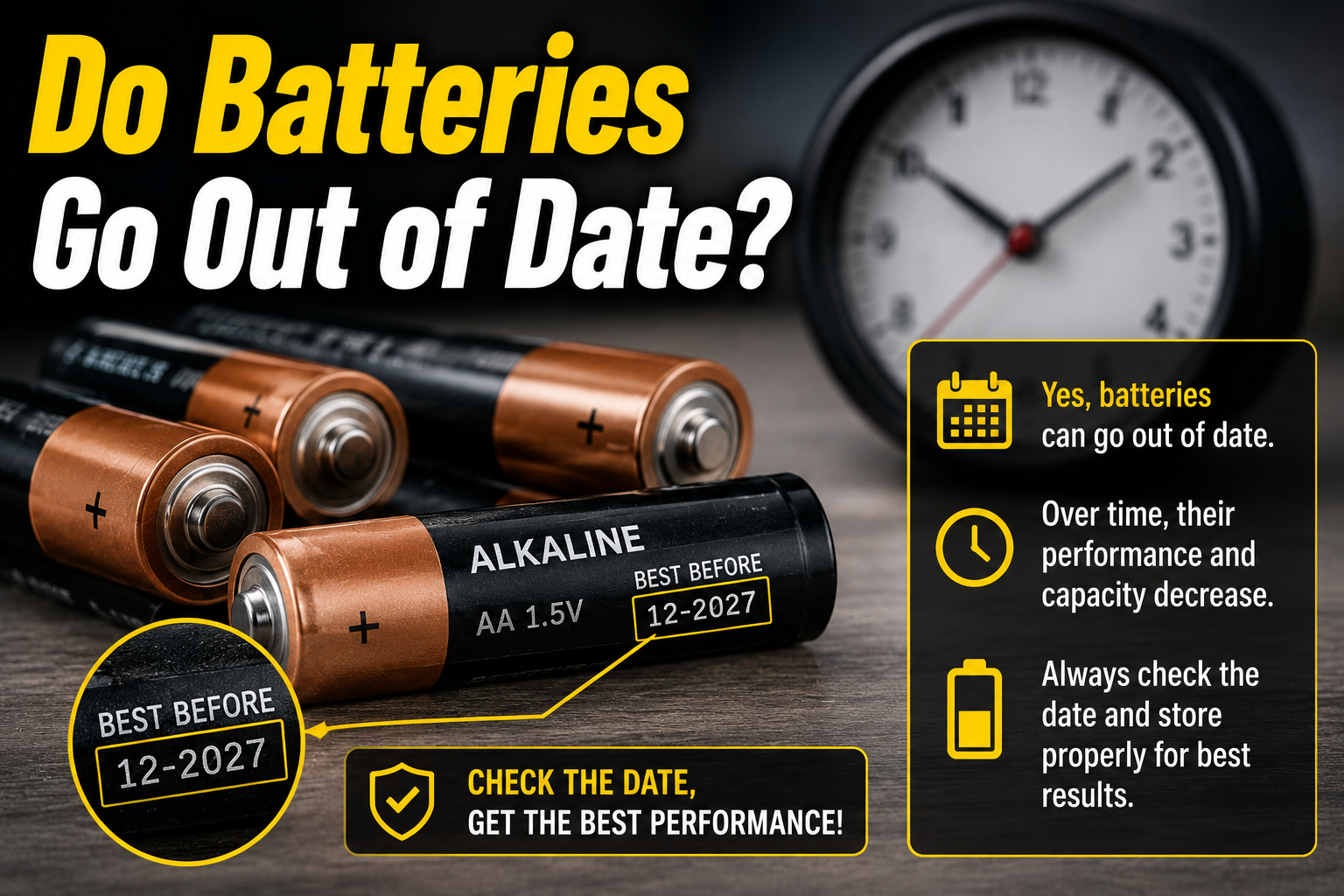
Yes, batteries go out of date, and the date is printed on nearly every one you buy. It is milder than it sounds, though. That marking is a best-before, not a cut-off, and a battery a year past it will usually still run a TV remote without complaint.
- What the date on a battery actually means?
- Why a battery drains while it is doing nothing?
- How long each type lasts on a shelf?
- Do unopened batteries last longer?
- Do rechargeable batteries go out of date?
- Car batteries are the exception worth watching?
- Are out-of-date batteries safe to use?
- How to check whether an old battery has anything left?
- How to store batteries so they last?
- Conclusion
- Frequently asked questions
- Can you use batteries after the expiration date?
- Do batteries expire if you never open the packet?
- How can I tell how old a battery is?
- Is it dangerous to use expired batteries?
- Do rechargeable batteries expire too?
- Related Articles
The two things worth caring about are that an old alkaline cell can leak and ruin whatever it is sitting in, and that a battery bought for an emergency kit needs to still work on the night you reach for it in the dark.
What the date on a battery actually means?
It is a best-if-used-by date. It marks the point where the maker stops guaranteeing full performance, not the point where the battery stops working. A cell past that date still holds charge, just less of it, and it will run down sooner in whatever you put it in.
You will usually find the year printed in a small box on the body of the cell, near the size marking. Coin cells are too small for that, so the date sits on the packaging instead. Some brands stamp the manufacture date on the outer carton and the best-before on the cells themselves, which is why the two can look like they disagree.
The window depends entirely on the chemistry. Shelf life varies by product: standard alkaline AA, AAA, C and D cells are good for around 10 years, the 9V version for about 5, and single-use lithium AA and AAA cells for up to 20.
Why a battery drains while it is doing nothing?
The reason is self-discharge. A battery is a chemical reaction held in check by the fact that the circuit is open, but the chemistry does not sit perfectly still. Small internal reactions keep nibbling at the stored energy, and tiny impurities inside the cell act as slow internal leaks. Nothing has to be plugged in for this to happen.
Temperature sets the pace. As a rough rule, every 10 degrees Celsius of extra warmth roughly doubles the rate. A box of batteries in a hot loft or a garage that bakes all summer ages far faster than the same box in a cupboard indoors.

The rate also swings enormously by type. A lithium coin cell loses around 1 percent a year. A car battery loses 3 to 5 percent a month. An older-style rechargeable AA can shed 10 to 15 percent in a month and be flat by the time you go looking for it.
How long each type lasts on a shelf?
| Battery | Shelf life | Worth knowing |
| Alkaline AA, AAA, C, D | About 10 years | 9V versions only about 5 |
| Single-use lithium AA, AAA | Up to 20 years | Best choice for emergency kits |
| Lithium coin cell (CR2032) | About 10 years | Loses roughly 1 percent a year |
| Zinc-carbon (heavy duty) | 3 to 5 years | The cheapest cells age fastest |
| Low self-discharge NiMH | 70 percent of charge after 10 years | Top up before you rely on it |
| Older-style NiMH | Weeks to a few months | Loses 10 to 15 percent a month |
| Lead-acid (car, mower) | 6 to 12 months unused | Recharge every 2 to 3 months |
| Lithium-ion pack | 2 to 3 years unused | Store it at about half charge |
One pattern runs through the whole table. Single-use chemistries store well and rechargeables do not, because the features that let a cell take charge quickly also let it lose charge quietly.
Do unopened batteries last longer?
Only a little. Sealed packaging keeps the terminals from touching metal and keeps moisture and dirt off the contacts, all of which helps. What it cannot do is pause the chemistry inside the cell, which carries on regardless.
The more useful point is that the clock starts at manufacture, not at purchase. A pack that has sat in a warehouse and then a shop shelf for three years arrives with three years already gone. If you are buying in bulk for a kit or a business, check the date printed on an actual cell before you commit, rather than trusting that new-looking packaging means new batteries.
Do rechargeable batteries go out of date?
Yes, and they do it in two separate ways. One is the charge sitting in them right now, which drains away on the shelf. The other is total capacity, which shrinks over years no matter how carefully you treat the cell.
Low self-discharge NiMH cells, sold pre-charged and ready to use, are the ones built for storage. The better ones retain up to 70 percent of their charge after 10 years when left unused and stored properly. Older NiMH designs are the opposite: charge a set, put them in a drawer, and they may be flat within a couple of months.
Lithium-ion packs in tools, laptops, and phones age on the calendar too, whether or not you use them. Store one at around 50 percent charge rather than full or empty, keep it somewhere cool, and top it up every six months or so. A lithium-ion cell left at zero for a long stretch can drop below a safe voltage and never come back.
A rechargeable that reads flat after a year in a drawer is usually not dead. Run it through two or three full charge and discharge cycles before you write it off.
Car batteries are the exception worth watching?
A car battery does not simply lose charge while it sits. It damages itself while it does.
As a lead-acid battery discharges, lead sulfate forms on the plates. Charge it again soon and that sulfate dissolves back into the acid. Leave it at a low charge for months and the crystals harden into a layer that will not dissolve, permanently cutting how much the battery can hold. That is sulfation, and it is why a car left standing all winter often needs a new battery in spring rather than just a jump start.
The numbers to watch on a 12 volt battery are simple. Around 12.7 volts means fully charged, 12.4 is roughly half, and below 12.0 the hard crystals start forming. A trickle charger or maintainer left connected takes care of the whole problem, and one costs less than a tank of fuel.
Are out-of-date batteries safe to use?
Usually, with two real caveats.
The first is leakage. As an alkaline cell ages or sits fully discharged inside a device, its seals can give way and let potassium hydroxide escape. That is the crusty white powder you find in a forgotten remote. It corrodes the metal contacts, it can kill the device outright, and it irritates skin and eyes, so wear gloves and keep it away from your face when you clean it up.
The second is mixing. Putting an old cell alongside fresh ones, or an alkaline next to a lithium, means the weakest cell in the chain gets driven hard by the others and is far more likely to vent. Replace every cell in a device at the same time, with the same brand and chemistry.
There is also a judgment call about where you use them. An expired battery is fine in a wall clock. It does not belong in a smoke alarm, a medical device, a car key you rely on, or the flashlight in your emergency kit. Coin cells deserve one extra note: age makes no difference to the swallowing risk, and they remain a serious hazard to small children whatever the date says.
How to check whether an old battery has anything left?
A multimeter is the reliable way, and a basic one costs very little. Set it to DC volts and touch the probes to the two ends.
- A fresh 1.5V alkaline reads about 1.5 to 1.6 volts. Around 1.3 it is well used. Below 1.1 it is finished.
- A fresh 9V block reads close to 9.5 volts. Below about 7.5 it is on its way out.
- A charged NiMH rechargeable reads about 1.4 volts and sits at 1.2 for most of its working life, so a 1.2 reading means full rather than flat.
Voltage on its own is optimistic, because a tired cell can show a healthy number until you ask it for current. A cheap battery tester applies a small load while it measures, which gets much closer to the truth. Dropping a cell to see whether it bounces gives a rough hint at best, and it tells you nothing about how much charge is left.
How to store batteries so they last?
- Keep them cool and dry. A cupboard indoors, not a loft, garage, or car. The fridge is not the upgrade it sounds like, because condensation on cold cells corrodes the contacts.
- Keep them apart. Leave them in the original packaging or a plastic case so terminals cannot touch each other, coins, or keys. A shorted cell in a drawer is a fire risk.
- Take them out of things you are not using. Seasonal decorations, spare remotes, camping gear. Most leak damage happens inside a device that has been left alone for a year.
- Rotate your stock. Put new packs behind the old ones and use the oldest first, the way a shop does.
- Top up rechargeables twice a year. Recharge stored NiMH and lithium-ion cells every six months, and keep a stored lead-acid battery on a maintainer or recharge it every two to three months.
- Recycle rather than bin the dead ones. Most supermarkets and hardware shops have a collection point, and tape over the terminals of lithium cells before you drop them in.
Conclusion
Batteries do go out of date, but the date is a guideline rather than a deadline. Alkalines are good for roughly a decade, single-use lithium for twice that, and rechargeables for months rather than years unless they are the low self-discharge kind.
Store them cool, keep them out of devices you are not using, and check the date on the cell rather than the packet. Save the fresh ones for the things that matter when the power goes out.
Frequently asked questions
Can you use batteries after the expiration date?
Usually yes. The date marks the end of guaranteed performance, not the end of the battery. Expect shorter runtime and a higher chance of leaking, so keep expired cells for low-stakes items like clocks and remotes rather than smoke alarms.
Do batteries expire if you never open the packet?
Yes. Sealed packaging protects the terminals but does not stop the chemistry inside the cell. The shelf life clock starts when the battery is made, not when you buy it, so a pack can arrive with years already used up.
How can I tell how old a battery is?
Look for a small printed box on the body of the cell, usually near the size marking, showing the best-before year. Coin cells carry the date on the packaging instead. Outer cartons sometimes show the manufacture date rather than the expiry.
Is it dangerous to use expired batteries?
The main risk is leaking rather than anything dramatic. Old alkaline cells can vent potassium hydroxide, which corrodes contacts and irritates skin and eyes. Wear gloves to clean it up, and never mix old and new cells in the same device.
Do rechargeable batteries expire too?
Yes. They lose stored charge on the shelf and total capacity over the years. Low self-discharge NiMH cells hold up best in storage, keeping most of their charge for years, while older designs can be flat within a couple of months.
Related Articles
Do All Solar Lights Have Batteries?
How to Connect Two Batteries in Parallel: A Step-by-Step Guide
How to Check a Battery’s Manufacturing Date?