



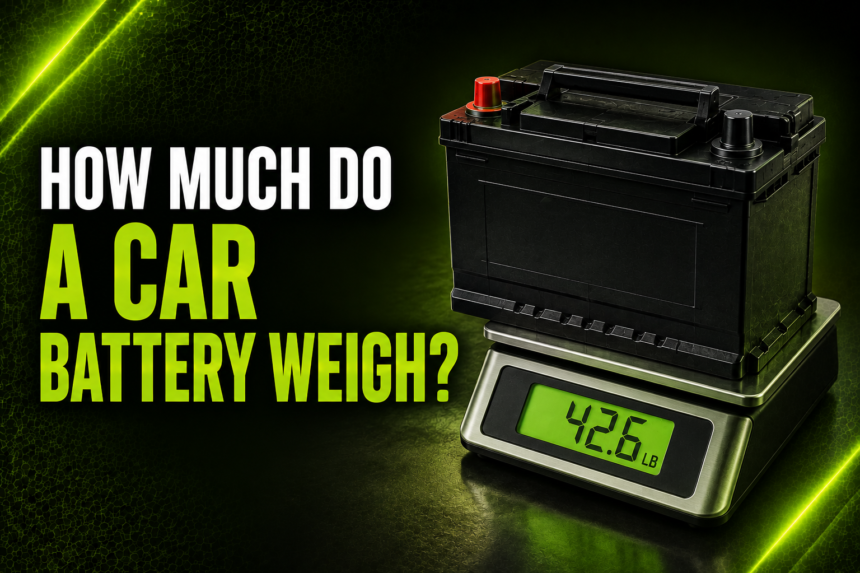
If you’ve ever popped the hood to replace a dead battery, you already know it isn’t the lightest part of your car. Many drivers ask the same question before heading to the auto parts store: how much do a car battery weigh? On average, a standard car battery weighs somewhere between 30 and 50 pounds, or roughly 14 to 23 kilograms. That’s about the same weight as a medium-sized dog or a large bag of dog food, so it’s no surprise that lifting one out of a tight engine bay can feel like a workout.
- 2. Average Car Battery Weight
- 3. Why Do Car Batteries Weigh So Much?
- 4. Types of Car Batteries and Their Weights
- 5. Car Battery Weight by Vehicle Category
- 6. Battery Group Sizes and Weight
- 7. Electric & Hybrid Vehicle Battery Weight (Bonus Section)
- 8. Factors That Affect Battery Weight
- 9. How to Check Your Car Battery’s Weight
- 10. Why Battery Weight Matters
- 11. Tips for Safely Lifting or Replacing a Heavy Car Battery
- 12. Frequently Asked Questions (FAQs)
- 13. Conclusion
- Related Articles
Knowing the weight of your battery isn’t just trivia. It matters when you’re buying a replacement, shipping a battery, installing it yourself, or simply trying to understand why your car feels a certain way when you drive it. In this guide, we’ll break down everything that affects battery weight, compare different battery types, and give you practical tips for handling one safely.
2. Average Car Battery Weight
Most car batteries fall within a fairly predictable weight range, though the exact number depends on the vehicle, the battery chemistry, and the battery’s physical size. For a quick reference, here’s how the average weight typically breaks down by vehicle type.
| Vehicle Type | Average Battery Weight |
|---|---|
| Compact car | 25–35 lbs (11–16 kg) |
| Sedan | 30–45 lbs (14–20 kg) |
| SUV / Crossover | 40–55 lbs (18–25 kg) |
| Pickup truck | 45–60 lbs (20–27 kg) |
| Commercial vehicle | 60–100+ lbs (27–45+ kg) |
As you can see, the general rule is simple: the bigger and more powerful the vehicle, the heavier its battery tends to be. Larger engines demand more starting power, which usually means more internal materials and a heavier overall unit.
3. Why Do Car Batteries Weigh So Much?
At first glance, it might seem strange that something used mainly to start your engine and power your electronics could weigh as much as a small piece of furniture. The answer lies in what’s actually inside the battery casing.
Most traditional car batteries are lead-acid batteries, and lead is a dense, heavy metal. Inside the battery, you’ll find a series of lead plates submerged in a liquid electrolyte solution made of sulfuric acid and water. These plates react chemically with the electrolyte to produce and store electrical energy. Because lead is so dense, even a modest stack of plates adds significant weight. On top of that, the plastic casing, connectors, and the electrolyte fluid itself all contribute additional pounds.
In short, a car battery is heavy because it needs to hold a lot of energy-producing material in a compact space, and lead happens to be one of the most efficient (if heavy) materials for that job.

4. Types of Car Batteries and Their Weights
Not all batteries are built the same way, and different chemistries can lead to noticeably different weights. Here’s a breakdown of the most common types you’ll encounter.
Lead-acid (flooded) batteries are the traditional, most widely used option. They’re relatively affordable and typically weigh between 30 and 50 pounds, making them the baseline for comparison.
AGM (Absorbent Glass Mat) batteries use a fiberglass mat to hold the electrolyte in place instead of leaving it as a free-flowing liquid. This design tends to make them slightly heavier than standard flooded batteries, often in the 35 to 55 pound range, but they offer better durability and vibration resistance.
Gel batteries work similarly to AGM batteries but use a gelled electrolyte. Their weight is comparable to AGM batteries, generally falling between 30 and 50 pounds, and they’re valued for their resistance to leaks.
Lithium-ion batteries, increasingly used in hybrids and some performance vehicles for auxiliary power, are the lightweight outlier. They can weigh as little as 10 to 25 pounds because lithium is far less dense than lead, though they tend to cost significantly more.
Here’s a side-by-side comparison for easy reference:
| Battery Type | Typical Weight | Lifespan | Relative Cost |
|---|---|---|---|
| Lead-acid (flooded) | 30–50 lbs | 3–5 years | Low |
| AGM | 35–55 lbs | 4–7 years | Medium-High |
| Gel | 30–50 lbs | 4–6 years | Medium-High |
| Lithium-ion | 10–25 lbs | 8–12 years | High |
5. Car Battery Weight by Vehicle Category
Beyond battery chemistry, the type of vehicle you drive plays a major role in determining battery weight. Compact cars like hatchbacks and small sedans usually need less cranking power, so their batteries tend to sit on the lighter end, typically 25 to 35 pounds. Mid-size sedans step up slightly, often landing between 30 and 45 pounds, since they carry more electronics and a somewhat larger engine.
SUVs and crossovers generally require more robust batteries because of their larger engines and additional electrical accessories, pushing weight into the 40 to 55 pound range. Pickup trucks, especially those with larger V6 or V8 engines, often need even more cranking power, particularly in cold climates, so their batteries can weigh 45 to 60 pounds or more. Commercial vehicles and heavy-duty trucks sit at the top of the scale, sometimes using multiple batteries or oversized units that weigh 60 to 100 pounds or more combined.
6. Battery Group Sizes and Weight
Car batteries are categorized using standardized “group sizes” set by the Battery Council International (BCI). These group numbers indicate the physical dimensions, terminal placement, and general capacity of a battery, which in turn correlates with weight. For example, a Group 24 battery, common in many sedans, typically weighs around 40 to 45 pounds, while a smaller Group 35 battery often used in compact cars and some Asian imports weighs closer to 35 to 40 pounds. Larger Group 65 batteries, frequently found in trucks and SUVs, can weigh 45 to 55 pounds, and Group 78 batteries used in some domestic trucks often weigh 50 pounds or more.
Knowing your vehicle’s group size, which is usually listed in your owner’s manual or on the battery itself, can help you quickly estimate the expected weight before you even lift it.
7. Electric & Hybrid Vehicle Battery Weight (Bonus Section)
It’s worth clearing up a common point of confusion. Electric and hybrid vehicles actually contain two very different types of batteries. The first is a small 12-volt auxiliary battery, similar in size and weight to a traditional car battery, which powers accessories like lights, infotainment systems, and the onboard computer. This battery typically weighs the same 25 to 45 pounds as a conventional vehicle’s battery.
The second is the main traction battery pack, the large lithium-ion unit that actually propels the vehicle. This is an entirely different category of weight. Depending on the vehicle and its range, these battery packs can weigh anywhere from 400 to over 1,000 pounds, since they’re built to store enormous amounts of energy for driving, not just starting the engine. So when someone asks how much do a car battery weigh in the context of an EV, it’s important to clarify whether they mean the small auxiliary battery or the massive main battery pack.
8. Factors That Affect Battery Weight
Several variables influence exactly how heavy a specific battery will be, even within the same general category. The battery’s capacity, measured in amp-hours (Ah), plays a big role, since higher-capacity batteries need more internal material to store more energy, which adds weight. Cold Cranking Amps (CCA), the measurement of how much power a battery can deliver in cold weather, also affects weight, as batteries designed for extreme cold often have thicker plates and more lead content.
Material quality matters too. Batteries built with higher-grade lead and denser plate construction can weigh more than budget alternatives, even if their external dimensions are similar. Finally, brand and manufacturing differences mean that two batteries in the same group size from different manufacturers can still vary by a few pounds due to differences in casing thickness, plate design, and internal architecture.
9. How to Check Your Car Battery’s Weight
If you want to know the exact weight of your specific battery rather than relying on averages, there are a few reliable ways to find out. The easiest method is to check the label directly on top of or on the side of the battery, where manufacturers often print the weight along with other specifications like voltage, CCA, and group size. If the label is worn or missing, you can visit the manufacturer’s official website and search using the battery’s model number, which usually pulls up a detailed spec sheet including weight.
If you already have the battery in hand and want to be completely certain, placing it on a bathroom scale is a simple and accurate way to weigh it at home. Just be sure to handle it carefully, since batteries contain corrosive materials and should always be kept upright.
10. Why Battery Weight Matters
Battery weight isn’t just a fun fact, it has real practical implications. In terms of vehicle performance, every extra pound adds to the overall weight your engine has to move, and while a single battery’s contribution to fuel efficiency is small, it’s part of the broader picture of vehicle weight management that automakers care about deeply.
From a handling and safety perspective, battery weight matters most when you’re the one doing the lifting. A 40 to 50 pound object positioned awkwardly in a tight engine bay can easily cause strain or injury if you’re not careful. This is especially true for anyone with back problems or limited mobility. Weight also affects shipping and replacement costs, since heavier batteries typically cost more to ship and may come with higher core charges or handling fees at auto parts stores.
11. Tips for Safely Lifting or Replacing a Heavy Car Battery
Replacing a car battery yourself can save money, but it’s important to do it safely given how much a car battery weighs. Before you begin, always disconnect the negative terminal first, followed by the positive terminal, to reduce the risk of electrical shorts. When lifting the battery, bend at your knees rather than your back, and keep the battery close to your body as you lift, just as you would with any heavy object.
Using a battery carrier strap can make a significant difference, especially if the battery has recessed handles or an awkward shape that’s hard to grip directly. If you’re working with an older battery, be mindful that corrosion around the terminals can make it slippery, so wearing rubber gloves adds both grip and protection from acid residue. If a battery feels too heavy or the engine bay is too cramped to lift it out safely on your own, it’s perfectly reasonable to ask for help or have a professional handle the installation instead.
12. Frequently Asked Questions (FAQs)
Is a heavier battery better? Not necessarily. A heavier battery often indicates more lead content and potentially higher capacity, but the right battery for your car depends on your vehicle’s specific requirements, not just weight. Always match the battery to your manufacturer’s recommended group size and specifications.
Do all cars use the same battery weight? No. Battery weight varies based on the vehicle’s size, engine type, and electrical demands, which is why a compact car’s battery can weigh 15 to 20 pounds less than a full-size truck’s battery.
How much does a Tesla or EV battery weigh? The small 12-volt auxiliary battery in an EV weighs about the same as a conventional car battery, roughly 25 to 45 pounds. The main lithium-ion battery pack that powers the vehicle, however, can weigh several hundred pounds, often between 400 and over 1,000 pounds depending on the model.
Can battery weight affect gas mileage? Technically yes, though the effect is minor. Since a car battery only weighs a few dozen pounds, its impact on fuel efficiency is negligible compared to factors like tire pressure, driving habits, and overall vehicle weight.
13. Conclusion
So, how much do a car battery weigh? As we’ve covered, the honest answer is “it depends,” but most drivers can expect somewhere between 30 and 50 pounds for a standard vehicle, with lighter compact car batteries dipping toward 25 pounds and heavier truck or commercial batteries climbing toward 60 pounds or more. Battery chemistry, group size, and vehicle type all play a role in the final number.
Whether you’re shopping for a replacement, preparing to install one yourself, or just satisfying your curiosity, understanding battery weight helps you handle the process more safely and confidently. When in doubt, check the label on your specific battery or consult your owner’s manual for the exact specifications recommended for your vehicle.
Related Articles
Are Super Start Batteries Good? An Honest Look
Can a Battery Be Too Dead to Jump? When a Jump Works and When It Won’t