


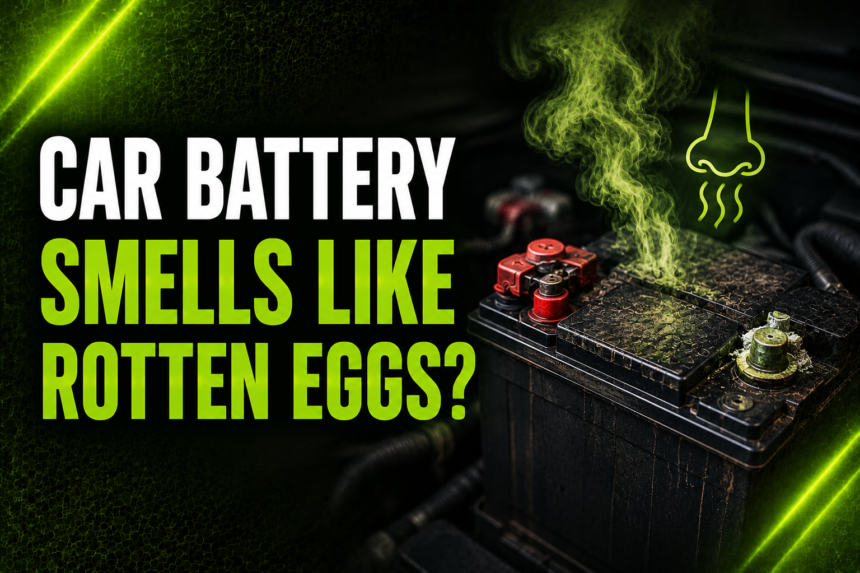
If you’ve popped the hood and caught a whiff of sulfur — that unmistakable rotten egg smell — coming from your battery, you’re right to pay attention. Your car battery is not supposed to smell like anything under normal operation. When it does, it’s usually a sign that the battery is overcharging, damaged, or nearing the end of its life, and it’s venting a gas called hydrogen sulfide as a result.
- What Causes a Car Battery to Smell Like Rotten Eggs?
- 1. The Battery Is Overcharging
- 2. The Battery Is Old or Failing
- 3. A Bad Battery Charger or Jump-Start Session
- 4. Physical Damage or a Cracked Case
- 5. Battery Type Matters
- Is a Rotten Egg Smell From a Car Battery Dangerous?
- Battery Smell vs. Catalytic Converter Smell: How to Tell the Difference
- What to Do Right Now: A Step-by-Step Safety Check
- How to Fix It
- How to Prevent It From Happening Again
- Frequently Asked Questions
- The Bottom Line
- Related Articles
The good news: this is one of the more diagnosable car smells out there, and in most cases you can pin down the cause and decide on next steps in under 15 minutes. Below, we’ll walk through exactly why this happens, how to tell if it’s dangerous, and what to do about it — whether that means a simple fix or a trip to the auto parts store for a new battery.
What Causes a Car Battery to Smell Like Rotten Eggs?
Every conventional car battery is a lead-acid battery filled with a mixture of sulfuric acid and water called electrolyte. Under normal charging and discharging, this chemical reaction stays contained and produces no odor you’d notice. The rotten egg smell shows up when something disrupts that balance and the battery starts breaking down sulfate compounds into hydrogen sulfide (H2S) gas — the same compound responsible for the smell of, well, rotten eggs.
Here are the most common reasons that happens:
1. The Battery Is Overcharging
This is by far the most common cause. Your alternator is responsible for keeping the battery charged at the correct voltage — typically around 13.5 to 14.5 volts while the engine is running. If the alternator’s voltage regulator fails, it can push too much voltage into the battery. That excess energy breaks down the electrolyte faster than the battery can handle, releasing hydrogen sulfide gas as a byproduct. You may also notice the battery case feels hot to the touch, looks swollen, or has fluid seeping from the top.
2. The Battery Is Old or Failing
Lead-acid car batteries typically last 3 to 5 years. As they age, the internal plates degrade and the battery becomes less efficient at holding a charge cleanly. An old battery is more prone to internal shorts and uneven charging, both of which can trigger the same sulfide odor even without an alternator problem.
3. A Bad Battery Charger or Jump-Start Session
If you’ve recently used a standalone battery charger — especially an older, non-smart charger without automatic shutoff — it may have kept pushing current into an already full battery. This is sometimes called “cooking” the battery, and it produces the same rotten egg smell as alternator overcharging.
4. Physical Damage or a Cracked Case
A cracked or damaged battery case can let electrolyte leak or vent improperly, allowing gas to escape where it normally wouldn’t. This is more common after a fender-bender, a pothole impact, or simply battery age combined with vibration over time.
5. Battery Type Matters
Not all batteries smell equally. Traditional flooded (wet-cell) lead-acid batteries are the most likely to produce a noticeable sulfur smell because their electrolyte is liquid and vents more easily. AGM (absorbent glass mat) batteries, which are sealed and use a fiberglass mat to hold the electrolyte, are far less prone to venting gas — so if you have an AGM battery and you’re still smelling sulfur, it’s a stronger signal that something is actively wrong rather than just normal wear.
Is a Rotten Egg Smell From a Car Battery Dangerous?
Yes — treat it as a genuine safety issue, not just a nuisance smell. Two separate hazards are at play:
- Hydrogen sulfide gas is toxic in high concentrations. In the small amounts typically released by an overcharging car battery, it usually causes headache, nausea, or eye and throat irritation with prolonged exposure — but it should never be ignored, especially in an enclosed garage.
- Hydrogen gas, which is also released during overcharging, is highly flammable and explosive in the right concentration. This is why you should never smoke, use a lighter, or create sparks (including from jumper cables) near a battery that’s actively venting gas.
If the smell is strong, the battery case is hot, swollen, or leaking, don’t start the engine again until you’ve addressed it. If you’re inside a closed garage, open the door and step back to let it ventilate before doing anything else.
Battery Smell vs. Catalytic Converter Smell: How to Tell the Difference
This is a common point of confusion, because a failing catalytic converter also produces a sulfur-like odor — but for a completely different reason (unburned sulfur in exhaust gas, rather than battery chemistry). Here’s how to tell which one you’re dealing with:
| Clue | Points to Battery | Points to Catalytic Converter |
|---|---|---|
| Smell location | Strongest under the hood near the battery | Strongest near the exhaust or from the tailpipe |
| When it happens | Present with engine off or running | Only while the engine is running |
| Other symptoms | Hot/swollen battery case, dashboard battery warning light | Rough idle, reduced power, check engine light |
| Visual clues | Corrosion, fluid on top of the battery | Discolored or glowing-hot converter housing |
If you’re not sure, start with the battery — it’s the easier and cheaper thing to rule out first.
What to Do Right Now: A Step-by-Step Safety Check
- Turn off the engine and remove the key. Don’t leave the car running while you investigate.
- Pop the hood and ventilate. If you’re in a garage, open the door. Avoid leaning directly over the battery to inspect it.
- Look, don’t touch, first. Check for a swollen or bulging battery case, corrosion around the terminals, or fluid on top of the battery. Swelling or leaking means the battery needs to be replaced — don’t attempt to charge or jump it.
- Check the dashboard. A battery warning light or a voltage gauge reading unusually high (above 14.8V while running) points toward an alternator overcharging issue.
- Feel the case (carefully, with the engine off). A battery that’s hot to the touch shortly after driving is a red flag for overcharging.
- Have the charging system tested. Most auto parts stores, including AutoZone, O’Reilly, and Advance Auto Parts, will test your battery and alternator for free. This is the fastest way to confirm whether the alternator’s voltage regulator is the culprit.
- Don’t jump-start or fast-charge a swollen or leaking battery. The risk of an explosion from built-up hydrogen gas isn’t worth it. Have it towed or replaced instead.
How to Fix It
The right fix depends on what’s actually causing the smell:
- Overcharging from a bad alternator: The alternator (or, more specifically, its voltage regulator) will need to be repaired or replaced. Expect to pay roughly $400–$900 for parts and labor at a shop, depending on your vehicle, or significantly less if you’re comfortable doing it yourself.
- Old or worn-out battery: Replace it. Most standard car batteries cost between $100 and $250 installed, with premium AGM batteries running higher.
- Bad charger: Stop using it. Replace it with a modern “smart” charger that automatically detects a full charge and switches to maintenance mode, preventing overcharging in the future.
- Cracked or damaged case: Replace the battery — a damaged case isn’t something you can safely repair.
- Loose or corroded connections: Sometimes a loose terminal connection causes irregular charging that mimics overcharging symptoms. Cleaning corrosion off the terminals and making sure connections are tight can sometimes resolve minor cases.
How to Prevent It From Happening Again
- Have your charging system tested annually, or any time you notice dimming headlights, slow cranking, or dashboard warning lights.
- Replace your battery proactively around the 4-to-5-year mark rather than waiting for it to fail.
- Use only a smart charger with automatic shutoff if you charge your battery manually.
- Keep terminals clean and tight — corrosion can cause charging irregularities over time.
- Park in a well-ventilated space when possible, especially if your battery is older.
Frequently Asked Questions
Can I still drive my car if the battery smells like rotten eggs? It’s best not to. A smelly battery is often a sign of overcharging or damage, both of which can leave you stranded or, in rare cases, pose a fire risk. Get it checked before your next drive if possible.
Will the smell go away on its own? No. The smell is a symptom of an underlying issue — overcharging, age, or damage — and it won’t resolve until that issue is fixed or the battery is replaced.
Is it safe to jump-start a battery that smells like rotten eggs? Only if the case isn’t swollen, cracked, or leaking. If you see any physical damage, don’t attempt a jump-start — replace the battery instead, since the built-up gas can pose an explosion risk near sparks.
How much does it cost to fix an overcharging problem? If the battery itself just needs replacing, expect $100–$250 installed. If the alternator’s voltage regulator is at fault, budget $400–$900 for parts and labor, though prices vary by vehicle.
Do electric or hybrid car batteries have this problem too? No. This issue is specific to conventional 12-volt lead-acid batteries used to start the engine and power accessories, not the high-voltage lithium-ion battery packs in EVs and hybrids.
Can cold weather cause a rotten egg smell from my battery? Indirectly, yes. Cold temperatures reduce a battery’s efficiency, which can cause a charging system to work harder and, in some cases, overcharge in an attempt to compensate — particularly in an already weak or aging battery.
The Bottom Line
A rotten egg smell coming from your car battery almost always points to overcharging, age-related wear, or physical damage — and it’s a signal worth taking seriously rather than masking with an air freshener. Start by ruling out the easy stuff: check for a swollen or leaking case, glance at your dashboard for warning lights, and get a free battery and alternator test at a local auto parts store. From there, whether the fix is a new battery, a repaired alternator, or simply cleaner terminal connections, you’ll have a clear answer instead of a mystery smell.
If you’re ever unsure or the battery looks physically damaged, don’t take chances — have it inspected by a professional or replace it outright. A new battery is a lot cheaper than a tow truck, and a lot safer than guessing.
Related Articles
How Much Does a Hybrid Battery Cost?
How Long to Charge a Car Battery? Times by Charger Size
How to Change Fire Detector Battery: A Complete Step-by-Step Guide
What Element Is Used in Batteries? A Complete Guide to Battery Materials