


If your motorcycle won’t start and you’re staring at a charger wondering how long to leave it hooked up, the short answer is: anywhere from 1 to 24 hours, depending on your battery type, its amp-hour (Ah) rating, how discharged it is, and the amperage of your charger. That’s a wide range, though, and guessing wrong can mean an undercharged battery that leaves you stranded again — or an overcharged one that shortens its life.
- Quick Answer: Charging Time by Battery Type
- Charging Time by Battery Type, Explained
- What Actually Determines Your Charging Time
- How to Calculate Your Exact Charging Time
- Charger Types: Trickle, Smart Maintainer, or Fast Charger?
- Step-by-Step: How to Charge a Motorcycle Battery Safely
- How to Check Your Motorcycle Battery’s State of Charge
- Signs You’re Overcharging or Undercharging
- How Much Does It Cost to Charge a Motorcycle Battery?
- Frequently Asked Questions
- Conclusion
- Related Articles
This guide breaks down exactly how long it takes to charge a motorcycle battery for every common battery chemistry, shows you how to calculate your specific charging time, and walks you through the safest way to do it.
Quick Answer: Charging Time by Battery Type
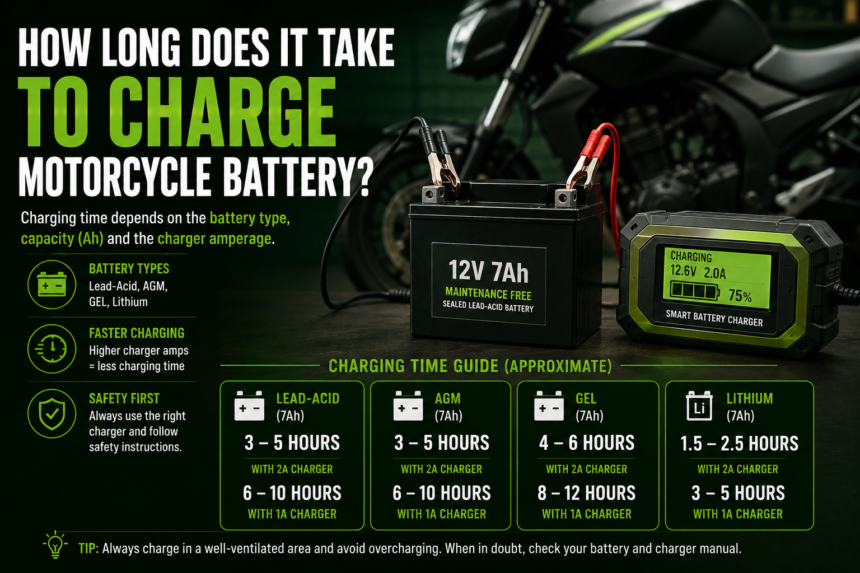
Before getting into the details, here’s a reference table you can use to estimate charging time at a glance, based on a standard 12-volt motorcycle battery and a charger rated between 1 and 2 amps (the recommended range for most bikes):
| Battery Type | Typical Charging Time | Best Charger Output |
|---|---|---|
| Conventional (Flooded Lead-Acid) | 8 to 24 hours | 1 to 2 amps |
| AGM (Absorbent Glass Mat) | 4 to 8 hours | 1 to 2 amps |
| Gel | 6 to 12 hours | 1 amp (low and steady) |
| Lithium-ion (LiFePO4) | 1 to 3 hours | Lithium-specific charger only |
These figures assume the battery is moderately discharged, not completely dead. A fully drained battery can take noticeably longer, and a battery on its last legs may never reach a full charge no matter how long you wait.
Charging Time by Battery Type, Explained
Conventional (Flooded Lead-Acid) Batteries
Flooded lead-acid batteries are the oldest and most affordable motorcycle battery design, and they’re still common on older bikes and budget models. They charge slowly because the chemical reaction inside them naturally decelerates as the plates approach full saturation.
Expect the first 70 to 80 percent of charge to arrive relatively quickly, while the last 20 to 30 percent trickles in much more slowly — this is normal and not a sign of a faulty charger. A deeply discharged flooded battery on a 1-amp charger can reasonably take a full day.
AGM Batteries
Absorbed Glass Mat batteries are sealed, spill-proof, and standard equipment on most modern motorcycles. Because the electrolyte is held tightly against the plates, AGM batteries accept charge more efficiently than flooded designs and typically finish in well under half the time. Just make sure your charger has an AGM setting or is AGM-compatible — charging one with the wrong profile can shorten its lifespan.
Gel Batteries
Gel batteries use a thickened, silica-based electrolyte, which makes them more resistant to vibration but also more sensitive to overcharging. They need a charger set to a lower voltage ceiling than flooded or AGM batteries. Using the wrong charger type is one of the most common ways riders accidentally damage a gel battery, so double-check compatibility before you plug in.
Lithium-ion (LiFePO4) Batteries
Lithium motorcycle batteries are the fastest-charging option by a wide margin, often reaching a usable charge in an hour or two. They’re also considerably lighter than lead-acid batteries, which is part of why they’ve become popular on performance and adventure bikes.
The catch is that they require a charger specifically designed for lithium chemistry — a standard lead-acid charger’s voltage curve is wrong for lithium cells and can cause permanent damage or, in rare cases, create a safety hazard.
What Actually Determines Your Charging Time
The table above gives you a starting point, but five specific variables determine your real-world charging time:
- Charger amperage. A 2-amp charger will finish roughly twice as fast as a 1-amp charger on the same battery — within safe limits for that battery’s size.
- Battery amp-hour (Ah) rating. Larger batteries hold more energy and take proportionally longer to fill. A 14 Ah battery takes noticeably longer than a 6 Ah battery on the same charger.
- Depth of discharge. A battery sitting at 70 percent charge will finish far faster than one that’s completely dead.
- Battery age and health. Batteries lose capacity over time. An aging battery may charge more slowly, hold less total charge, and, in some cases, never reach 100 percent again — a sign it needs replacing.
- Ambient temperature. Cold temperatures slow the chemical reactions inside a battery, extending charging time. High heat can speed up charging but risks damaging the battery if not properly regulated by a smart charger.
How to Calculate Your Exact Charging Time
Instead of guessing, you can estimate your specific charging time with a simple formula:
Charging time (hours) = Battery Ah rating ÷ Charger amp output × 1.2
The 1.2 multiplier accounts for charging inefficiency, since no charger transfers energy at 100 percent efficiency.
Example: You have a 10 Ah AGM battery and a 1.5-amp smart charger. 10 ÷ 1.5 = 6.7 hours, then 6.7 × 1.2 = about 8 hours for a full charge from a significantly discharged state.
Your battery’s Ah rating is printed directly on its label. If you can’t find it, check your owner’s manual or search your battery’s model number online.
Charger Types: Trickle, Smart Maintainer, or Fast Charger?
Not all chargers are built the same, and picking the right one affects both charging time and battery longevity:
- Trickle chargers deliver a low, steady current (often under 1 amp) and are meant for slow, gentle charging or long-term maintenance. They don’t automatically stop, so leaving one connected too long on an older, non-smart model can lead to overcharging.
- Smart maintainers are the safest everyday choice. They monitor voltage, charge at an appropriate rate, then switch to a low-power “float” mode once the battery is full, so you can leave them connected indefinitely without risk.
- Fast/high-amperage chargers cut charging time significantly but generate more heat and stress on the battery. They’re best reserved for emergencies rather than routine use, and they should never be used on lithium batteries unless explicitly rated for that chemistry.
For most riders, a smart maintainer in the 1 to 2 amp range is the best balance of speed and battery health.
Step-by-Step: How to Charge a Motorcycle Battery Safely
- Turn off the ignition and remove the battery from the bike if possible, or at minimum disconnect the negative terminal first for in-place charging.
- Inspect the battery for cracks, swelling, or corrosion on the terminals. Clean corrosion with a baking-soda-and-water solution and a wire brush before charging.
- Confirm your charger matches your battery chemistry (flooded, AGM, gel, or lithium) and voltage (6V or 12V).
- Connect positive to positive, negative to negative. If the battery is still in the bike, connect the negative clamp to an unpainted metal ground point on the frame rather than the battery terminal itself.
- Set the correct amperage, ideally no more than 10 percent of the battery’s Ah rating, then power on the charger in a well-ventilated area away from open flames.
- Monitor progress using your charger’s display or a separate multimeter, and let it run until it reaches full charge or switches to float/maintenance mode.
- Disconnect in reverse order: charger off first, then negative clamp, then positive clamp.
How to Check Your Motorcycle Battery’s State of Charge
A multimeter is the most reliable way to know exactly where your battery stands, both before and after charging. With the engine off and the battery rested for at least 30 minutes, check the voltage across the terminals and compare it to this chart for a standard 12-volt battery:
| Voltage Reading | Approximate State of Charge |
|---|---|
| 12.6V or higher | 100% |
| 12.4V | 75% |
| 12.2V | 50% |
| 12.0V | 25% |
| Below 11.8V | Discharged / needs charging |
If your battery reads below 12.0V regularly even after a full charge cycle, that’s usually a sign it’s aging out and losing capacity.
Signs You’re Overcharging or Undercharging
Overcharging shows up as a hot battery casing, a bulging or swollen shape, a sulfur or rotten-egg smell, or fluid leakage on flooded models — stop charging immediately if you notice any of these. Undercharging typically shows up as slow or weak engine cranking, dim headlights, or a battery that reads under 12.4V shortly after you thought charging was complete. If a battery won’t hold a charge at all, or won’t accept one even after several hours on a known-good charger, it’s likely time for a replacement rather than more charging time.
How Much Does It Cost to Charge a Motorcycle Battery?
It’s a minor expense either way, but for context: a typical 1-amp smart charger draws roughly 12 to 15 watts. Charging a moderately discharged battery for 8 hours uses about 0.1 kWh of electricity. At a US average residential rate of around $0.16 per kWh, a full charge cycle costs a couple of cents — a negligible cost compared to the price of a jump start, a tow, or a replacement battery from neglecting a low charge.
Frequently Asked Questions
How long does it take to charge a motorcycle battery with a trickle charger? A standard 0.75 to 1 amp trickle charger typically needs 6 to 24 hours to fully charge a motorcycle battery, depending on the battery’s size and how discharged it is. Slower amperage means a gentler, longer charge, which is generally healthier for the battery long-term.
Can I charge a motorcycle battery overnight? Yes, as long as you’re using a smart charger or maintainer designed to automatically switch to float mode once the battery is full. Leaving a basic, non-automatic trickle charger connected overnight without supervision carries a real risk of overcharging.
Will a car battery charger work on a motorcycle battery? Not reliably. Car battery chargers are typically rated for much higher amperage than a motorcycle battery can safely handle, which can overheat or damage a smaller battery. Use a charger specifically rated for motorcycle or powersport batteries whenever possible.
How long does it take to charge a completely dead motorcycle battery? A fully dead battery on a 1-amp charger can take 12 to 24 hours or more, since the charger has to rebuild the charge from essentially zero. If a battery won’t accept any charge after several hours, it may have failed internally and need replacement.
Can I ride my motorcycle right after charging the battery? Generally yes, once the battery shows a full charge on your charger’s display or reads 12.6V or higher on a multimeter. Riding also helps maintain charge, since the bike’s alternator continues charging the battery while the engine runs.
How often should I charge my motorcycle battery in winter storage? Rather than repeated manual charging, connect a smart maintainer for the entire storage period. It will keep the battery topped off automatically without the risk of overcharging that comes with checking in every few weeks.
Conclusion
How long it takes to charge a motorcycle battery ultimately comes down to four things: your battery’s chemistry, its amp-hour rating, how depleted it is, and the amperage of your charger — with times ranging from about an hour for a lithium battery on a fast charger to a full day for a deeply discharged flooded lead-acid battery on a low-amp trickle charger.
Using the formula and voltage chart above, you can estimate your own charging time precisely instead of guessing, and following the step-by-step process will help you charge safely without risking damage to the battery or yourself.
If you’re not sure which charger fits your bike, check your battery’s label for its chemistry and Ah rating, then invest in a smart maintainer rated for that battery type — it’s the simplest way to avoid a dead battery and keep your motorcycle ready to ride whenever you are.
Related Articles
How Do You Change Battery in VW Key Fob? A Complete Step-by-Step Guide
Can a Car Battery Recharge Itself? The Truth Explained