



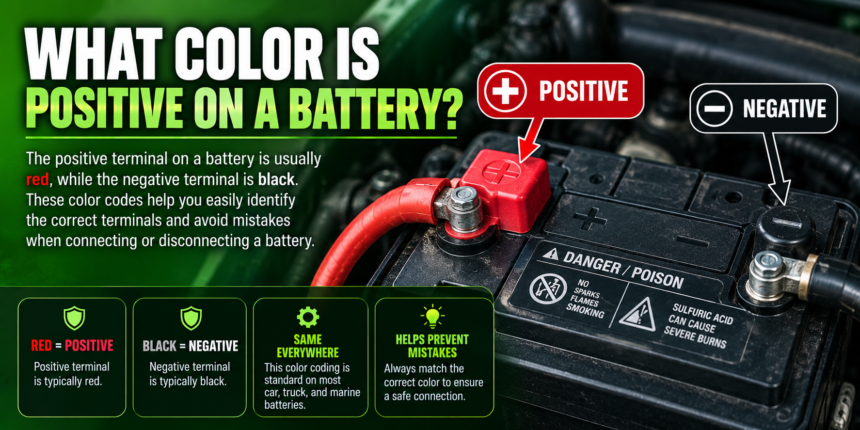
Red is positive. Black is negative. That holds for car batteries, jumper cables, battery chargers, jump packs, and nearly every DC wire you will run into. Color alone is not quite enough to bet a car’s electronics on, though. Cables get filthy, replacement parts get fitted in a hurry, and under enough grime both cables look black.
- Red is positive, black is negative
- Three ways to identify the positive terminal
- Quick reference: positive and negative by battery type
- What to do when the colors are wrong or missing
- Does red mean positive on everything?
- AA, AAA, and other household batteries
- Which terminal do you connect first?
- The jump-starting order, and why it ends on bare metal
- What happens if you connect them backwards?
- Conclusion
- Frequently asked questions
- Is red always positive on a battery?
- What if both battery cables look black?
- Which battery terminal do you disconnect first?
- Is the positive terminal bigger than the negative?
- What happens if you connect a car battery backwards?
- Related Articles
Every battery carries two markers that never fade: a plus and a minus stamped into the case, and one post that is physically fatter than the other. Here is how to read all three, and what to do when they disagree.
Red is positive, black is negative
The convention runs right through the automotive world. The positive terminal gets red: a red cable, a red plastic cap, a red ring around the post, or a black cap with a red plus printed on it. The negative gets black.
The choice of red is not decorative. Red reads as a warning, and the positive side is the one that bites. Drop a wrench across the positive post and the car body, and you have made a short circuit through several hundred amps. Do the same on the negative post and nothing happens, because the body is already negative.
The cables themselves give the game away too. The negative cable is short and bolts straight to the engine block or the body panel nearby. The positive cable is thicker, better insulated, and runs off across the engine bay to the starter motor and the fuse box.
Three ways to identify the positive terminal
Use these in order. Each one is harder to fake than the one before it.
- The symbols. A plus sign, and often the letters POS, are molded into the plastic case beside one post. A minus and NEG sit beside the other. They are pressed into the plastic rather than printed on, so they survive everything short of the battery itself failing.
- The size. The positive post is deliberately fatter. On the common SAE type used across North America and Japan it measures about 17.5mm across against 15.9mm for the negative. On European DIN and EN batteries the pair runs about 19.5mm and 17.9mm. The gap exists so a clamp sized for the negative will not seat properly on the positive.
- Where the cable goes. Follow each cable with your eyes. The one that ends on bare metal a few inches away is the negative. The one that disappears toward the starter and fuse box is the positive.
Quick reference: positive and negative by battery type
| Battery | Positive | Negative |
| Car battery (top post) | Red cap or cable, + or POS in the case, fatter post | Black cable, – or NEG, short cable to the engine block |
| Jumper cables and chargers | Red clamp | Black clamp |
| AA, AAA, C, D cells | Raised nub end | Flat end |
| 9V block | Small round stud | Large hexagonal socket |
| Coin cell (CR2032) | Wide flat face with the printing | Smaller face opposite |
| USB and DC hookup wire | Red conductor | Black conductor |
Everything in that table is a physical feature rather than a printed one, apart from the cable colors themselves. That is the point. Shapes and molded symbols survive the years that fade a red sleeve to grey.

What to do when the colors are wrong or missing
Start by cleaning. Corrosion and road grime hide the molded symbols far more often than genuine wear does, and a wire brush or a paste of baking soda and water will usually bring them back in under a minute. Wear gloves and eye protection while you do it.
Then treat color with suspicion on any car that has been worked on. Replacement cables and roadside repairs sometimes get made with whatever wire was on the shelf, and a black positive cable is not rare on an older vehicle. The molded symbols and the post sizes stay honest when the wiring does not. Side-post batteries, common on General Motors vehicles, are the awkward case: there are no posts to compare, so the stamped symbols beside the two threaded holes are the only guide you have.
If you still are not sure, a multimeter settles it in seconds. Set it to DC volts, put the red probe on one post and the black probe on the other, and read the display. A positive number means the red probe is on the positive terminal. A negative number means they are the other way around. A healthy 12 volt battery at rest reads about 12.6.
The multimeter is the only method that cannot be fooled by dirt, a faded cap, or a previous owner’s wiring. A basic one costs less than a single blown fuse box.
Does red mean positive on everything?
For direct current, yes, almost everywhere. Jumper cables, battery chargers, portable jump packs, solar setups, RV and marine wiring, and hobby electronics all follow it. In a USB cable the red wire carries the positive supply and the black one is ground.
Household mains wiring is a separate system and the colors there mean something else entirely. They describe live, neutral, and earth rather than positive and negative, and the code changes from country to country. Do not carry the battery convention across into a wall socket.
There is one historical wrinkle worth knowing if you work on old cars. A number of British vehicles built up to the 1960s used positive earth, where the positive terminal was the one bolted to the chassis. Red still meant positive on those cars. What changed was which terminal was grounded, which is why fitting a modern radio to one of them takes some care.
AA, AAA, and other household batteries
Small batteries carry no color code at all, because they do not need one. The shape tells you instead. On an AA, AAA, C or D cell the raised nub is positive and the flat end is negative, and every battery compartment prints a small diagram showing which way each cell goes. A 9V block gives you a small round stud for positive and a larger hexagonal socket for negative, so the connector only fits one way. On a coin cell, the wide flat face carrying the printed model number is the positive side.
Inside any of them the positive end connects to the cathode and the negative end to the anode, which is how a battery works at its simplest: two electrodes with different appetites for electrons, separated by an electrolyte.
Which terminal do you connect first?
The rule is short and worth memorizing: negative comes off first and goes back on last.
The reason is the same short circuit as before. With the negative cable disconnected, the battery has no path back to the car body, so a wrench that slips off the positive post and touches metal does nothing at all. Take the positive off first and that same slip dumps the full current of the battery through your tool.
For a battery swap, the order is: engine off and key out, loosen and lift the black negative clamp and tuck it clear of the post, then the red positive clamp. Fit the new battery, connect the red positive clamp first, and finish with the black negative. Tighten each one properly, because a loose clamp arcs and heats up.
The jump-starting order, and why it ends on bare metal
Park the cars close without letting them touch, switch both engines off, and connect in this order: red to the flat battery’s positive, red to the good battery’s positive, black to the good battery’s negative, and the final black clamp to a bare unpainted bolt or bracket on the flat car’s engine block, well away from its battery.
That last step trips people up, because it seems more logical to clamp onto the negative post. The reason it does not go there is that the final connection is the one that sparks, and a lead-acid battery vents hydrogen gas, which ignites from almost nothing. Grounding to the engine block puts that spark a safe distance from the vent caps.
Start the healthy car, give it a couple of minutes, then start the flat one. Remove the clamps in exactly the reverse order, and never let the two clamp ends touch each other while the other end is connected. Goggles and gloves are worth wearing, and AAA recommends leaving the job to a technician if the battery looks damaged, is leaking, or has been sitting frozen overnight.
What happens if you connect them backwards?
Fuses go first, which is exactly what they are for. A main fuse or fusible link blows within a fraction of a second and takes the hit for the rest of the car.
Past that, the damage climbs quickly. Alternator diodes are the usual casualty, because they conduct in one direction and reversed voltage drives current straight through them. After that come the engine control unit, the infotainment head unit, and any sensor left in circuit. On a modern car packed with control modules, a reversed battery can turn into a four-figure repair.
The warning signs are immediate: bright sparking as the clamp touches, a smell of hot plastic, rapid clicking, or a car that shows no sign of life at all. If you catch it while connecting, pull the clamp off, check the main fuses before turning the key, and get the charging system tested. Jumper cables have no protection against this, though many portable jump packs do refuse to deliver current until they see the right polarity.
Conclusion
Red is positive and black is negative, on car batteries and on almost anything else running on direct current. Treat the color as your first check rather than your only one: look for the plus stamped into the case, notice that the positive post is the fatter of the two, and reach for a multimeter whenever the two signals disagree. Then remember the order. Negative off first, positive on first, and the last jump-start clamp goes on bare metal, not the battery.
Frequently asked questions
Is red always positive on a battery?
On car batteries, jumper cables, chargers and other DC gear, yes. Household mains wiring uses a different color system that describes live, neutral and earth instead, and it varies by country, so the battery convention does not carry over.
What if both battery cables look black?
Clean the case and read the plus and minus stamped into the plastic beside each post. You can also compare post sizes, since the positive is fatter, or follow the short cable that bolts to the engine block, which is always the negative.
Which battery terminal do you disconnect first?
The negative, every time. With it off, the battery has no path back through the car body, so a slipped wrench on the positive post cannot short anything. Reconnect in reverse: positive first, negative last.
Is the positive terminal bigger than the negative?
Yes, slightly. On standard SAE posts the positive measures about 17.5mm across and the negative about 15.9mm. European DIN and EN batteries run about 19.5mm and 17.9mm. The difference is deliberate, to stop clamps going on the wrong way round.
What happens if you connect a car battery backwards?
Fuses and fusible links blow first. Beyond them, reversed polarity commonly kills alternator diodes and can damage the engine control unit and other modules. Disconnect immediately, check the fuses before starting the engine, and have the charging system tested.
Related Articles
What Does Battery Reconditioning Mean?
Which Battery Cable to Disconnect First?