


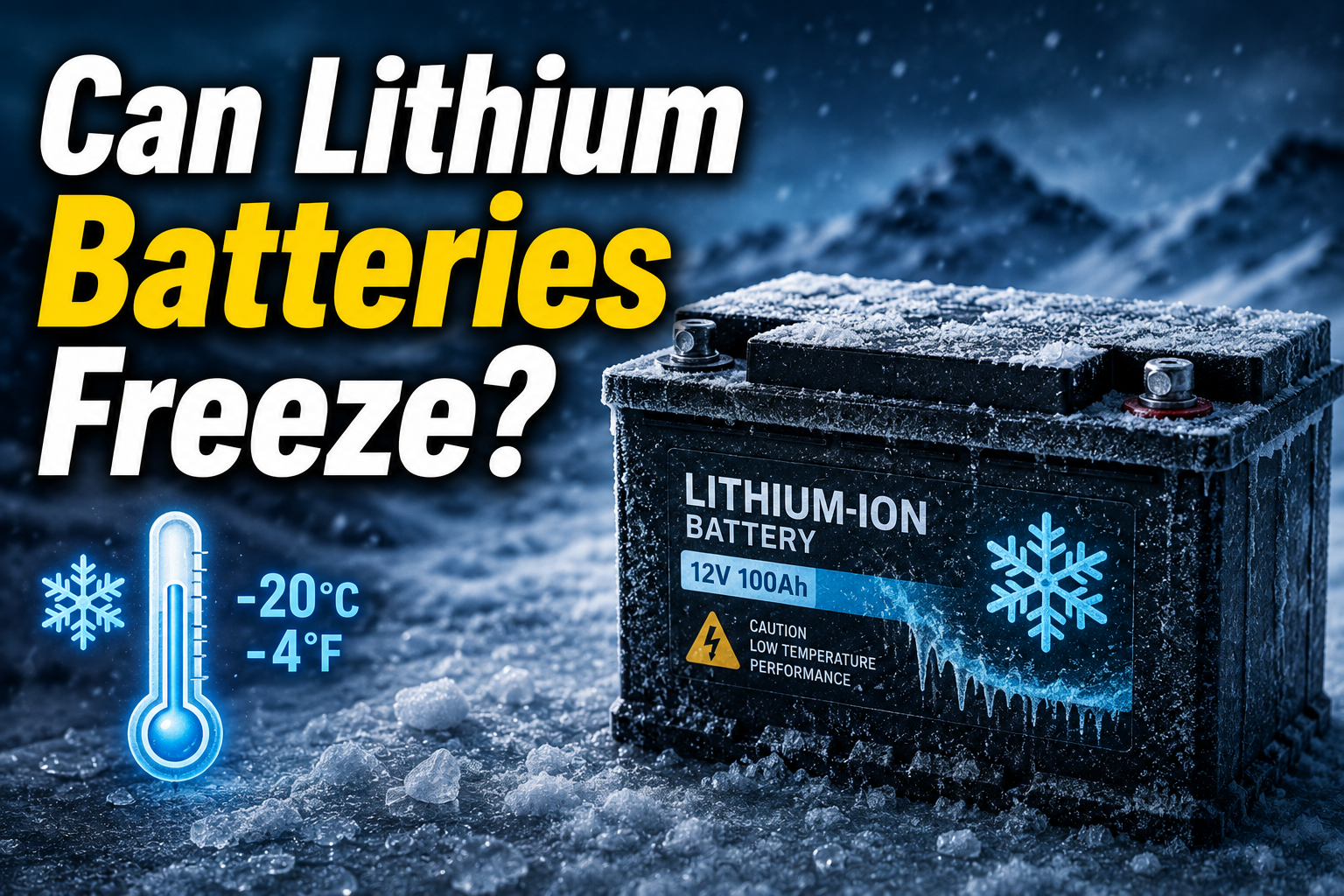
Lithium batteries almost never freeze solid the way a bottle of water does. The liquid inside only starts to thicken and crystallize at extreme cold, roughly -20°F to -40°F, which is far below the point where water turns to ice.
- Do lithium batteries actually freeze solid?
- What cold really does: temporary power loss?
- The one rule that matters: never charge below freezing
- Temperatures at a glance
- Lithium vs lead-acid in the cold
- How to protect your battery in winter?
- Conclusion
- Frequently asked questions
- At what temperature does a lithium battery freeze?
- Can I charge a lithium battery in freezing weather?
- Is it safe to use a lithium battery in the cold?
- Does cold permanently damage a lithium battery?
- How should I store a lithium battery over winter?
- Related Articles
Long before it gets that cold, though, freezing weather does affect your battery in two ways worth knowing. First, cold temporarily cuts its power and range, which bounces back once it warms up.
Second, and much more important, you should never charge a lithium battery when it is below freezing, because doing so causes permanent damage. Understanding those three things, freezing solid, losing power, and the charging danger, is the key to using lithium batteries safely in winter.
So the honest answer is layered. Can the electrolyte freeze? Only in extreme cold. Will normal winter temperatures hurt the battery? They sap its performance for a while but do not ruin it. Is there a real risk? Yes, but it comes from charging in the cold, not from the cold alone. Here is what each part means and how to stay on the safe side.
Do lithium batteries actually freeze solid?
Not under normal winter conditions. Unlike water, which freezes cleanly at 32°F, the electrolyte inside a lithium battery is a solvent mix with a much lower freezing point. It does not turn to a solid block at freezing temperatures; instead, in extreme cold it slowly thickens and can crystallize, and that only happens somewhere around -20°F to -40°F depending on the exact chemistry.
When the electrolyte does thicken that much, it becomes very hard for the ions to move through it, which spikes the battery’s internal resistance and can cause lasting harm if you try to use or charge it in that state. But for the vast majority of people, that level of cold is rare. The everyday winter worry is not the battery freezing solid; it is the performance drop and the charging rule covered next.
The key distinction: ‘freezing’ a lithium battery is not like freezing water. The electrolyte only crystallizes in extreme cold far below 32°F, so a truly frozen-solid lithium battery is uncommon.

What cold really does: temporary power loss?
The effect you will actually notice in winter is reduced power, and the cause is chemistry slowing down. As the temperature drops below about 32°F, the electrolyte gets more viscous, like cold syrup, so the lithium ions move more sluggishly. That raises the battery’s internal resistance and makes it harder to deliver current.
In practice, that means shorter range and weaker output when it is cold. Your phone might die faster, your e-bike might not go as far, and a solar battery might show less usable capacity. The good news is that this loss is temporary.
Warm the battery back up and the performance returns, because nothing has been permanently changed, the chemistry just moves faster again at normal temperatures. The colder it gets, the bigger this dip, but it is a fading of power, not a failure of the battery.
A common winter scare shows how this plays out. Someone leaves a device in a cold garage overnight, tries to switch it on in the morning, and the screen flickers and dies, so they assume the battery is ruined. Usually it is not. The battery is simply too cold to deliver current, and once it comes back to room temperature it powers up normally.
The lesson is to judge a cold battery by how it behaves after it warms up, not by how it acts while it is still frozen. That said, if a battery has been sitting in genuinely extreme cold, it is worth letting it warm gently rather than immediately putting it under heavy load.
The one rule that matters: never charge below freezing
If you remember one thing, make it this: do not charge a lithium battery when the temperature is below 32°F (0°C). Discharging in the cold is fine, just with reduced capacity, but charging is a different story. This limit is well documented; Battery University explains that consumer lithium-ion cells should not be charged below freezing at all.
The reason is a process called lithium plating. Normally, when you charge a battery, lithium ions slot neatly into the anode. When it is too cold, they cannot enter fast enough, so instead they build up as a layer of metallic lithium on the anode’s surface.
This plating is permanent. It causes lasting capacity loss and can even pierce the internal separator, which is a safety risk. Charging slowly does not save you, either, since research shows plating still happens below freezing even at very low charge rates. The battery may look like it is charging normally, which is exactly what makes this trap so easy to fall into.
Bottom line: cold discharge is fine; cold charging is not. If a battery is below 32°F, let it warm to room temperature before you plug it in. Many quality lithium batteries have a built-in cutoff that blocks cold charging for this reason.
Temperatures at a glance
Here is how a typical lithium battery behaves as the temperature falls. The exact numbers vary by chemistry and model, but the pattern holds.
| Temperature | What happens to a lithium battery | Is it safe? |
| Below about 32°F (0°C) | Range and power drop as the battery slows down | Fine to use, but do not charge it |
| Around 14°F (-10°C) | Noticeably weaker output; bigger capacity loss | Discharge only; charging causes damage |
| -20°F to -40°F (-29 to -40°C) | Electrolyte thickens and can crystallize | Risk of harm even from use; warm it first |
| Charging below 32°F (0°C) | Lithium plating builds up inside the cell | Never do this; the damage is permanent |
The takeaway from the table is that using a lithium battery in the cold is mostly about accepting less range, while charging in the cold is the line you should not cross. When in doubt, warm the battery up first.
Lithium vs lead-acid in the cold
Lithium actually handles cold far better than the old lead-acid batteries it often replaces. A lead-acid battery’s electrolyte is largely water, so a discharged one can genuinely freeze solid, crack its case, and leak, especially when it is low on charge. Lithium’s non-water electrolyte does not do that under normal winter conditions.
The performance gap shows up too. Around freezing, a lithium battery typically keeps roughly 95 to 98 percent of its rated capacity, while a lead-acid battery can drop to 70 to 80 percent, and the difference grows as it gets colder.
Some lithium iron phosphate (LFP) batteries even generate a little heat as they discharge, which helps them stay closer to their normal output. So if you are choosing a battery for a cold climate, lithium is generally the more dependable option, as long as you respect the no-cold-charging rule.
There is a practical reason this matters for buyers. A lead-acid battery is most vulnerable to freezing exactly when it is low on charge, because a discharged lead-acid electrolyte is closer to plain water and freezes at a higher temperature. That is the opposite of what you want in winter, when you may be leaning on the battery hardest.
Lithium sidesteps that failure mode entirely, and it delivers steadier voltage as it drains, so devices keep running normally instead of fading. For an RV, boat, or off-grid solar system that has to work through a cold season, those advantages usually outweigh lithium’s higher purchase price, provided you have a way to avoid charging it while it is below freezing.
How to protect your battery in winter?
A few simple habits keep a lithium battery healthy through the cold months. None of them are complicated:
- Never charge it below freezing. Bring the battery indoors or into a warmer space and let it reach room temperature before plugging in.
- Store it around half charge. For long winter storage, keep the battery at roughly 40 to 50 percent, not full and not empty, which is the least stressful state for the cells.
- Keep it out of unheated sheds and car trunks. An insulated box, a heated garage, or simply bringing the battery inside protects it from the worst cold.
- Warm it before charging or hard use. If a battery has been out in the cold, let it warm up first; even an hour indoors makes a difference.
- Consider a self-heating or cold-rated battery. For solar or off-grid use in freezing climates, batteries with built-in heaters or wider temperature ranges are worth the extra cost.
Do these and cold weather becomes a minor inconvenience rather than a battery-killer. The single most valuable habit is the charging rule: warm first, then charge.
Conclusion
So, can lithium batteries freeze? Only in extreme cold, roughly -20°F to -40°F, does the electrolyte thicken enough to matter, so freezing solid is uncommon. Ordinary winter temperatures simply cut a battery’s range and power for a while, and that returns once it warms up.
The real rule to live by is to never charge a lithium battery below 32°F, since that causes permanent lithium plating. Store batteries around half charge, keep them out of the deep cold, and always warm a cold battery before charging.
Do that, and lithium will outperform lead-acid all winter long. A good result is a battery that loses a little range in the cold but comes back to full strength when it warms up.
Frequently asked questions
At what temperature does a lithium battery freeze?
The electrolyte only thickens and crystallizes at extreme cold, roughly -20°F to -40°F, far below water’s 32°F. So a lithium battery rarely freezes solid in normal winter weather; it just loses power temporarily as it gets cold.
Can I charge a lithium battery in freezing weather?
No. Never charge a lithium battery below 32°F (0°C). Doing so causes lithium plating, which permanently reduces capacity and can be unsafe. Let the battery warm to room temperature first, then charge it normally.
Is it safe to use a lithium battery in the cold?
Yes, discharging in the cold is fine, though you will get less range and power until it warms up. The temporary drop is normal and reversible. Just avoid charging it while it is below freezing.
Does cold permanently damage a lithium battery?
Cold alone usually does not; the power loss is temporary and returns with warmth. Permanent damage mainly comes from charging while frozen, which causes lithium plating, or from exposure to extreme cold well below zero.
How should I store a lithium battery over winter?
Store it around 40 to 50 percent charge in a cool, dry place that does not drop far below freezing, such as indoors rather than an unheated shed. Avoid leaving it fully charged or fully drained for long periods.
Related Articles
Can an Alternator Kill a Battery?
Can a Car Battery Die While Driving?
Can a Bad Starter Drain a Battery?
Can a Battery Be Too Dead to Jump? When a Jump Works and When It Won’t