


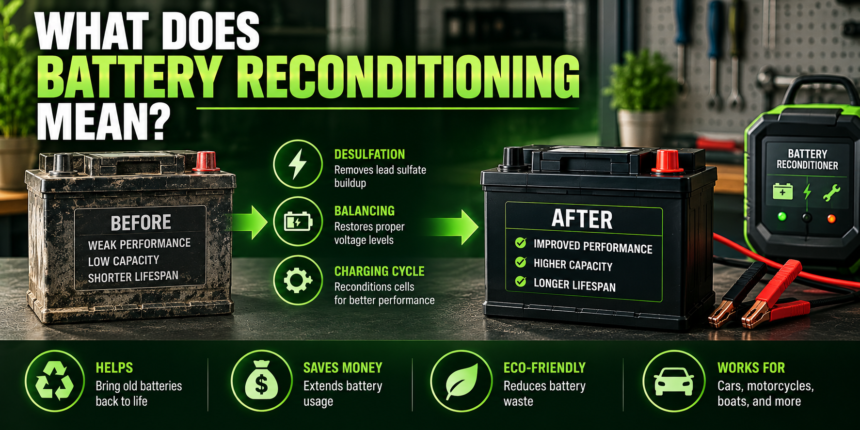
Battery reconditioning means restoring some lost performance in a worn rechargeable battery by reversing fixable problems, mainly sulfation and cell imbalance, instead of repairing physical damage or replacing the battery.
It is a controlled charging and discharging process, usually done with a special charger, that can bring a tired battery back to stable, usable capacity. It is not a rebuild, and it cannot save a battery that is truly worn out. Here is what that actually means in practice.
What actually goes wrong with an old battery
To understand reconditioning, it helps to know why a battery weakens in the first place. Every rechargeable battery works through reversible chemical reactions. Over many charge and discharge cycles, small side effects build up and slowly rob the battery of capacity.
In lead-acid batteries, the big one is sulfation. When a battery sits partly charged, gets stored for a long time, or is drained too deeply too often, hard lead-sulfate crystals form on the internal plates. Those crystals block the chemical reactions, so the battery charges slowly, holds less energy, and eventually struggles to start anything. Cells can also drift out of balance with each other, and in flooded batteries the electrolyte level can drop. Reconditioning targets exactly these reversible problems.
The key word there is reversible. Some battery wear is permanent: the plates physically shed material, the internal structure breaks down, and no charging trick brings that back. But a good share of the capacity a battery seems to lose is not permanent damage at all, just sulfation and imbalance sitting on top of a battery that is otherwise sound. That is the gap reconditioning aims at, which is why so many batteries get thrown away while still holding real, recoverable life.
What reconditioning actually does
Reconditioning is a set of electrical and electrochemical steps that partially undo that damage. A modern battery reconditioning charger, run by a microprocessor, does this automatically in stages.
- Desulfation. The charger sends a controlled charge pattern, often high-voltage pulses, that breaks down the hardened lead-sulfate crystals on the plates. This is the core of reconditioning, and it is why the process is sometimes just called desulfation.
- Rebalancing the cells. A controlled charge and discharge cycle brings the individual cells back toward the same state, so no single weak cell drags the pack down.
- Correcting electrolyte (flooded batteries only). On serviceable flooded batteries, topping up the cells with distilled water so the plates stay covered is part of the job.
Done at the right stage of wear, this can recover a meaningful chunk of capacity. Industry sources put realistic recovery at roughly 60 to 90 percent of the battery’s original usable capacity, which is enough to extend its working life by months or sometimes a year or two. A good technical overview of the mechanisms is available from Ufine Battery’s guide.
The honest version: Reconditioning does not rebuild damaged electrodes or return a battery to factory-new specs. It reverses the fixable stuff and gets a battery back to stable, usable performance, no more.
Which batteries can be reconditioned?
This is where a lot of confusion lives, because reconditioning means different things for different chemistries, and it simply does not work on some. This table sums it up.
| Battery type | Reconditioning works? | Notes |
| Flooded lead-acid | Often yes | Best candidate; desulfation and topping up electrolyte can help |
| AGM lead-acid | Sometimes, gently | Skip equalization; use correct voltage and pulsed desulfation |
| Gel lead-acid | Usually no | Sensitive to the voltages used in reconditioning |
| Lithium-ion / LiFePO4 | No (not desulfation) | Different failure mode; managed by the BMS, not reconditioning |
| EV / hybrid packs | Software balancing only | Means cell rebalancing and BMS reset, not cell repair |
The pattern is clear: reconditioning in the classic desulfation sense is a lead-acid thing, and it works best on flooded batteries that are only mildly sulfated. AGM batteries can respond to a gentle version. Gel batteries usually should not be reconditioned, and lithium batteries are a different world entirely. Before you start, it is worth identifying exactly which type you have, because the label on the case decides whether reconditioning is safe, pointless, or actively risky.
What reconditioning can’t fix
Being honest about the limits saves you time and money. Reconditioning is not a cure-all, and there are clear cases where it will not help.
A severely degraded battery. If a battery has lost active material, has physically damaged plates, or tests at around 50 percent state of health or below, reconditioning gives at best a short, temporary bump. Replacement is the better call.
Lithium-ion batteries. Lithium and LiFePO4 batteries fail through gradual chemical aging, not sulfation, so desulfation does nothing for them. Their health is managed by a built-in battery management system (BMS), not by a reconditioning charger.
EV and hybrid packs, mostly. For an electric or hybrid car, reconditioning usually does not mean repairing the cells. It refers to software-level work: rebalancing cell voltages, recalibrating the thermal system, or resetting the BMS. That can improve range estimates and how the car feels, but true cell degradation still needs hardware replacement, and these high-voltage packs are not for DIY work.
If a lead-acid battery is heavily sulfated all the way through, reconditioning also tends to fail. The technique helps light sulfation far more than severe, hardened cases.
How long does it take?
Reconditioning is not a quick top-up. A full cycle, including charging, desulfation, resting, and testing, commonly takes somewhere in the range of 12 to 24 hours for a car battery. The exact time depends on the battery’s size and condition and the program your charger runs.
A smart reconditioning charger walks through its stages on its own, so most of that time is unattended, but it is not something you finish in an afternoon. It is also normal to test the result at the end rather than assume it worked: measure the resting voltage, and if you have one, put a load tester on the battery to see how far the voltage sags under demand.
A battery that holds up under load has genuinely recovered; one that collapses the moment you draw current has not, no matter how full it reads at rest.
Is battery reconditioning worth it?
For the right battery, yes. Reconditioning a mildly sulfated lead-acid battery can delay a replacement by a year or two, which saves money and keeps a working battery out of the recycling stream a little longer. That makes it appealing for cars, backup power, and off-grid or solar storage setups where lead-acid batteries are common. A reconditioning charger is a modest one-time cost, and after that each battery it rescues is close to free, so the math often works out in your favor if you have more than one lead-acid battery to look after.
The catch is expectations. Reconditioning is a maintenance and life-extension tool, not a repair that makes an old battery new. It works on reversible problems, on the right chemistries, caught early enough. Handled with that in mind, it is a genuinely useful trick. Treated as a way to resurrect any dead battery, it will disappoint. And because the process involves sulfuric acid and, in flooded batteries, opening cells, take the safety seriously: gloves, eye protection, and good ventilation, or leave it to a professional.
There is also a bigger-picture reason it is catching on. A reconditioned battery is one that stays in service instead of heading to disposal, which cuts both cost and electronic waste. For anyone running a bank of lead-acid batteries, in an RV, a boat, or an off-grid home, building reconditioning into a regular maintenance routine can stretch the whole set’s life and delay an expensive round of replacements. The trade-off many of those owners eventually weigh is switching to lithium batteries, which cost more upfront but never need reconditioning at all.
Conclusion
Battery reconditioning means reversing the fixable causes of lost capacity, mainly sulfation and cell imbalance, to bring a worn battery back to stable, usable performance. It works best on mildly sulfated lead-acid batteries, does little for severely degraded or lithium batteries, and takes roughly 12 to 24 hours with a smart charger. Think of it as extending a good battery’s life, not rebuilding a dead one, and it becomes a practical, money-saving habit.
Frequently asked questions
Does battery reconditioning actually work?
Yes, on the right battery. It can recover 60 to 90 percent of capacity in a mildly sulfated lead-acid battery. It does little for severely degraded batteries or lithium chemistries.
Is reconditioning the same as recharging?
No. Recharging just refills a battery’s charge. Reconditioning uses a controlled charge and discharge process to reverse sulfation and rebalance cells, restoring lost capacity, not just topping it up.
Can you recondition a lithium battery?
Not in the desulfation sense. Lithium batteries age chemically and are managed by a BMS. What passes for reconditioning in EVs is software rebalancing and recalibration, not cell repair.
How many times can a battery be reconditioned?
A few times over its life, with diminishing returns each round. Every reconditioning recovers less, and once the plates are physically worn, the battery is due for replacement.
Is battery reconditioning safe to do at home?
It can be, with care. You are working with sulfuric acid and, on flooded batteries, open cells. Wear gloves and eye protection, work in a ventilated space, and use a proper reconditioning charger, or leave it to a pro.
Related Articles
Which Battery Cable to Disconnect First?