


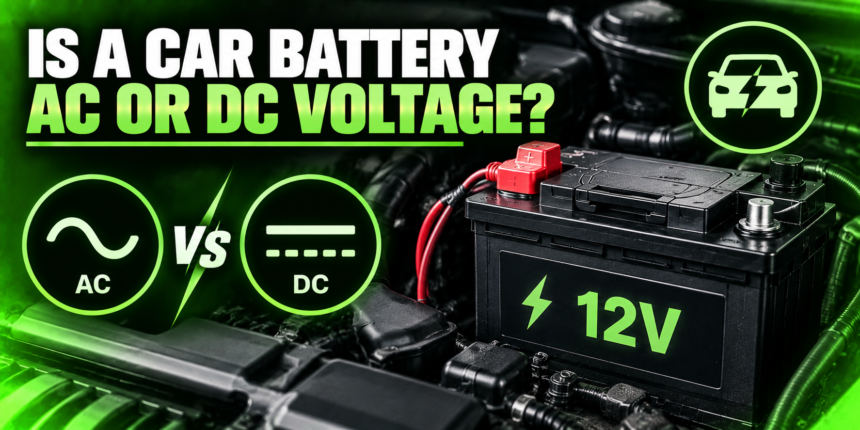
A car battery is DC. Direct current, nominally 12 volts, reading about 12.6 volts at the terminals when it is fully charged and rested.
- What AC and DC actually mean
- Why a battery can only produce DC
- The confusing part: your alternator generates AC
- Which means there is a little AC in your car after all
- Why cars run on DC in the first place
- Measuring it: use the DC setting
- What about 48-volt systems?
- Where AC does turn up in a car
- Conclusion
- Frequently asked questions
- Is a car battery AC or DC?
- Is a car alternator AC or DC?
- Why is my car battery reading zero on my multimeter?
- Can you charge a car battery with AC?
- What voltage should a car battery be?
- Related Articles
That is the whole answer, and it is not really in dispute. What makes people ask the question is that the alternator sitting a foot away from that battery generates AC, and somewhere in the middle those two facts seem to contradict each other.
They do not, and the reason is worth understanding, because it explains a couple of things that catch people out with a multimeter.
What AC and DC actually mean
Direct current flows one way. Electrons leave the negative terminal, travel round the circuit and return to the positive, and the polarity never changes. Plot the voltage against time and you get a flat line.
Alternating current reverses direction, over and over. In the United States mains electricity swaps direction 60 times a second, and in the UK and most of Europe 50 times a second. Plot that and you get a sine wave crossing zero twice per cycle.
| Direct current (DC) | Alternating current (AC) | |
| Direction of flow | One way, always | Reverses 50 or 60 times a second |
| Polarity | Fixed positive and negative | Swaps continuously |
| Typical sources | Batteries, solar panels, rectifiers | Mains supply, generators, alternators |
| Can a battery store it? | Yes | No |
| Found in your car | Everywhere | Inside the alternator, and in inverters |
The distinction is not academic. It changes what a component can do, what a meter reads, and what a battery can store.
Why a battery can only produce DC
A battery is a chemical device, not a mechanical one, and its chemistry has a direction.
Inside a lead-acid car battery, a reaction between lead, lead dioxide and sulphuric acid pushes electrons out of one plate and pulls them into the other. That reaction has a fixed polarity. The negative plate is always the negative plate. Nothing inside a battery reverses fifty or sixty times a second, so nothing about its output can alternate.
The 12-volt figure comes from stacking. A single lead-acid cell produces about 2.1 volts. Six of them in series gives roughly 12.6 volts, which is why a healthy rested car battery reads 12.6 rather than a round 12. The “12 volt” label is a nominal name for the system, not a measurement.
The same logic applies to every battery you own. AA cells, phone batteries, hybrid packs and EV packs are all DC, for exactly the same reason.
The confusing part: your alternator generates AC
Here is where the question comes from.
An alternator does not produce DC. It produces three-phase alternating current, and it does so because that is what a spinning magnet inside a set of stationary coils naturally makes. The engine turns a rotor, the rotor is an electromagnet, and as its field sweeps past the stator windings it induces AC in them.
Alternators are built this way deliberately. The older alternative, a DC generator with brushes and a commutator, was heavier, produced less output at low speed and wore out faster. Once cheap silicon diodes arrived, making AC and then converting it became the better engineering choice.
That conversion is called rectification, and it happens inside the alternator housing before anything leaves it. As ShopOwner explains, diodes in the rectifier pass current in one direction only, folding the alternating waveform into a one-way flow. By the time the output reaches the alternator’s main terminal it is DC, at roughly 13.7 to 14.7 volts with the engine running.
How the rectifier does it
Worth a paragraph, because it is the piece that resolves the whole question.
Three-phase AC means three separate sine waves, each offset from the next by a third of a cycle. The rectifier is a bridge of six diodes, two for each phase. Each diode passes current one way and blocks it the other, so the bridge sends every positive half of every wave to the output and flips every negative half to join it rather than opposing it.
The result is not the flat line a battery produces. It is a series of overlapping humps, positive at all times but rising and falling. Because there are three phases arriving out of step with each other, those humps overlap heavily and the output is far smoother than a single-phase rectifier could manage.
The battery then does the rest of the smoothing, which is why a car with a weak battery can show electrical symptoms that a car with a healthy one would absorb without complaint.
So the car does contain AC. It exists for a few centimetres of copper winding inside a sealed aluminium case, and then it is gone.
Which means there is a little AC in your car after all
Rectification is not perfect. Converting a sine wave into a straight line by chopping and folding it leaves a residue, a small alternating component riding on top of the DC. That residue is called ripple, and every healthy charging system has a trace of it.
The battery is what keeps it harmless. A large lead-acid battery acts as a buffer, absorbing the small AC component so the rest of the car sees something close to clean DC. This is one of the underappreciated jobs a car battery does: it is not just a store of energy for starting, it is a stabiliser for the whole electrical system.
When a rectifier diode fails, that AC stops being a trace. Ripple rises sharply, and because control modules communicate using low-voltage signals, stray AC can corrupt those signals and produce faults that look nothing like a charging problem. Flickering lights, radio noise and intermittent electrical gremlins are the classic symptoms.
Why cars run on DC in the first place
Given that mains electricity is AC and the alternator makes AC, it is fair to ask why the car does not simply use it.
Because you have to store it. A battery can only store and deliver DC, and a car absolutely must have stored energy available with the engine off. Everything else follows from that.
Because electronics need it. Engine management units, sensors, injectors and every digital module on the vehicle run on steady DC. Feed them alternating voltage and the constant polarity reversal would corrupt signals and destroy semiconductors.
Because DC is easier at low voltage. Switching, fusing and controlling DC across a car’s wiring loom is straightforward, and 12 volts is low enough to be reasonably safe to work on.
Because AC’s advantage does not apply here. AC won the argument for grid distribution because it transforms easily to high voltages for long-distance transmission with low losses. A car’s wiring runs a few metres. There is nothing to gain.
Measuring it: use the DC setting
This is the practical consequence, and it trips people up regularly.
When you test a car battery, set the multimeter to DC volts, marked V with a straight line above it, or VDC. Black lead in the COM socket, red lead in the socket marked V. Fluke’s guide to measuring battery voltage walks through the setup.
Set the meter to AC volts instead and you will read something close to zero on a healthy battery, because there is essentially no alternating component to measure. That reading is not a dead battery. It is the wrong setting, and it sends people to buy batteries they did not need.
There is one time you do want the AC setting on a car, and it is the ripple test. With the engine running, probes on the battery terminals, meter on AC volts, you should see a very small number. A large one points at a failed diode in the alternator. That is the only routine automotive measurement where AC volts is the correct choice.
Two related points while you have the meter out. Connecting a battery to an AC supply directly will not charge it and will damage it, which is why every mains charger contains a rectifier. And a battery cannot be run backwards into producing AC, no matter what it is connected to, because the chemistry only works one way.
If you get a negative DC reading, incidentally, your probes are simply on the wrong terminals. Swap them. Nothing is damaged, and a digital meter shows the minus sign precisely because DC has a fixed polarity to get backwards.
What about 48-volt systems?
Newer cars increasingly carry a second, higher-voltage system alongside the familiar 12-volt one, usually 48 volts, to run mild-hybrid starter-generators, electric superchargers and active suspension.
That system is DC too. The jump to 48 volts is about current rather than current type: at four times the voltage you can move the same power through much thinner cable, which saves weight. The battery is still a battery, so it still stores and delivers DC.
Those cars typically keep a conventional 12-volt battery as well, for lighting, modules and everything that was designed around 12 volts, with a converter shuttling energy between the two. Both are DC. Nothing in the arrangement introduces AC.
Where AC does turn up in a car
Three places, and all of them are conversions rather than exceptions.
Inverters. If your car has a household socket, or you have plugged an aftermarket inverter into the accessory socket, that device takes 12 volts DC and synthesises 120 or 230 volts AC for mains appliances. The battery is still DC. The inverter is manufacturing the AC.
Hybrid and electric drivetrains. The traction battery in a hybrid or EV is a high-voltage DC pack, often several hundred volts. But the motors that drive the wheels are AC motors, so an inverter converts pack DC into three-phase AC to run them, then converts it back during regenerative braking. The same pattern as the alternator, running in reverse.
EV charging. Public rapid chargers supply DC straight to the pack. Home and destination chargers supply AC, and an onboard charger inside the car rectifies it. The battery only ever accepts DC, whichever kind of charger you plug in.
Conclusion
A car battery is DC, nominally 12 volts and about 12.6 volts when fully charged and rested, because the chemistry that produces the voltage has a fixed polarity. The alternator does generate AC, but diodes inside it convert that to DC before it reaches anything else, leaving only a trace of ripple that the battery absorbs. When you test a battery, use the DC setting. The AC setting has exactly one job on a car, and that is checking the alternator’s diodes.
Frequently asked questions
Is a car battery AC or DC?
DC, direct current. A fully charged 12-volt car battery reads about 12.6 volts DC at rest. Battery chemistry has a fixed polarity, so a battery cannot produce alternating current.
Is a car alternator AC or DC?
It generates AC internally, specifically three-phase AC, then converts it to DC using a rectifier made of diodes before the output leaves the alternator. So it produces AC but delivers DC, which is where most of the confusion about this comes from.
Why is my car battery reading zero on my multimeter?
Most likely the meter is set to AC volts. A car battery produces DC, so an AC setting reads close to nothing. Switch to DC volts, marked VDC or V with a straight line, and try again before assuming the battery is dead.
Can you charge a car battery with AC?
Not directly. A battery charger plugs into AC mains and rectifies it to DC internally, then feeds that DC to the battery. Applying raw AC to a battery would not charge it properly and would damage it.
What voltage should a car battery be?
About 12.6 volts DC or higher when fully charged and rested, falling to roughly 12.4 at 75 percent charge and 12.2 at half. With the engine running you should see 13.7 to 14.7 volts DC, which is the alternator charging it.
Related Articles
Lithium Battery vs High Capacity Battery: Which Is Better?
How to Make an Electromagnet’s Battery Stronger?
Why Is My Phone Battery Draining While Charging? Causes and Fixes