



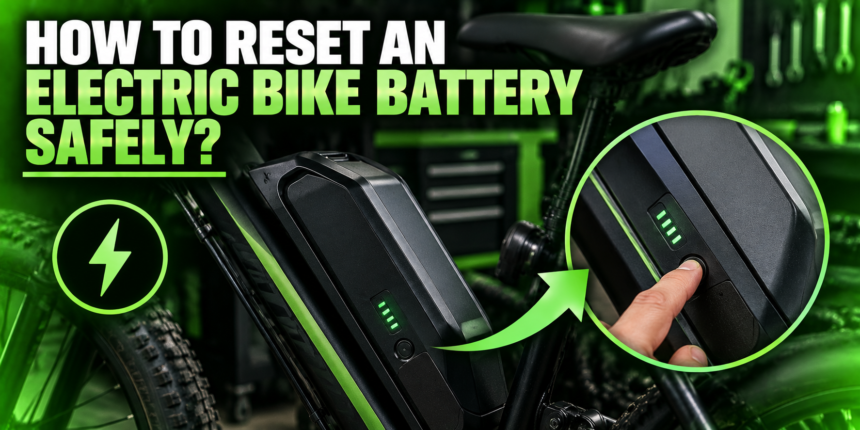
To reset an electric bike battery, turn the bike off, remove the battery from the frame, wait 5 to 10 minutes, then click it firmly back into place and power on. This simple power cycle clears most temporary glitches. If the charge gauge is still wrong, follow it with one full, uninterrupted charge to 100 percent and a short ride, which lets the battery’s built-in electronics recalibrate.
- What ‘resetting’ actually means
- Before you start
- How to reset your e-bike battery, step by step
- Recalibrating the charge gauge
- When a reset is the wrong fix
- What never to do
- Conclusion
- Frequently asked questions
- Does resetting an e-bike battery delete my settings or charge?
- My battery has no reset button. How do I reset it?
- Should I fully drain the battery before recharging to reset it?
- How often should I recalibrate my e-bike battery?
- My battery is swollen or got wet. Can I reset it?
- Related Articles
That is the whole safe process. You should never need to open the battery case or touch anything inside it, and doing so is dangerous. Below is the step-by-step method, plus how to tell when a reset will not fix the problem.
A quick note before the steps, because e-bikes differ: always check your owner’s manual first, since some models have a specific reset procedure or a reset button, and others expect you to simply power-cycle and ride. If you cannot find the manual, it is usually on the maker’s website. When in doubt, a shop that services e-bikes can do this safely for you.
What ‘resetting’ actually means
On a modern e-bike, resetting the battery really means one of two things, and it helps to know which you need. The first is a simple power cycle: removing the pack lets the battery’s electronics and the motor controller fully power down and clear small software glitches, the same idea as restarting a frozen phone. The second is a recalibration of the battery management system, or BMS, the circuit board inside every lithium pack that tracks charge and protects the cells. For a deeper look at what the BMS does, this guide to e-bike battery management systems is a useful reference.
Recalibration matters because the BMS estimates your remaining charge, and over time that estimate can drift away from the battery’s true level. That is why your percentage might read 60, then drop to 20 on one short hill. A full charge re-aligns the BMS to the real cell voltages so the gauge tells the truth again. One thing a reset does not do: lithium batteries have no ‘memory effect,’ so you are not clearing a memory or restoring lost capacity, just fixing software drift.
It is worth matching the symptom to the right fix, because they call for different things. A bike that suddenly freezes, throws a one-off error, or acts strangely after sitting in the garage for months usually just needs a power cycle to clear a glitch. A bike whose battery percentage is jumpy or clearly wrong, but that otherwise rides fine, needs the fuller recalibration through a full charge. And a bike that cuts out under load, refuses to charge, or has a pack that looks or smells wrong is not a software problem at all, and no reset will help. Knowing which bucket you are in saves time and keeps you from forcing a fix that will not work.
The short version: a power cycle clears glitches, and a full charge recalibrates the charge gauge. Neither one opens the battery or restores an old, worn-out pack.

Before you start
A little preparation keeps this safe and simple. Take a moment to set up before touching anything:
- Turn the bike off and unplug the charger. Never reset while the bike is on or charging.
- Steady the bike so it will not fall, ideally on a stand or against a wall.
- Have the key ready if your battery locks to the frame; you will need it to remove the pack.
- Inspect the battery first. If it looks swollen, cracked, wet, or smells odd, stop here and see the safety section, since a reset is not the right move.
Work at room temperature if you can. A very hot or very cold pack should be left to settle to normal temperature before you charge it, since charging a cold lithium battery can damage the cells.
How to reset your e-bike battery, step by step
For most bikes, this power-cycle method is all you need. It is safe, needs no tools, and takes only a few minutes:
- Turn the e-bike off completely and make sure the charger is unplugged.
- Remove the battery from the frame. Unlock it with your key or release latch and slide it out. If your battery has a power button, press it to release any residual charge.
- Wait 5 to 10 minutes. This pause lets the battery’s electronics and the controller fully power down and clear any temporary faults.
- If your battery has a dedicated reset button, hold it for about 10 to 20 seconds during this pause. Many batteries do not have one, and that is fine, the wait itself does the work.
- Reseat the battery firmly until it clicks and the lock engages. A loose connection is a common cause of odd behavior, so make sure the contacts line up.
- Power the bike back on and check the display. Take a short ride and confirm the throttle and pedal assist feel normal.
If the bike powers up cleanly and the earlier problem is gone, you are done. If the charge gauge is still jumping around, move on to the recalibration below.
Recalibrating the charge gauge
This is the fuller reset, and it is the fix when your battery percentage is inaccurate rather than glitchy. The goal is to let the BMS re-learn where full and empty really are. The safe way to do it uses a normal full charge, not a forced deep discharge:
- Reinstall the battery and power the bike on.
- Plug in the manufacturer’s charger and charge all the way to 100 percent without interruption. Always use the charger that came with your bike, since the wrong charger can bypass the battery’s safety features.
- Leave it plugged in for an extra 1 to 3 hours after it reads full. During this time the BMS balances the cells so the whole pack charges evenly, which is what sharpens the gauge.
- Unplug, then ride normally for 10 to 20 minutes so the system settles into an accurate reading.
You do not need to run the battery down to zero first. Modern lithium packs prefer to avoid both extremes, and routinely draining to empty just adds wear. A single full, balanced charge every month or so, or every 20 to 30 rides, is enough to keep the gauge honest. If the reading is still erratic after this, the issue is likely physical rather than software.
Do this recalibration occasionally, not constantly. A full charge with a little extra balancing time is healthy; repeated deep discharges are not.
When a reset is the wrong fix
A reset only cures software hiccups. If the real problem is physical or chemical, resetting will not help and forcing it can be dangerous. Use this quick guide to tell the difference:
| A reset may help when… | Skip the reset and get help when… |
| The charge gauge jumps around (60% to 20% on one small hill) | The pack is swollen, cracked, dented, or smells odd |
| The bike acts strangely after long storage | The battery got wet or was submerged |
| An error code appears out of nowhere | The contacts are corroded or damaged |
| The gauge is confused after a rare full drain | The bike shuts off at once under high assist |
| The display percentage seems clearly wrong | Range is short because the pack is simply old |
The right-hand column points to a damaged, wet, or worn-out pack, or a fault the BMS is deliberately protecting you from. In those cases, stop and contact your bike’s maker or a qualified e-bike shop. Also keep expectations realistic on age: a healthy pack loses roughly 2 to 4 percent of its capacity a year, and once it is down to about 70 to 80 percent of new, shorter range is normal wear that no reset can undo.
What never to do
A few actions turn a simple fix into a serious hazard. Lithium e-bike batteries store a lot of energy, so these lines are worth taking seriously:
- Never open the battery casing. The cells inside can deliver dangerous current, and any online guide telling you to crack the case or disconnect internal wires is unsafe. The BMS is sealed inside for a reason.
- Never short the terminals or ‘reset’ pins with a wire. This can cause a fire, and it is not how consumer packs are meant to be reset.
- Never force a charge on a damaged or wet battery. If the pack was submerged or is swollen and the BMS refuses to turn on, that refusal is a safety feature, not a fault to override.
- Never use a non-original or unknown charger to try to revive it. The wrong charger can bypass the battery’s protections and damage the cells.
- Never ignore heat, swelling, or a strange smell. Move the battery to a safe, non-flammable spot and replace it rather than reset it.
If your bike is still under warranty, contact the manufacturer before attempting anything beyond a basic power cycle, since opening or tampering with the pack will usually void it and, more importantly, put you at risk.
Conclusion
Resetting an e-bike battery is usually quick and safe: power down, pull the pack, wait a few minutes, reseat it firmly, and ride. If the charge gauge is off, add one full uninterrupted charge with a little extra balancing time to recalibrate the battery’s system.
Check your manual for model-specific steps, use only the original charger, and never open the case or force a charge on a damaged pack. Above all, know when a reset is the wrong tool: swelling, water, corrosion, or an aged battery calls for a professional or a replacement. A good result is a bike that powers up cleanly with an accurate gauge, fixed without ever opening the battery.
Frequently asked questions
Does resetting an e-bike battery delete my settings or charge?
No. A reset clears temporary software glitches and re-aligns the charge gauge; it does not erase settings or restore lost capacity. Lithium batteries have no memory effect, so you are simply fixing a confused reading, not wiping the battery.
My battery has no reset button. How do I reset it?
Most e-bikes have no dedicated button and do not need one. Turn the bike off, remove the pack, wait 5 to 10 minutes, reseat it firmly, then power on and ride. That power cycle, plus a full charge, handles nearly every case.
Should I fully drain the battery before recharging to reset it?
No. Reserve a full drain for rare calibration only, and even then let the bike shut off on its own rather than forcing it. Routine deep discharges add wear. A normal full charge with extra balancing time is the healthy way to recalibrate.
How often should I recalibrate my e-bike battery?
Only occasionally, typically a few times a year, or once the charge gauge looks clearly wrong or after long storage. A full balanced charge every 20 to 30 rides keeps the reading accurate. Recalibrating monthly is unnecessary and adds no benefit.
My battery is swollen or got wet. Can I reset it?
No. Do not reset or charge a swollen, cracked, or water-exposed battery, and never open the case. These are physical faults, and forcing power is a fire risk. Isolate the battery safely and contact the maker or a qualified e-bike shop for replacement.
Related Articles
What Are Carbon Batteries? A Plain Guide