


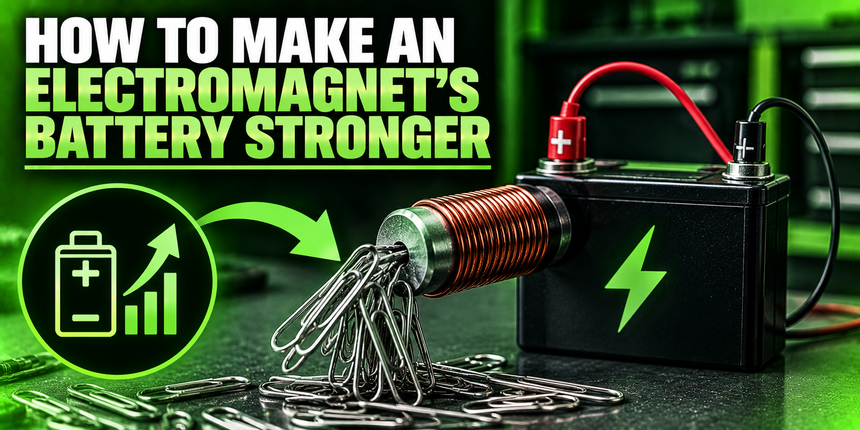
The quickest way to make an electromagnet stronger through its battery is to use a higher-voltage battery, which pushes more electric current through the coil. Strength comes from that current, so more current means a stronger magnet. Swapping a 1.5-volt AA for a 9-volt battery, or wiring batteries together, drives more current and boosts the pull. But the battery is only half the story. You get the biggest jump by combining a stronger power source with more turns of wire and an iron core, and by keeping the setup safe so it does not overheat. Here is how each piece works and how to put them together.
- What actually makes an electromagnet strong
- The battery’s real job: driving current
- Every way to make it stronger
- Why a bigger battery does not always help
- Stay safe: the short-circuit trap
- A simple recipe for a much stronger electromagnet
- Conclusion
- Frequently asked questions
- Does a bigger battery make an electromagnet stronger?
- What makes an electromagnet strongest?
- Should I add batteries in series or parallel?
- Why does my electromagnet get hot?
- Can I use any metal for the core?
- Related Articles
It also helps to fix the wording, because it changes what you do. An electromagnet is not really powered by a ‘stronger battery’ in the way a bigger engine is stronger. It is powered by current flowing through a coil, and the battery’s job is to drive that current. Once you see it that way, the ways to make it stronger fall into place, and so do the mistakes to avoid.
What actually makes an electromagnet strong
An electromagnet’s strength depends on two main things: how much current flows through the wire, and how many times the wire is wrapped around the core. Scientists combine these into one idea called ampere-turns, which is simply the current multiplied by the number of turns. Double the turns or double the current, and you roughly double the strength. The educational guide at Sciencing lays out the same relationship, and it is the key to everything below.
A third factor is the core, the material the wire is wrapped around. Wrapping the coil around iron instead of empty air concentrates the magnetic field and multiplies the strength many times over. So the three levers are current, turns, and core. The battery controls the first one, which is why people focus on it, but the other two matter just as much.
A quick example shows how these stack up. Picture a coil of 20 turns on a plain pencil, connected to a single AA cell: it will barely pick up a paper clip. Now wrap 200 turns of the same wire around an iron nail and connect it to a 9-volt battery. You have raised the turns tenfold, raised the voltage sixfold, and added an iron core, and the same basic parts now lift a small handful of paper clips. Nothing exotic changed; you simply pushed more current through more turns around a better core. That is the whole game, and it is why focusing on only the battery leaves most of the strength on the table.
The core idea: strength comes from ampere-turns (current times the number of coils), boosted by an iron core. The battery’s role is to supply the current, so think ‘more current,’ not just ‘bigger battery.’
The battery’s real job: driving current
The battery sets the voltage, and voltage is the push that moves current through the coil. By Ohm’s law, for a given coil, more voltage means more current. That is why a 9-volt battery makes a stronger magnet than a single 1.5-volt cell, and why wiring several cells in series, which adds their voltages, drives even more current.
But current also depends on the coil’s resistance, not just the battery. A coil made of long, thin wire has more resistance and allows less current; a short, thick coil has little resistance and allows a lot. So the same battery can produce a weak or strong magnet depending on the wire. The takeaway: to get more current you can raise the voltage, lower the resistance, or both, but you have to do it carefully, for reasons the safety section explains.
Every way to make it stronger
Here is the full menu of upgrades, what each one does, and the catch to watch for. You can combine several at once for the biggest effect.
| What to change | Why it helps | Watch out for |
| More coils of wire around the core | Strength rises with the number of turns; more turns, stronger magnet | Keep the wire insulated so turns do not short together |
| A higher-voltage battery | More voltage pushes more current through the coil | Too much current overheats the wire and battery |
| Thicker or shorter wire (less resistance) | Lets more current flow for the same voltage | Can tip into a short circuit if resistance gets too low |
| An iron core instead of air | Iron concentrates the field and multiplies strength | Use iron, steel, or nickel, not aluminum or copper |
| Batteries in series | Adds their voltages for more current | Only helps if the coil, not the battery, limits current |
Most of these come back to the same thing: pushing more current through more turns of wire around an iron core. The strongest simple electromagnets stack all of them, plenty of tightly wound turns, a solid iron core, and a battery that can supply good current without being overwhelmed.
Why a bigger battery does not always help
This is the part most guides skip. Reaching for a much bigger battery does not automatically give a much stronger magnet, and it can even work against you. The reason is where the resistance sits in the circuit.
If the coil has decent resistance, adding voltage (a higher battery, or cells in series) raises the current and strengthens the magnet, just as you would expect. But if the coil has very low resistance, then connecting a big battery is close to putting a bare wire straight across the terminals.
At that point the battery’s own internal resistance becomes the limit, the voltage sags, and instead of a much stronger magnet you get a wire that heats up fast and a battery that drains in minutes. More battery is only useful if the coil, not the battery, is what is holding back the current. That is why adding more turns of thin wire is often a smarter upgrade than simply grabbing a bigger battery: it raises the turns and the resistance together, so the magnet gets stronger without turning into a short circuit.
Stay safe: the short-circuit trap
A simple electromagnet is basically a controlled short circuit, so a little care keeps it from becoming an uncontrolled one. When too much current flows, the wire and the battery both get hot, sometimes hot enough to burn you or ruin the battery. These habits keep it safe:
It helps to know why the heat appears. Any wire has a little resistance, and pushing current through resistance produces heat, the same effect that warms a toaster or a light bulb filament. In a normal circuit the current is modest, so the warming is tiny. In an electromagnet coil with low resistance and a strong battery, the current can be large, and that turns the coil into a small heater. The heat is not a sign the magnet is working harder in a useful way; it is wasted energy, and it is the thing to keep in check.
- Use enough wire. A longer, thinner coil adds resistance that limits the current to a safe level. Very short, thick coils across a strong battery are what overheat.
- Do not leave it connected. Hook up the battery only while you are using the magnet, then disconnect it. Leaving it on drains the battery and builds heat.
- Feel for heat. If the wire or battery gets warm, disconnect and let it cool. Warmth is the warning sign before anything gets dangerous.
- Keep it away from iron filings. Loose filings that bridge the bare battery terminals can carry current and get red-hot quickly, so keep them clear of the leads.
- Add a switch. A simple push switch lets you power the coil only for a moment, which is safer and saves the battery.
Rule of thumb: if it gets hot, it is drawing too much current. Back off, add more turns of thinner wire, or use a smaller battery, then try again.
A simple recipe for a much stronger electromagnet
Putting it together, here is a safe build that is far stronger than the basic single-cell version:
- Take a long iron nail or iron bolt as the core. Iron works far better than a nail made of other metals.
- Wrap a long piece of thin insulated (enamelled) copper wire tightly around the nail, in neat, close turns. More turns means a stronger magnet, so use plenty, and add extra layers if you can.
- Leave a few inches free at each end and strip the insulation off just those tips so they can connect.
- Connect the ends to a 9-volt battery, or two AA cells wired in series, ideally through a small switch.
- Press the switch and test it on paper clips. Add more turns or a slightly higher voltage to increase the pull, watching for any heat.
The long, thin, many-turn coil is what lets you use a higher voltage safely: it keeps the current in a sensible range while the extra turns and the iron core do the heavy lifting. That combination gives you a strong magnet without a hot wire.
Conclusion
To make an electromagnet stronger through its battery, drive more current through the coil: use a higher-voltage battery or cells in series, but pair that with plenty of turns of thin wire and an iron core, since strength comes from ampere-turns, not voltage alone.
A bigger battery only helps when the coil, not the battery, limits the current, and pushing too hard just overheats the wire. Build it with a long, many-turn coil around iron, add a switch, and disconnect it when you are done. A good result is a magnet that lifts far more than the basic version while staying cool to the touch.
Frequently asked questions
Does a bigger battery make an electromagnet stronger?
Usually yes, up to a point. A higher-voltage battery pushes more current through the coil, which strengthens the magnet. But if the coil has very low resistance, a big battery mostly overheats the wire instead, so adding more turns of wire often helps more.
What makes an electromagnet strongest?
The combination of high current, many turns of wire, and an iron core. Strength depends on ampere-turns, the current multiplied by the number of coils, and an iron core multiplies the field further. Stack all three for the strongest simple magnet.
Should I add batteries in series or parallel?
For more strength, use series, which adds the voltages and drives more current through the coil. Parallel keeps the voltage the same and mainly extends run time. Series only helps if the coil, not the battery, is limiting the current.
Why does my electromagnet get hot?
It is drawing too much current, which heats the wire and battery. This happens with short, thick coils or an oversized battery. Fix it by using a longer, thinner coil, a smaller battery, and disconnecting the power when you are not using it.
Can I use any metal for the core?
No. Use a magnetic metal like iron, steel, or nickel, which concentrates the field. Non-magnetic metals such as aluminum or copper do not work as a core and will not boost the strength, so a plain iron nail is the classic choice.
Related Articles
Which Battery Cable to Disconnect First?