



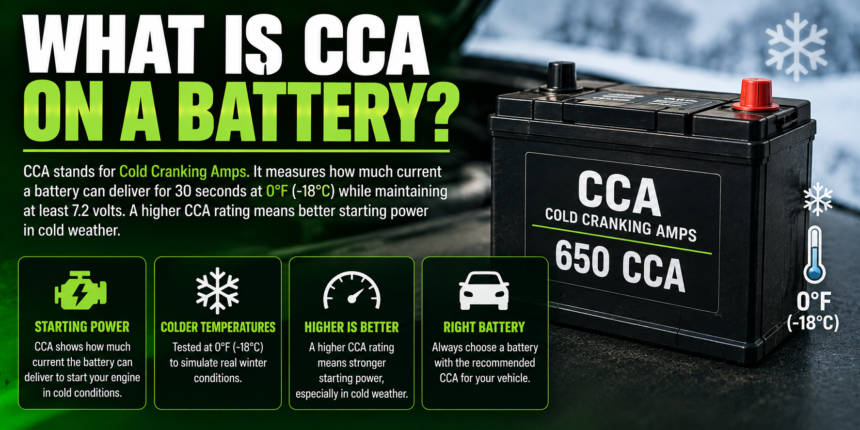
CCA stands for Cold Cranking Amps. It is the number of amps a fully charged 12-volt battery can deliver for 30 seconds at 0F (-18C) while holding its voltage above 7.2 volts.
- What the CCA test actually involves
- Why the test is done in the freezing cold
- CCA, CA, MCA, HCA and RC
- How much CCA does your vehicle need?
- Is a higher CCA always better?
- CCA and newer battery types
- CCA falls as the battery ages
- Conclusion
- Frequently asked questions
- What does CCA mean on a car battery?
- Is a higher CCA battery better?
- What is the difference between CCA and CA?
- Can I use a battery with a lower CCA than recommended?
- How do I check my battery’s actual CCA?
- Related Articles
In plain terms, it is a measure of muscle rather than endurance. CCA tells you how hard a battery can push for the few seconds it takes to turn an engine over on the worst morning of the year. It says nothing about how long the battery will run your headlights, and nothing about how many years it will last.
It is the number most people should check first when buying a starter battery, and the number most commonly misread.
What the CCA test actually involves
CCA is not a marketing figure. It is a standardised laboratory test defined by the Battery Council International and specified under SAE J537.
Four conditions have to be met at once:
- The current. A battery rated at 600 CCA has to supply 600 amps.
- The duration. It has to hold that current for a full 30 seconds.
- The temperature. The battery is chilled to 0F (-18C) before the test begins.
- The voltage floor. Throughout those 30 seconds, terminal voltage must not fall below 7.2 volts, which is 1.2 volts per cell.
That voltage floor is the part that matters most. Almost any battery can dump a huge current for an instant. Holding voltage up while it does so, in the cold, for half a minute, is the hard part, and 7.2 volts is roughly the minimum a starter and the car’s electronics can work with.
Typical figures for a passenger car sit between about 350 and 600 amps, with trucks and diesels running considerably higher.

Why the test is done in the freezing cold
Because cold squeezes a battery from both ends at the same time.
As the temperature falls, the chemical reactions inside the battery slow down and its internal resistance rises, so it can deliver less current. A battery at 18C can put out roughly twice the power of the same battery at -18C.
Meanwhile the engine gets harder to turn. Oil thickens, internal friction climbs, and the starter has to work considerably harder for the same result.
So exactly when the battery has least to give, the engine asks for most. As Interstate Batteries puts it, the available starting power falls while the required starting power rises. That crossover is where cars fail to start, and it is why the industry chose to rate starting batteries at a temperature most drivers will rarely see. Rating at 0F builds in the worst case.
CCA, CA, MCA, HCA and RC
Battery labels carry several similar-looking ratings, and they are not interchangeable. This is where most buying mistakes happen.
| Rating | Full name | Test temperature | What it tells you |
| CCA | Cold Cranking Amps | 0F (-18C) | Starting power in the cold |
| CA / SAE | Cranking Amps | 32F (0C) | Starting power in mild weather |
| MCA | Marine Cranking Amps | 32F (0C) | The same test as CA, labelled for boats |
| HCA | Hot Cranking Amps | About 80F (27C) | Starting power when warm |
| RC | Reserve Capacity | 80F (27C) | Minutes at 25 amps before dropping to 10.5 volts |
The key point is that CA, MCA and HCA are all measured somewhere warmer than CCA, so they always produce a bigger number for the same battery. CA and MCA typically run around 20 to 25 percent higher than that battery’s CCA.
That gap is exactly why a battery advertised as “800 amps” can be a weaker battery than one advertised as “650 amps”. If the 800 is MCA, its CCA equivalent is roughly 640. To convert MCA or CA to an approximate CCA figure, multiply by 0.8.
Reserve capacity is a different quantity altogether. It measures endurance rather than punch: how many minutes the battery could run a 25-amp load if the alternator stopped. On a modern car full of electronics, reserve capacity deserves as much attention as CCA, and the two are not correlated.
How much CCA does your vehicle need?
The real answer is simple: at least as much as the manufacturer specifies. That figure appears in the owner’s manual, on the label of the battery currently fitted, and in any retailer’s fitment lookup. Fitting less than the specified CCA is how people end up with a car that starts perfectly all summer and refuses in January.
If you want a rough sanity check, the traditional rule of thumb is about 1 CCA per cubic inch of engine displacement for a petrol engine, and roughly double that for a diesel. So a 5.7-litre V8, which is around 350 cubic inches, wants somewhere near 350 CCA as an absolute floor. Diesels need far more because of their much higher compression.
Two adjustments are worth making on top of the manufacturer’s figure. If you live somewhere with hard winters, choosing a battery 15 to 20 percent above the minimum gives you margin for cold mornings and for the natural decline that comes with age. And if the car carries a lot of electrical load, look at reserve capacity as well rather than chasing CCA alone.
Going below spec is the only genuine mistake here. Everything else is a judgement call.
Reading it off the label
The CCA figure is usually printed on the top or front label of the battery, near two other numbers worth knowing.
The group size is a BCI code such as 24F, 35 or H6. It describes the physical dimensions, terminal positions and post types, so it determines whether the battery physically fits and the cables reach. Group size and CCA are independent: two batteries of the same group size can carry very different CCA ratings.
The date code tells you when the battery was made, usually as a letter for the month and a digit for the year. A battery loses capability sitting on a shelf, so a fresh date code is worth looking for.
If the label shows a large number with no unit next to it, check carefully before assuming it is CCA. That is precisely the situation where a CA or MCA figure gets mistaken for a cold rating.
Is a higher CCA always better?
Higher is safe, but it is not automatically better, and it is worth understanding why.
A bigger CCA number will not make your car start faster or damage anything. The starter draws only the current it needs, so surplus capability simply sits there as headroom. In a cold climate that headroom is genuinely useful.
The complication is how manufacturers achieve very high CCA figures. Cranking current depends on the surface area of the plates, so the straightforward way to raise CCA is to fit more plates into the same box. To make them fit, the plates and the separators between them are made thinner.
Thinner plates crank harder and wear out sooner. They are more vulnerable to vibration, to shedding active material, and to the damage caused by deep discharge. A battery built to advertise an exceptional CCA figure may well have traded away durability and reserve capacity to get there.
So treat CCA as a threshold to clear rather than a score to maximise. Meet the specification, add a sensible margin for your climate, and then judge the battery on reserve capacity, build quality and warranty instead of chasing the biggest number on the shelf.
CCA and newer battery types
Chemistry affects how easily a battery hits a given CCA figure.
AGM batteries have lower internal resistance than conventional flooded batteries, so they generally deliver a higher CCA from the same size of box, and they hold voltage better under a heavy sustained load. That is one reason cars with stop-start systems, which crank far more often, are fitted with them from the factory.
Lithium starter batteries are the awkward case. They can produce enormous burst current for their weight, and manufacturers often quote pulse cranking amps rather than a true SAE CCA figure, which makes direct comparison difficult. Lithium also behaves differently in genuine cold: below freezing its output drops off sharply, and many packs will not accept a charge at all until they warm up. If you are comparing a lithium battery against a lead-acid one, check whether the headline number is a real CCA rating tested at 0F or something measured another way.
CCA falls as the battery ages
The figure on the label is what the battery could do when new. It is not what your battery can do today.
Cranking performance declines steadily as plates sulfate, corrode and shed material. The industry benchmark is that a battery delivering less than about 80 percent of its rated CCA is at the end of its useful life, even if it still starts the car on a mild day.
This is also why a battery can pass a voltage check and still be finished. Voltage tells you state of charge. CCA tells you the ability to deliver current, and the two decline independently.
There is a practical wrinkle here that is rarely mentioned. Battery University notes in its guide to measuring CCA that CCA cannot really be measured in the field at all. A true CCA test means chilling the battery and discharging it under controlled conditions, a process that can take the best part of a week per battery and is seldom performed outside a laboratory.
What a garage or parts shop actually does is estimate it. A conductance tester measures the battery’s internal resistance in a couple of seconds and infers a CCA figure from it. Those testers are good enough to be useful, and the reading they give you is the practical way to find out where your battery stands, but the number is a well-informed estimate rather than a measurement.
Get one done if your battery is more than three years old, or before winter if you live somewhere cold. It costs nothing at most parts shops and it is the only meaningful way to know whether the number on the label still means anything.
Conclusion
CCA is Cold Cranking Amps: the amps a 12-volt battery can hold for 30 seconds at 0F without falling below 7.2 volts. It measures starting power in the worst conditions, not capacity and not lifespan. Match or slightly exceed your vehicle’s specified figure, do not confuse it with the higher CA or MCA ratings, and remember that the label shows what the battery could do when new. A conductance test tells you what it can do now.
Frequently asked questions
What does CCA mean on a car battery?
Cold Cranking Amps. It is the current a fully charged 12-volt battery can deliver for 30 seconds at 0F while keeping terminal voltage above 7.2 volts. It measures cold starting power, not capacity or expected life.
Is a higher CCA battery better?
Higher is safe and useful in cold climates, but it is not automatically better. Very high CCA figures are usually achieved with more and thinner plates, which can reduce durability. Meet the manufacturer’s figure, add margin for your climate, then judge on reserve capacity and build quality.
What is the difference between CCA and CA?
The test temperature. CCA is measured at 0F and CA at 32F. Because warmer conditions are easier on a battery, the CA number is always higher, typically by 20 to 25 percent. Multiply a CA or MCA figure by about 0.8 to approximate its CCA.
Can I use a battery with a lower CCA than recommended?
You can fit it, but you should not. It may start the car in mild weather and fail on the first genuinely cold morning. Always meet or exceed the CCA the vehicle manufacturer specifies.
How do I check my battery’s actual CCA?
You cannot do it with a multimeter, and a true CCA test is a laboratory procedure. A conductance tester at a garage or parts shop estimates it from internal resistance in seconds. Below about 80 percent of the rated figure, the battery is due for replacement.
Related Articles
Which Battery Cable to Disconnect First?
Which Battery Has the Most Voltage?