


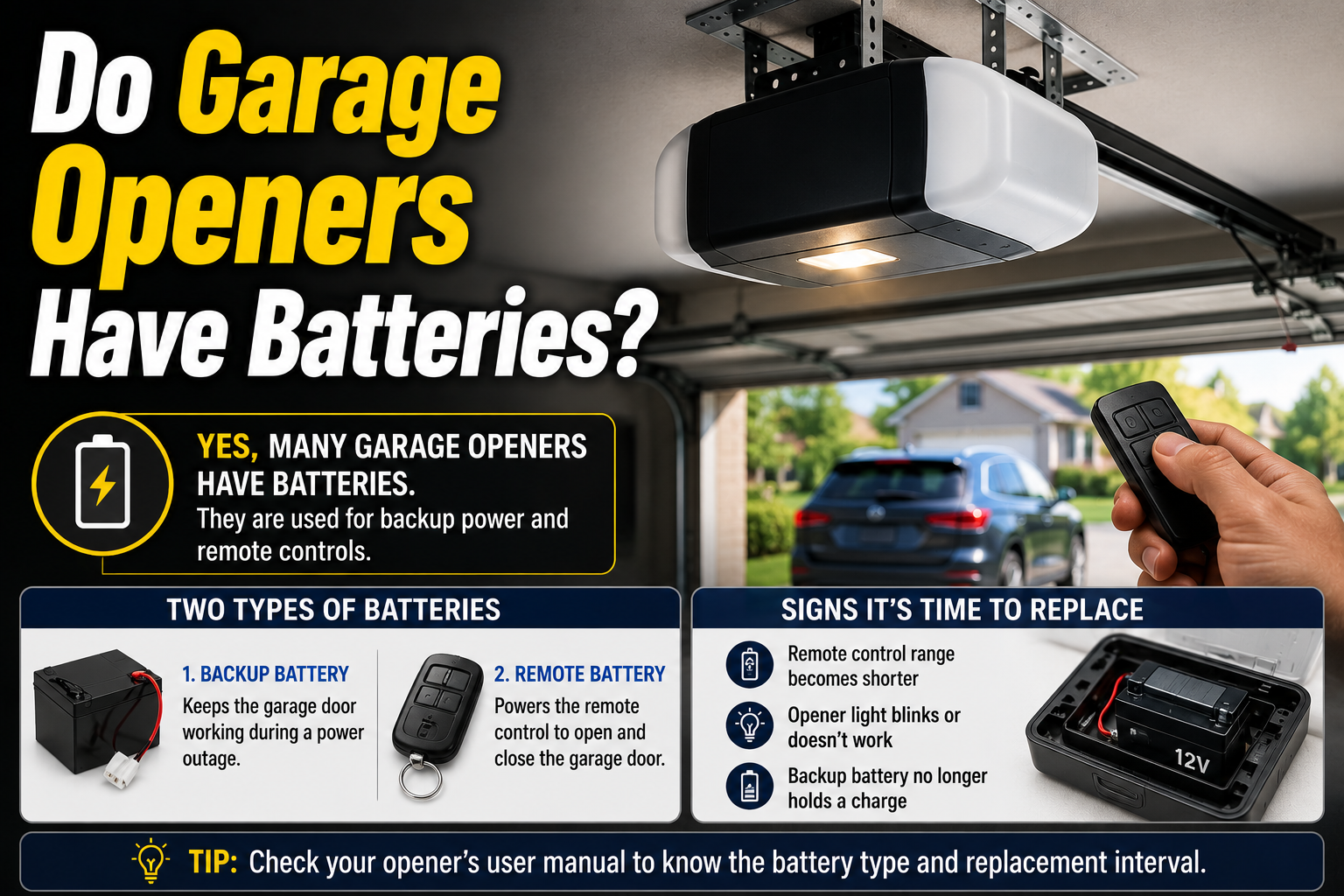
It depends which part of the opener you mean, and that is the key to a clear answer. The main motor unit that lifts the door normally runs on your home’s electricity, not batteries. But the remote control in your car and the keypad by the door almost always run on batteries.
- The opener motor: power, not batteries (mostly)
- The backup battery, and why California requires it
- The remote and keypad: almost always batteries
- Which battery goes where?
- How to tell a battery is dying?
- Replacing the batteries safely
- Conclusion
- Frequently asked questions
- Does the garage door opener motor run on batteries?
- Why is my garage door opener beeping?
- What battery does a garage remote use?
- Is a battery backup garage door opener required by law?
- How long do garage door opener batteries last?
- Related Articles
On top of that, many newer openers also include a backup battery inside the motor unit so the door still works during a power outage, and in California that backup battery is now required by law. So the honest answer is: yes, garage openers use batteries, but where and why depends on the component. Here is a plain breakdown of each part, what powers it, and when you will need to replace a battery.
Thinking about it component by component clears up most of the confusion, including the common question of why an opener suddenly starts beeping. Below we cover the motor unit, the backup battery and the law behind it, and the remote and keypad, then finish with how to spot a dying battery and swap it safely.
The opener motor: power, not batteries (mostly)
The heart of the system, the motor unit mounted on your garage ceiling or wall, is powered by your home’s electrical supply. It plugs into a standard outlet and draws mains power to drive the motor that pulls the door up and down its track. In normal use, that motor does not run on batteries at all, which is why a basic opener keeps working for years without you ever thinking about a battery for it.
The flip side is what happens when the power goes out. A plug-in-only opener with no backup will not work during a blackout, which means lifting the door by hand using the manual release cord, the red handle that disconnects the door from the opener.
A heavy door is awkward to lift, and if your garage is your main way in and out, a power cut can leave you stuck. That inconvenience is exactly the problem a backup battery is designed to solve.
The simple rule for the motor: it runs on household power, not batteries, during normal use. A battery only enters the picture as a backup for when the power fails.
The backup battery, and why California requires it
Many modern garage door openers include a backup battery tucked inside the motor housing. When the power goes out, the opener switches to this battery so you can still open and close the door a number of times until power returns.
It is a genuine convenience and safety feature, especially in areas prone to storms and outages. In fact, this is now legally required in California: under a law known as SB-969, every residential garage door opener sold or installed in the state since July 1, 2019 must have a battery backup. Manufacturers like Chamberlain and LiftMaster build openers specifically to meet this rule.
These backup batteries are usually a 12-volt sealed lead-acid battery, roughly the size used in a home alarm system, though some newer models use lithium instead. They typically last somewhere between one and three years, and a bit longer for lithium types, before they need replacing.
Because a lead-acid battery slowly degrades whether you use it or not, it is worth replacing on schedule rather than waiting for it to fail during the one outage when you need it most. When it does get low, the opener lets you know, which brings us to the warning signs later on.
It helps to have realistic expectations of a backup battery. It is meant to get you through a power cut with a handful of door cycles, not to run the opener indefinitely, so the fewer times you open and close during an outage, the longer it lasts. Cold weather also matters: batteries lose capacity in low temperatures, so an opener in an unheated garage in a cold climate may get noticeably shorter backup life and a shorter overall battery lifespan than the same unit in a mild region.
A good habit is to test the backup once or twice a year by unplugging the opener briefly and checking the door still operates on battery. If it struggles or the light warns you, the battery is near the end of its life even if it has not started beeping yet.
The remote and keypad: almost always batteries
This is where batteries are nearly universal. The handheld remote you keep in your car runs on a small battery, almost always a coin cell such as a CR2032, though some remotes use a AA, a AAA, or a 12-volt A23 cell instead. These typically last one to two years, and a fading remote battery is the single most common reason a garage door ‘stops working’, when in fact only the remote has gone quiet.
The wireless keypad mounted outside the garage, the one you punch a code into, also runs on a battery, usually a 9-volt but sometimes AA or AAA cells. Keypads tend to last one to three years, though they take a beating from the weather, so in cold climates the battery can drain faster.
One thing to note: the wired wall button inside the garage, hardwired to the opener, does not use a battery, since it draws power through its wiring. So among the controls, it is the wireless ones, the remote and the keypad, that need batteries.
Which battery goes where?
Here is the whole system at a glance, so you can see exactly which parts use batteries and which do not:
| Part of the system | Battery it uses | Rough lifespan |
| Motor unit (normal power) | None; runs on household AC power | n/a |
| Motor unit (backup, if fitted) | 12V sealed lead-acid, sometimes lithium | About 1 to 3+ years |
| Remote control | Coin cell (often CR2032); some AA/AAA | About 1 to 2 years |
| Wireless keypad | Usually a 9V; sometimes AA/AAA | About 1 to 3 years |
| Wired wall button | None; hardwired to the opener | n/a |
The pattern is easy to remember: anything wireless (the remote, the keypad) needs its own battery, the motor runs on mains power, and a backup battery is an added feature inside the motor unit. Always check your owner’s manual or the label on the existing battery for the exact type before buying a replacement, since brands and models differ.
How to tell a battery is dying?
Your opener usually gives clear signals when a battery is running low, and the signal tells you which battery it is:
- The opener beeps or flashes. A backup battery that is low typically makes the motor unit beep every 30 to 60 seconds, or show an amber or red light instead of green. That is the backup battery talking, not the remote.
- The remote only works up close. If you have to stand right next to the door for the remote to respond, its coin cell is fading. Shrinking range is the classic sign.
- Buttons need several presses. An unresponsive remote or keypad that works only after repeated tries usually points to a weak battery.
- Only the wall button works. If the door responds to the hardwired wall switch but not the remote, the remote’s battery is the likely culprit, since the wall button has no battery to fail.
Matching the symptom to the part saves you from replacing the wrong thing. A beeping motor unit means the backup battery; a short-range remote means the coin cell in your hand.
Replacing the batteries safely
Most of these swaps are quick and need only basic tools. The approach differs a little by part:
- Remote: slide or unscrew the back cover, pop out the old coin cell, and insert a fresh one matching the polarity (the plus and minus signs). Snap it shut and test.
- Keypad: open the compartment (often at the bottom), replace the 9-volt or AA/AAA battery, close it, and confirm your code still opens the door.
- Backup battery: for safety, unplug the opener first, open the battery cover on the motor unit, disconnect the old battery (noting which wire goes where, red to positive, black to negative), fit the matching new battery, then plug the opener back in. A new lead-acid backup battery often needs a full charge, so give it about a day before relying on it.
A couple of extra tips. Use standard batteries rather than rechargeables in remotes and keypads, since rechargeables often supply slightly lower voltage and can make the controls less reliable. And do not throw a spent lead-acid backup battery in the household trash; take it to a battery recycling point, as many home improvement and battery stores accept them.
If a control still fails after a fresh, correct battery, the issue may be with the device or the opener rather than the battery, and it may need reprogramming or a look from a technician.
It is also worth ruling out the simple things before assuming a battery is dead, because not every failure is a battery. Corroded battery terminals, especially in a weather-exposed keypad, can block the connection even with a good battery, so a quick clean of the contacts sometimes brings a control back to life. A remote that stopped working after you changed the battery may simply need reprogramming to the opener using the Learn button.
And if the whole system is dead, including the wired wall button, the problem is power to the opener, a tripped outlet or breaker, not any battery at all. Checking these first can save you money and a needless trip to the store.
Conclusion
So, do garage openers have batteries? Yes, but where depends on the part. The motor unit runs on your home’s power and only uses a battery as an outage backup, and in California that backup is required by law. The wireless remote and keypad almost always run on batteries, usually a coin cell and a 9-volt, while the hardwired wall button does not.
When your opener beeps or a remote’s range shrinks, match the symptom to the right part, replace that battery with the correct type, and recycle any old lead-acid backup. A good result is a system where every control responds and the door still opens when the power is out.
Frequently asked questions
Does the garage door opener motor run on batteries?
No, not for normal use. The motor unit runs on your home’s electricity. A battery only comes in as a backup, if your opener has one, so the door can still operate during a power outage. Otherwise you open it by hand.
Why is my garage door opener beeping?
Usually because the backup battery in the motor unit is low. Many openers beep every 30 to 60 seconds or show an amber or red light to signal this. Replacing the backup battery, typically a 12-volt sealed lead-acid, stops the beeping.
What battery does a garage remote use?
Most garage remotes use a small coin cell, commonly a CR2032, though some use AA, AAA, or a 12-volt A23. They last about one to two years. A remote that only works up close usually just needs a fresh battery.
Is a battery backup garage door opener required by law?
In California, yes. Under SB-969, all residential garage door openers sold or installed since July 1, 2019 must have battery backup. Other areas do not require it, but it is a useful feature anywhere power outages are common.
How long do garage door opener batteries last?
It varies by part. Remote coin cells and keypad batteries last about one to three years, while backup batteries in the motor unit last around one to three years, a little longer for lithium. Replace them proactively rather than waiting for failure.
Related Articles
Does a Wireless Charger Damage Your Battery? What Actually Matters
Does Sentry Mode Drain Battery? What Tesla Owners Should Expect