



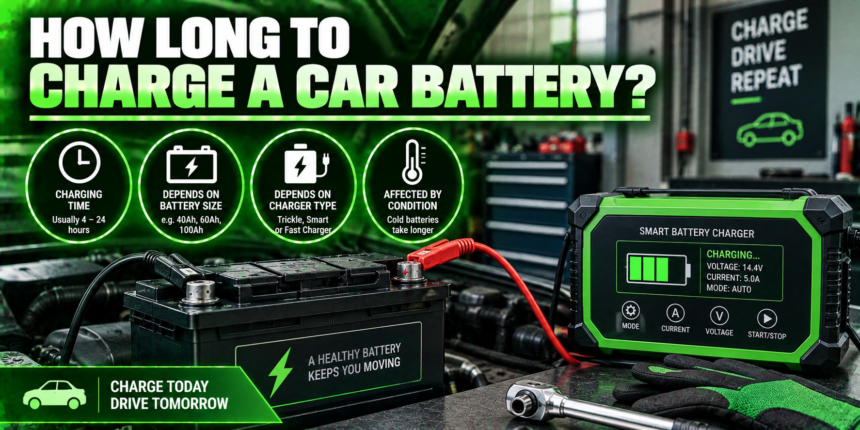
A flat car battery takes roughly 4 to 6 hours on a 10 amp charger, 8 to 12 hours on a 4 to 6 amp charger, and 24 hours or more on a 2 amp trickle charger. Those are the numbers most people are looking for.
- Charging times by charger size
- Work out the time for your own battery
- Why the last 30 percent takes longer than the first 70
- How flat is it? Voltage tells you
- What amperage should you use
- Does battery type change the time?
- Can you just drive it instead?
- How to tell when it is actually finished
- Conclusion
- Frequently asked questions
- How long does it take to charge a car battery at 10 amps?
- How long does it take to charge a car battery at 2 amps?
- Can I leave a car battery charging overnight?
- How long do I need to drive to recharge a car battery?
- How do I know when my car battery is fully charged?
- Related Articles
There is a catch worth understanding before you set a timer, though. Getting a battery charged enough to start the car and getting it genuinely full are two different jobs, and the second one takes far longer than the arithmetic suggests. That gap is where most batteries quietly get ruined.
Charging times by charger size
These assume a standard 45 to 60 amp hour car battery that is properly flat.
| Charger output | Time to a usable charge | Time to genuinely full |
| 2 amps | 20 to 24 hours | 24 to 36 hours |
| 4 to 6 amps | 6 to 8 hours | 8 to 12 hours |
| 10 amps | 3 to 4 hours | 5 to 8 hours |
| 20 amps | 1.5 to 2 hours | 3 to 4 hours |
| 40 amps and up | 30 to 60 minutes | Not achievable at this rate |
The last row matters. A high-output charger or a jump pack will get an engine turning quickly, but it does not fill the battery. It gets you moving and leaves the real work undone.
Work out the time for your own battery
The rough calculation is simple. Take the battery capacity in amp hours, work out how much of it is missing, and divide by the charger output.
A 60 amp hour battery that is completely flat needs 60 amp hours put back. On a 10 amp charger, 60 divided by 10 gives 6 hours.
Then add for inefficiency. Lead-acid charging is not lossless. A meaningful share of the energy going in comes back out as heat rather than stored charge, so you need to supply roughly 110 to 120 percent of the capacity to reach a true full charge. That takes the 6 hours nearer 7.

If the battery is only half flat, halve the figure. A battery at 50 percent on a 10 amp charger needs about 3 to 4 hours, not 7.
Where do you find the amp hour figure? It is usually printed on the battery label. If yours only shows cold cranking amps, a rough conversion is to divide the CCA by 7 or 8, which puts a 500 CCA battery at somewhere around 60 to 70 amp hours.
Why the last 30 percent takes longer than the first 70
This is the part that catches everybody out, and it is not a fault in your charger.
Lead-acid batteries charge in stages. In the first stage the charger pushes a steady current and the battery drinks it happily. In the second stage, once the voltage limit is reached, the current has to taper off while the battery saturates, and that taper is slow by nature.
Battery University’s reference on charging lead acid puts real numbers on it: during the constant-current stage a battery reaches about 70 percent in 5 to 8 hours, and the remaining 30 percent takes another 7 to 10 hours of slower topping charge. The topping stage takes longer than the bulk stage that preceded it, despite doing less than half the work.
It also explains why fast charging is a compromise rather than a free win. Higher currents and multi-stage chargers can cut total time to 8 to 10 hours, but they do it by shortening or skipping the full topping charge.
Skipping it has a cost. A battery repeatedly denied that final saturation gradually loses the ability to accept a full charge, because the sulfate left on the plates hardens instead of dissolving back. The AA states the consequence plainly in its guidance on flat batteries: you can halve a battery’s lifetime by not fully charging it regularly.
So the honest answer to how long to charge a car battery is that a few hours gets you driving, and overnight gets you a battery that will still be healthy next year.
How flat is it? Voltage tells you
Before charging, measure the resting voltage. Leave the car untouched for a few hours first, because a recent charge or a recent start distorts the reading.
At 12.6 volts or above the battery is essentially full and needs nothing. Around 12.4 volts it is about 75 percent charged and a couple of hours will do it. At 12.2 volts you are at roughly half, and at 12.0 volts around a quarter. Anything at 11.9 or below is deeply discharged and needs a long, gentle charge rather than a fast one.
That reading is also your best guide to time. A battery at 12.4 volts is not a 7-hour job. A battery at 11.8 volts is, and possibly longer.
One caution: a battery that has sat deeply discharged for weeks may not come back at all. If it will not climb past about 12.4 volts after a full charge cycle, or it drops back down within a day, the damage is done and it needs replacing rather than more charging.
What amperage should you use
The useful rule is to charge at around 10 percent of the battery’s amp hour rating. For a typical 50 amp hour car battery that means about 5 amps, which is why 4 to 6 amp settings are the sweet spot for an overnight charge.
Higher currents are fine in moderation. Charge acceptance is highest when the battery is empty and falls as it fills, so a healthy battery can take a brisk charge early on. What it cannot take is a heavy current all the way to full, which drives gassing, heat and water loss.
A few practical limits:
- 2 amps for maintenance, storage and reviving an old or delicate battery gently
- 4 to 6 amps for a standard overnight charge, the safest all-round choice
- 10 amps when you need the car back within a few hours
- Above 20 amps rarely worth it on a manual charger, and easy to overdo
A smart charger removes all of this from your hands. It picks the current, holds the correct voltage, runs the topping stage properly and drops to float when it is done, which is why a cheap smart charger is a better buy than a bigger dumb one.
Safety is worth thirty seconds of attention. Charge in a ventilated space, because a charging lead-acid battery gives off hydrogen and hydrogen is explosive. Switch the charger off at the wall before connecting or disconnecting the clamps so you are not making a spark at the terminal. Stop if the case gets hot to the touch or you smell sulfur. Never charge a frozen battery.
Does battery type change the time?
Yes, and it changes what charger you need as well.
Flooded lead-acid, the traditional type with removable caps, follows all the figures above.
AGM batteries, fitted to most cars with stop-start, charge on a similar schedule but need a charger with an AGM setting. They want a slightly higher absorption voltage than a flooded battery, and an old charger without that setting will leave an AGM chronically undercharged, which shortens its life in exactly the way described above. Check for an AGM or EFB mode before you connect anything to one.
Lithium replacement batteries are the outlier. Lithium accepts current almost all the way to full instead of tapering off for hours, so a lithium 12 volt battery can go from flat to full in two to three hours rather than eight. It needs a lithium-specific charger, though. A lead-acid charger’s desulfation and equalisation modes can damage it.
Temperature shifts everything too. Cold slows the chemistry, so a battery charged in an unheated garage in January will take noticeably longer than the same battery in July. Charging in the warm is faster and kinder, within reason: avoid charging above about 49 degrees Celsius, and never charge a battery that has frozen.
Can you just drive it instead?
Not really, and this is the most common way people end up buying a battery they did not need.
Your alternator is built to run the car’s electrics and replace the energy a normal start consumed. It is not built to refill an empty battery. Once the lights, heater, wipers and infotainment have taken their share, what is left over for the battery is modest.
Thirty minutes of steady driving will help a battery that is merely low. It will not recharge one that was flat enough to need a jump start. To do that on the alternator alone you would be driving for hours, and you would be asking the charging system to run at full output the whole time, which is hard on it.
If you have jump started a car, the sequence that actually works is: drive it home, then put it on a proper charger overnight. The drive gets you off the roadside. The charger does the repair.
How to tell when it is actually finished
A smart charger tells you by switching to float or showing a green light. Trust it.
Without one, there are two checks. The charging current is the reliable one: a battery is full when the current it accepts has dropped to around 3 to 5 percent of its amp hour rating, so a 60 amp hour battery is done at roughly 2 to 3 amps and falling.
The other is resting voltage. Disconnect the charger, wait one to two hours, and measure. A fully charged flooded battery reads about 12.6 to 12.8 volts, and an AGM slightly higher at 12.8 to 13.0. Measuring straight off the charger gives an inflated reading, which is why the wait matters.
If you are using a basic charger with no automatic cutoff, do not leave it connected for days. Once saturated, a battery should not sit at topping voltage for more than about 48 hours before dropping to float, and a charger that cannot do that will start cooking the battery.
Conclusion
Expect 4 to 6 hours on a 10 amp charger, 8 to 12 overnight at 4 to 6 amps, and a day or more at 2 amps. The arithmetic is capacity divided by charger amps, plus about 20 percent for losses. But the final 30 percent takes longer than the first 70, and skipping it is what shortens battery life. Charge at roughly a tenth of the amp hour rating, use a smart charger, and do not expect a drive to do a charger’s job.
Frequently asked questions
How long does it take to charge a car battery at 10 amps?
About 3 to 4 hours to a usable charge and 5 to 8 hours to genuinely full, for a standard 45 to 60 amp hour battery that is flat. Halve those figures if the battery is only half discharged.
How long does it take to charge a car battery at 2 amps?
Around 24 to 36 hours from flat. Two amps is a trickle rate, better suited to maintaining a battery in storage or gently reviving an old one than to recovering a dead one in a hurry.
Can I leave a car battery charging overnight?
With a smart charger, yes. It switches to float once the battery is full and holds it there safely. With a basic manual charger, no, because it will keep pushing current into a full battery and cause gassing, heat and water loss.
How long do I need to drive to recharge a car battery?
Thirty minutes of steady driving helps a battery that is merely low, but it will not refill one that needed a jump start. The alternator exists to run the car and replace what starting used, not to recover a flat battery.
How do I know when my car battery is fully charged?
The charging current drops to around 3 to 5 percent of the battery’s amp hour rating. Alternatively, disconnect and wait one to two hours: a full flooded battery rests at 12.6 to 12.8 volts, and an AGM at 12.8 to 13.0.
Related Articles
How Much Does a Hybrid Battery Cost?
How Often to Change a 2019 BMW X3 Battery?