


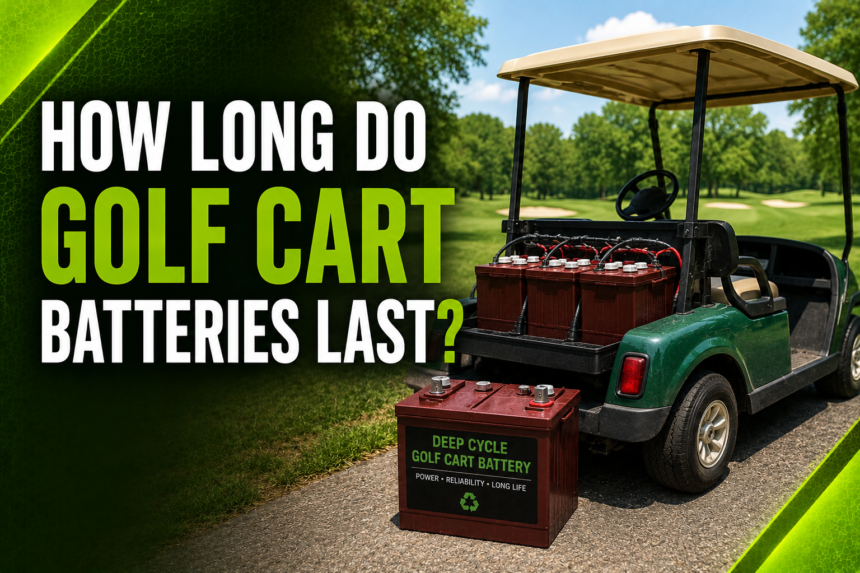
Most golf cart batteries last four to six years. Flooded lead-acid packs, the traditional six-volt batteries in rows under the seat, typically run four to six years with decent care. Sealed AGM packs go four to seven. Lithium packs run eight to twelve years and often longer.
- Lifespan by battery type
- Why cycles are the real unit
- What kills a lead-acid pack early
- Signs your pack is finished
- How to get the full life out of them
- Where lithium changes the arithmetic
- Conclusion
- Frequently asked questions
- How long do golf cart batteries last on average?
- Why did my golf cart batteries only last two years?
- Do I need to replace all my golf cart batteries at once?
- How often should I add water to golf cart batteries?
- Are lithium golf cart batteries worth it?
- Related Articles
Those numbers hide the thing that actually decides it, though. A golf cart battery does not wear out by the calendar. It wears out by the cycle, and how many cycles it gives you depends almost entirely on how flat you let it get before you plug it back in.
Lifespan by battery type
| Battery type | Typical life | Maintenance |
| Flooded lead-acid | 4 to 6 years | Water monthly, keep terminals clean, charge fully after use |
| AGM | 4 to 7 years | Sealed, no watering, still needs full charges |
| Gel | 4 to 6 years | Sealed, easily damaged by overcharging |
| Lithium (LiFePO4) | 8 to 12 years or more | Effectively none |
The ranges overlap because two identical packs in two identical carts routinely reach very different ages. A course fleet cart doing several rounds a day burns through its cycles in three or four years. The same batteries in a private cart used at weekends can still be going at eight.
Six volt, eight volt or twelve volt
The pack in your cart is built from several batteries wired in series to make 36 or 48 volts: typically six 6-volt batteries, six 8-volt, or four 12-volt. The choice affects life as well as range.
Six-volt golf cart batteries carry the thickest plates and generally give the longest cycle life, which is why they have been the default for decades. Eight and twelve volt versions fit more capacity into fewer boxes and give a cart more range or more power, but they do it with thinner plates, and they typically give up some cycle life in exchange. If longevity is what you care about, a six-volt pack is the conservative choice.
Why cycles are the real unit
Every charge and discharge is one cycle, and a lead-acid battery has a finite number of them in it. The important part is that the number is not fixed. It changes dramatically with how deeply you discharge.
Manufacturer cycle data for deep-cycle flooded batteries shows roughly this pattern:

- Take the pack down 20 percent before recharging and you can expect around 3,000 cycles
- Take it down 50 percent and you get around 1,200
- Take it down 80 percent and you get around 500
Read that again, because it is the whole answer. Running a pack flat every time costs you roughly six times the service life of running it gently, and the batteries themselves are identical. Trojan recommends staying between 20 and 50 percent discharge for exactly this reason, even though the batteries can physically handle 80.
Translate that into years and the picture snaps into focus. Discharging to 80 percent every day burns 500 cycles in under two years. Discharging to 20 percent on the same daily schedule stretches those cycles across eight. Same batteries, same cart, four times the life.
So the honest answer to how long golf cart batteries last is: as long as the way you use them allows.
What kills a lead-acid pack early
Running it flat. The single biggest factor, for the reason above. If your cart is regularly limping home, the pack is being asked for more than it should give and it is paying for that in cycles.
Leaving it sitting discharged. When a lead-acid battery sits in a partial state of charge, lead sulfate compounds form on the plates. That is sulfation, and past a certain point it is permanent. It is why a cart left half charged over a winter can come out of storage with a third of its range gone. Charge it fully after every use, not just when it feels low.
Letting the water get low. Flooded batteries lose water every charge, because gassing is part of how they recharge. If the level drops far enough to expose the plates to air, those plates corrode and that damage does not come back. Check monthly.
Heat. High temperatures accelerate ageing, self-discharge and water loss all at once. A pack living in a Florida garage works harder for its years than the same pack in Michigan, which is one reason identical batteries post such different numbers.
Mixing old with new. A pack runs in series, so every battery carries the same current. Put one new battery into a set of five four-year-olds and the new one is dragged down to the pace of the tired ones. If one has failed, the rest are usually not far behind. Replace the set.
Winter is when packs die, and here is why
Cold does not kill a healthy battery. Cold kills a discharged one, and the numbers are stark.
The electrolyte in a fully charged lead-acid battery does not freeze until roughly minus 92 Fahrenheit. At a 40 percent state of charge, that same electrolyte freezes at about 16 Fahrenheit, which is an ordinary winter night in most of the country. As a battery discharges, its electrolyte becomes more like plain water, and water freezes.
A frozen battery is usually a cracked battery. So the rule for storage is simple: fully charge the pack before you put the cart away, and top it back up during the layoff rather than leaving it to drift down over four months. Trojan’s battery watering guide covers the freezing thresholds and the correct watering sequence in more detail.
Signs your pack is finished
The cart tells you well before it stops.
Range goes first. A pack that used to do 30 miles starts doing 18, then 12. That is the clearest single measure, and it is worth noting your usual range while the pack is healthy so you have something to compare against.
Then comes the hill test. A tired pack sags badly under load, so climbs that were unremarkable start slowing the cart to walking pace. Charging time also changes: a worn pack either takes noticeably longer to charge or finishes suspiciously fast, both of which mean it is no longer holding what it used to.
Physical signs are worth a look too. Swollen or bulging cases, heavy white or blue corrosion on the terminals, and one battery that reads lower than the rest after a full charge all point to a pack near the end.
How to check rather than guess
Two measurements settle it, and neither needs a workshop.
The first is resting voltage. Charge the pack fully, then leave it completely alone for at least six hours, ideally overnight. A battery that has just been charged or just been driven will read misleadingly high or low, which is why the wait matters. Then measure each battery individually. They should read within about 0.05 volts of each other. One battery sitting noticeably below the rest has failed or is failing, and it is dragging the whole pack with it.
The second, for flooded batteries, is specific gravity. A cheap hydrometer draws electrolyte from each cell and reads its density. After a full charge, Trojan deep-cycle batteries should read about 1.285. Cells that come in well below that, or that vary a lot from one another within the same battery, indicate a battery that is done.
One caution. All of these symptoms also appear when a pack is simply undercharged or under-watered, so check water levels and give it a full overnight charge before you conclude the batteries are done. Plenty of packs get replaced a year early.
How to get the full life out of them
Nothing here is complicated, and together these habits are the difference between four years and eight.
- Charge fully after every use, even a short one. Partial charges leave sulfate behind.
- Do not run it flat. Plan routes so the pack comes home with plenty in reserve.
- Water flooded batteries after charging, never before. The level rises during charge, so topping up first causes overflow. Use distilled water only and fill to about an eighth of an inch below the vent well.
- Never let the plates go dry. If they are already exposed, add just enough water to cover them, charge fully, then top up properly.
- Keep the terminals clean and the connections tight.
- Store it charged. Fully charge before a layoff and check it monthly.
- Use the right charger for your chemistry. A lead-acid charger and a lithium pack are not compatible.
- Equalise flooded batteries occasionally. A controlled overcharge redistributes the electrolyte and reverses light sulfation. It is worth doing when specific gravity readings come back low after a full charge, and it applies to flooded batteries only.
- Add nothing but water. Additives and tonics do not work as advertised and will void most warranties.
Temperature is worth planning around too. Battery capacity falls by roughly one percent per degree Celsius below 20, so a cart that feels weak on a cold morning may be fine. Heat is the one that does lasting damage, and the engineering literature on lead-acid characteristics is consistent that high operating temperature increases the ageing rate directly.
Where lithium changes the arithmetic
Lithium iron phosphate packs run to thousands of cycles rather than hundreds, and they tolerate deep discharge instead of being punished for it. There is no watering, no equalising, no sulfation to worry about, and no penalty for leaving the pack partly charged.
The trade is upfront cost. A lithium pack costs considerably more than a set of flooded batteries, so the case rests on replacement counts rather than sticker price. Over the eight to twelve years a lithium pack is expected to serve, a lead-acid owner is likely buying two packs, possibly three if the cart works hard. That is where the money evens out, and it evens out faster for high-use carts than for a weekend runabout.
If your cart does a couple of gentle miles a week and lives in a mild climate, flooded lead-acid is still hard to beat on cost per year. If it works daily, gets run down hard, or lives somewhere hot, lithium generally wins.
Conclusion
Expect four to six years from a flooded lead-acid golf cart pack, four to seven from AGM, and eight to twelve or more from lithium. Depth of discharge matters more than any other single factor: gentle cycling can multiply the life of the same batteries several times over. Charge fully after every use, water flooded batteries after charging, never store the pack discharged, and replace the set rather than one battery.
Frequently asked questions
How long do golf cart batteries last on average?
Four to six years for flooded lead-acid, four to seven for AGM, and eight to twelve or more for lithium. Private carts used at weekends reach the top of those ranges. Fleet carts cycled several times a day often manage only three or four years.
Why did my golf cart batteries only last two years?
Almost always deep discharging, storage in a discharged state, or low water. Running a pack down 80 percent each time uses its cycles roughly six times faster than gentle cycling, and a pack left flat over winter can sulfate permanently.
Do I need to replace all my golf cart batteries at once?
Yes. The pack is wired in series, so one new battery is dragged down to the level of the tired ones around it. If one has failed after several years of service, the others are usually close behind. Replace the whole set.
How often should I add water to golf cart batteries?
Check monthly. Always water after a full charge, never before, because the level rises during charging and topping up first causes overflow. Use distilled water and fill to roughly an eighth of an inch below the bottom of the vent well.
Are lithium golf cart batteries worth it?
If the cart is used daily, run down hard, or kept somewhere hot, usually yes, because one lithium pack tends to outlast two or three lead-acid sets. For a lightly used cart in a mild climate, flooded lead-acid still costs less per year.
Related Articles
Honda Battery Warranty Guide 2026: Coverage, Terms & Claim Process
How Long to Trickle Charge a Car Battery? (Full Time Guide)
Can a Battery Be Too Dead to Jump? When a Jump Works and When It Won’t