


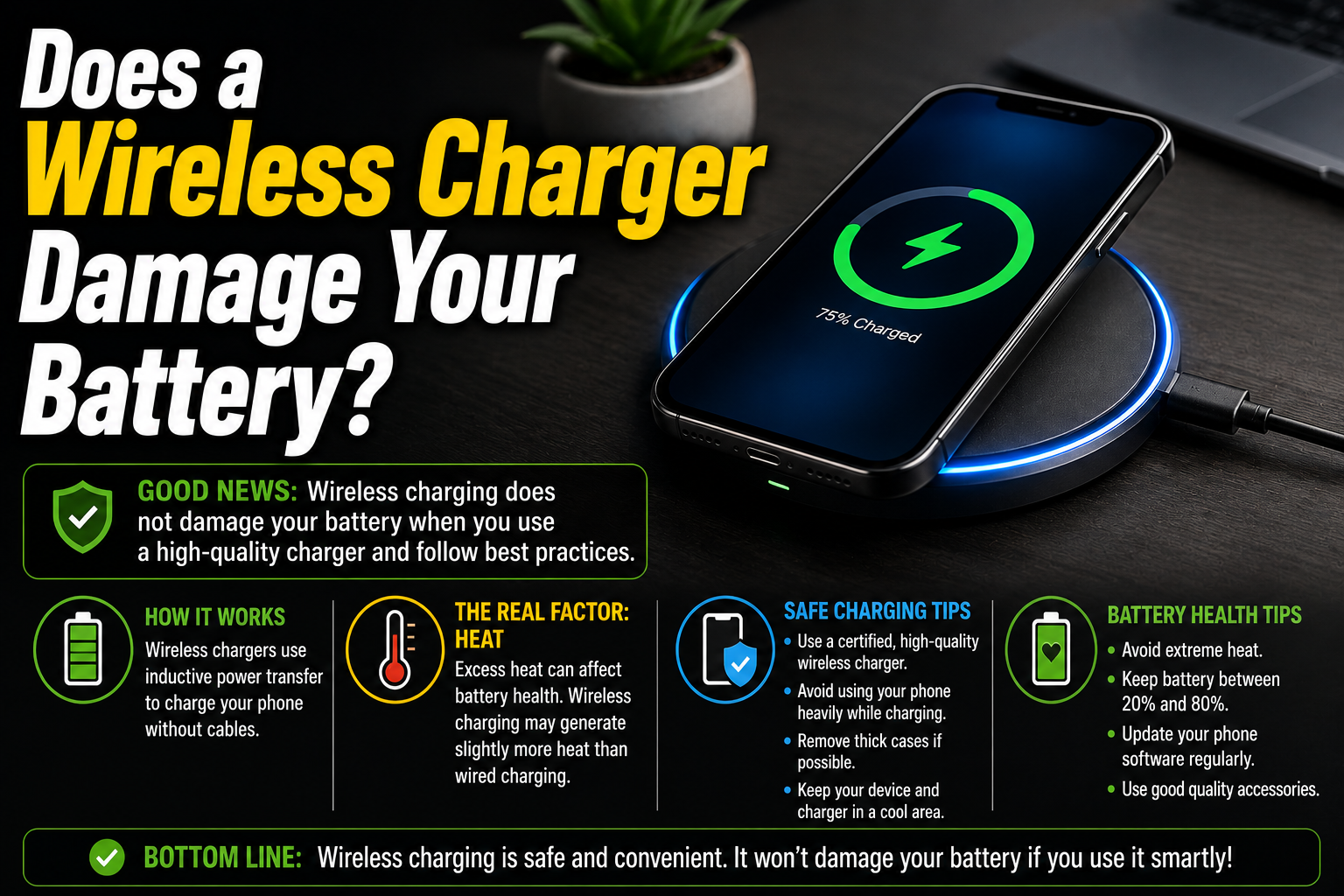
No, a wireless charger will not damage your phone’s battery. Dropping your phone on a pad instead of plugging in a cable does not wear the battery out faster on its own. Certified wireless chargers are built with safety limits that keep the process gentle.
- What actually wears a phone battery?
- How does wireless charging work, and where does the heat come from?
- Wired vs wireless: how do they really compare?
- When is wireless charging worth skipping?
- How do you charge wirelessly without hurting your battery?
- Conclusion
- Frequently asked questions
- Related Articles
The worry is not baseless, though. Wireless charging does run a little warmer than a cable, and heat is the one thing that genuinely ages a battery. So the honest answer is that the method is fine, but a couple of habits around it are worth getting right. Here is what actually matters.
What actually wears a phone battery?
Your phone runs on a lithium-ion battery, and these batteries wear out slowly no matter what you do. After a few years, any phone holds less charge than it did on day one. Two things speed that up, and neither is the shape of your charger.
Heat is the big one. A battery kept warm ages much faster than a cool one. A battery sitting at around 45°C can lose capacity more than twice as fast as the same battery kept near 25°C. That is why a hot car dashboard is one of the worst places to leave a phone.
A high charge level is the other. Sitting at 100% for hours puts more strain on the cells than sitting around the middle. This is why so many phones now offer a setting to pause charging at 80%. The sweet spot for daily use is roughly 20% to 80%, staying out of both extremes.
Charge cycles matter too, but less than people think. One cycle means using 100% of the battery’s capacity, and it does not matter whether that happens in one long charge or several small top-ups. A typical phone battery is rated to keep about 80% of its capacity after roughly 500 full cycles, which is years of normal use. Crucially, the charging method does not change how many cycles you use.
There is even a small twist here that works in your favor. Two shallow charges, say from 30% to 80% twice, are gentler on the battery than one deep charge from empty to full, even though both add up to the same single cycle of energy. So topping up throughout the day, which is exactly how most people use a wireless pad, is not a bad habit at all. It is often kinder to the battery than draining it flat and doing one big overnight charge.

The takeaway: heat and time spent at 100% wear a battery, not whether you used a cable or a pad.
How does wireless charging work, and where does the heat come from?
Wireless charging uses two coils of copper wire, one in the pad and one in your phone. When you set the phone down, the pad’s coil creates a magnetic field, and that field induces a current in the phone’s coil, which charges the battery. There is no direct electrical connection, just an invisible handshake between the two coils.
That handshake is not perfectly efficient. Some of the energy turns into heat rather than charge, both in the pad and in the back of the phone. This is why a phone often feels warmer on a pad than on a cable, and it is the root of the whole worry.
Modern chargers handle this better than they used to. A Qi-certified charger is required to watch its own temperature and slow down the moment things get too warm. The battery is also separated from the charging coils by a layer of thermal insulation, so the heat you feel on the glass is not landing directly on the cells. Newer standards like Qi2 add magnets that snap the phone into perfect alignment, which cuts wasted energy and keeps the heat down further. Poor alignment on an old pad is one of the main reasons a phone cooks itself while charging slowly.
The heat only becomes a real problem when it has nowhere to go. A phone charging inside a thick case, on a soft bed, or in direct sun traps that warmth against the battery, and that is when slow damage adds up.
To put numbers on it, a battery repeatedly charged in hot conditions can reach that worn-out 80% capacity point in far fewer cycles than one kept cool. The same 500-cycle battery might feel tired much sooner if it spends its life warm and full. That is not a wireless-charging problem specifically, but a warm pad in a bad spot can nudge you toward the worse end of that range, which is the whole reason the setup around the pad matters more than the pad itself.
Wired vs wireless: how do they really compare?
Line the two up against the things that actually age a battery, and the picture gets clear. The method barely matters; the conditions around it do.
| What actually wears the battery | Wired charging | Wireless charging |
| Heat during charging | Lower | Higher |
| Charge cycles used | Same | Same |
| Time spent sitting at 100% | Depends on habits | Often longer (left on the pad) |
| Wear on the charging port | Some over years | None |
Wireless charging loses on heat and often on time-at-100%, because a phone left on a nightstand pad tends to sit at full charge all night. It wins on port wear, since you never plug anything in. For most people the differences are small enough that convenience can win, as long as you manage the heat.
Two other differences are worth knowing. Wireless charging is usually slower than a good cable, and that slower pace actually generates less of a heat spike than the very fastest wired charging does. It is also less efficient overall, meaning more of the wall’s energy is lost as heat rather than stored in the battery, so wireless costs a little more on your power bill over time. Neither of these hurts the battery in a way you would notice; they are trade-offs for the convenience, not hidden dangers.
When is wireless charging worth skipping?
Wireless charging is fine for everyday use, but a few situations tip the balance toward a cable.
- When the phone is already hot. If the device feels warm from gaming or a hot day, plugging in adds less heat than a pad does.
- Through a thick or metal case. Bulky cases block the energy transfer and force the pad to work harder, which makes more heat and slower charging. Metal cases can stop it working at all.
- In a hot car or direct sunlight. High heat plus a high charge level is the worst combination for a battery. A car mount in summer sun is exactly that.
- When you need speed. A cable is usually faster. If you are rushing out the door, plug in and skip the pad.
None of these mean wireless charging is dangerous. They just mean a cable is the smarter pick in those moments.
How do you charge wirelessly without hurting your battery?
You can use a pad every day and keep your battery healthy for years. It comes down to managing heat and avoiding long stretches at full charge. None of this requires effort or expense, just a few small choices.
- Use a certified charger. Stick to Qi-certified pads from known brands. They regulate heat and power properly, while cheap uncertified pads often skip those safeguards and run hot.
- Take off bulky cases. Charge with a thin case or none at all so heat can escape and the coils line up well.
- Keep it cool and in the open. Charge on a hard, open surface with airflow, not on a bed, under a pillow, or in the sun. A cool phone is a happy battery.
- Turn on the charge-limit feature. Most phones can pause charging at 80% or delay the final top-up until just before you wake. This is the single biggest thing you can do to reduce wear.
- Do not leave it on the pad for days. A night on the pad is fine. Leaving it there full for days on end keeps it at 100% longer than it needs to be.
These habits line up with what phone makers themselves recommend. For the official version, Apple’s battery guidance walks through the same points on heat, charge level, and the built-in features that protect your battery.
Conclusion
A wireless charger does not damage your battery. What ages any battery is heat and long spells at 100%, and a pad only nudges those slightly. Use a certified charger, ditch the thick case, keep the phone cool and in the open, and turn on your phone’s charge-limit setting. Do that and you get the convenience of dropping your phone on a pad with no real cost to how long the battery lasts.
Frequently asked questions
Is it OK to leave my phone on a wireless charger overnight? Yes. Modern phones stop charging at 100%, so a night on the pad is fine. Turn on the charge-limit or optimized-charging setting to reduce wear even further.
Does wireless charging make my phone battery drain faster? No. It does not affect how fast the battery drains during use. It only charges the battery; day-to-day battery life depends on your apps and screen, not the charging method.
Why does my phone get warm on a wireless charger? Some energy turns into heat as it passes between the coils, especially if the phone is misaligned or in a thick case. A certified pad slows down when it senses too much heat.
Is wireless charging worse for the battery than a cable? Only slightly, and only because it runs a bit warmer. Manage the heat and the difference is small enough not to worry about for everyday use.
Do I need an expensive wireless charger? Not expensive, but certified. A Qi-certified pad from a reputable brand handles heat and power safely. Bargain uncertified pads are the ones that can run hot and stress the battery.
Related Articles
Does Sentry Mode Drain Battery? What Tesla Owners Should Expect
Do Batteries Go Out of Date? What the Date Means
Do All Solar Lights Have Batteries?
How to Connect Two Batteries in Parallel: A Step-by-Step Guide