



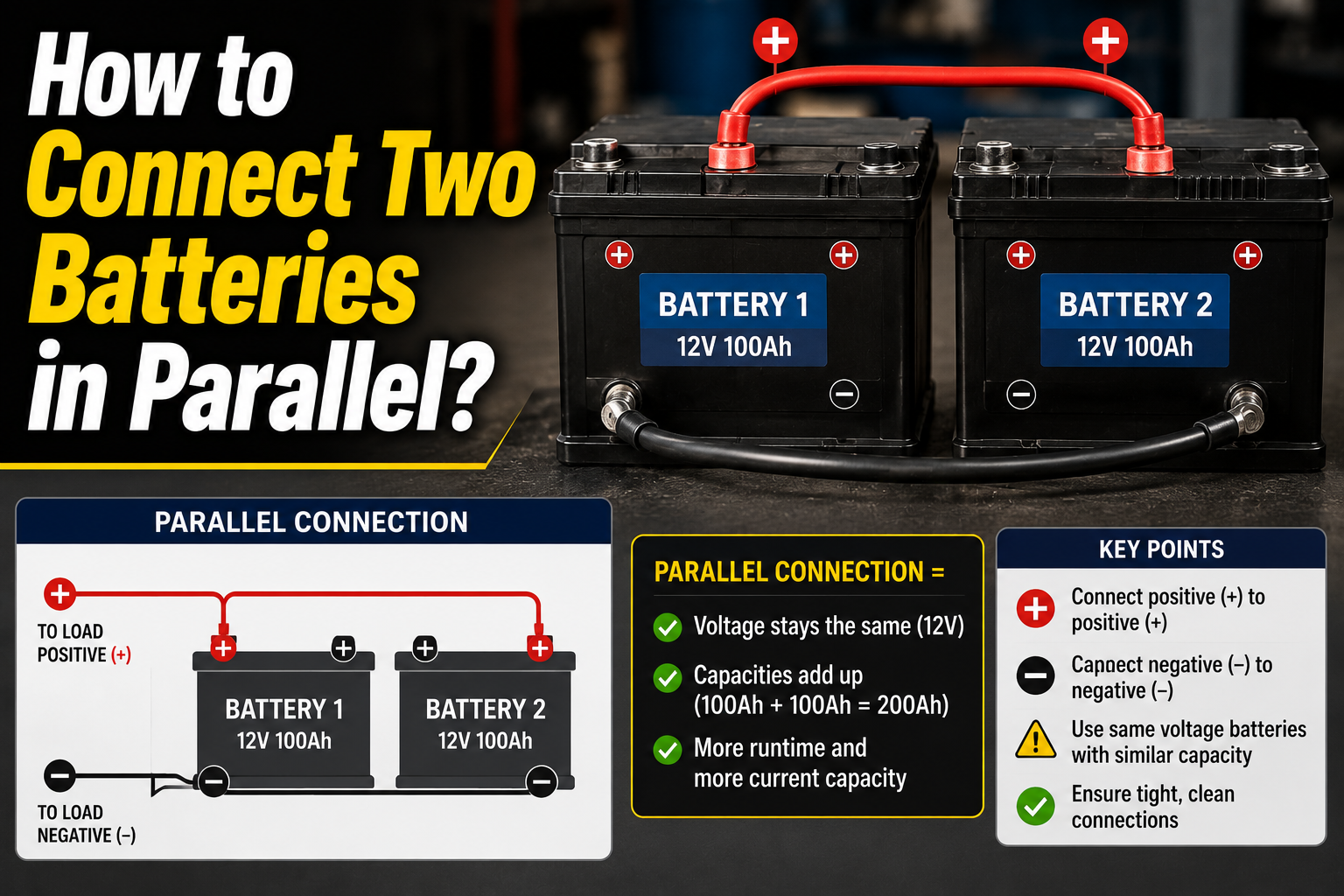
To connect two batteries in parallel, join the two positive terminals together with one cable and the two negative terminals together with another.
- What parallel wiring actually does
- Parallel vs series: which one do you want?
- Before you start: match your batteries
- What you need
- How to connect two batteries in parallel, step by step
- Why diagonal wiring matters
- Fusing and wire size: the safety part
- Common mistakes to avoid
- Conclusion
- Frequently asked questions
- Related Articles
That is the whole idea: positive to positive, negative to negative. Doing this keeps the voltage the same and doubles the capacity, so two 12V 100Ah batteries become a 12V 200Ah bank that runs your gear about twice as long.
The catch is getting the details right, because the batteries need to be matched, the load should be drawn diagonally, and each battery needs a fuse. Here is how to do it safely.
What parallel wiring actually does
Wiring in parallel adds capacity while keeping voltage flat. Voltage is like water pressure and capacity is like the size of the tank. Parallel connection makes the tank bigger without changing the pressure, so your 12V system stays 12V but holds more energy.
The numbers are simple. Two 12V 100Ah batteries in parallel give you 12V and 200Ah. The amp-hours add together, the voltage does not. That extra capacity is why people wire batteries in parallel for RVs, vans, boats, and off-grid solar setups: they want more hours of runtime at the same voltage their inverter and appliances already use.
Current output goes up too. Because both batteries share the load, the bank can deliver more amps at once than a single battery could, which helps when you run a big inverter or several loads together.
Parallel vs series: which one do you want?
Before you wire anything, make sure parallel is the connection you actually need. Series and parallel do opposite things, and mixing them up is a common and costly mistake.

| What changes | Parallel (positive to positive) | Series (positive to negative) |
| Voltage | Stays the same (12V + 12V = 12V) | Adds up (12V + 12V = 24V) |
| Capacity (amp-hours) | Adds up (100Ah + 100Ah = 200Ah) | Stays the same (100Ah) |
| Runtime | Longer at the same voltage | Same runtime, higher voltage |
| Use it for | More runtime on a 12V system | Higher-voltage systems (24V, 48V) |
The rule is easy to remember. Parallel gives you more runtime at the same voltage. Series gives you more voltage at the same runtime. If your inverter and appliances run on 12V and you just want them to last longer, parallel is your answer. If you are building a 24V or 48V system, you need series, or a mix of both.
Before you start: match your batteries
Parallel batteries have to be evenly matched, and this is the step beginners skip most. When two batteries are joined positive to positive, they become one shared pool of power. If they are not alike, the stronger one constantly tries to charge the weaker one, which wastes energy and wears both out faster.
Match these four things before you connect anything:
- Voltage. Both batteries must be the same nominal voltage, so 12V with 12V. Never mix voltages in parallel.
- Chemistry and type. Pair lead-acid with lead-acid, or lithium with lithium. Do not mix a flooded battery with an AGM, or either with lithium.
- Capacity, age, and brand. Use the same amp-hour rating, ideally the same model from a similar age. An old battery paired with a new one drags the new one down.
- State of charge. Charge both fully and get their resting voltages very close, within about 0.05 volts, before you join them. This matters most for lithium, where connecting two packs at very different voltages can cause a large, dangerous inrush of current.
Safety first: connecting two lithium batteries at very different states of charge can produce a big spark and damage the battery management system. Always balance them to nearly the same voltage before wiring them together.
What you need
This is a short job with the right parts on hand. Gather these before you begin:
- Two matched batteries, both fully charged.
- Two battery interconnect cables of the same gauge and the same length, one for the positive link and one for the negative.
- A fuse or circuit breaker for each battery’s positive cable, sized for your system.
- A wrench or socket set to fit the terminals, ideally a torque wrench so you can tighten to the maker’s spec.
- Insulated gloves and eye protection.
- A wire brush to clean the terminals and a multimeter to check voltages.
How to connect two batteries in parallel, step by step
Work slowly, keep metal tools away from bridging both terminals at once, and follow this order. It applies to a simple two-battery 12V bank.
- Charge and check both batteries. Fully charge each one, then measure the resting voltage of both with a multimeter. Get them within about 0.05 volts of each other before you go further.
- Disconnect everything and set the batteries side by side. Make sure no charger or load is connected. Place the batteries close together with the terminals facing the same way, and clean each post with a wire brush.
- Connect the two positive terminals. Run one cable from the positive terminal of Battery A to the positive terminal of Battery B. Tighten it firmly.
- Connect the two negative terminals. Run the matching cable from the negative terminal of Battery A to the negative terminal of Battery B. Your two batteries are now wired in parallel.
- Take your load and charging leads diagonally. Connect your system’s positive lead to the free positive post on one battery, and your system’s negative lead to the free negative post on the other battery. This is the part that keeps both batteries working equally, and the next section explains why.
- Add the fuses. Fit an inline fuse or breaker on each battery’s positive cable, as close to the battery as you can. This is not optional on a real install.
- Check your work. Measure the voltage across the bank. It should read the same as a single battery, around 12.6 to 13 volts for a charged 12V bank. Confirm every connection is tight, then reconnect your system.
Because parallel wiring does not change voltage, a multimeter cannot confirm the connection worked the way it can with a series bank. A steady single-battery voltage reading and tight, correct terminals are your confirmation.
Why diagonal wiring matters
Diagonal wiring is the difference between a bank that ages evenly and one that kills a battery early. It means taking your main positive from one battery and your main negative from the other, so the current has to travel through both batteries by an equal path.
Here is the problem it solves. If you connect both your load’s positive and negative to the same battery, that battery does most of the work and the other one loafs. The hard-working battery discharges deeper and wears out sooner, while the lazy one never pulls its weight. Over time the bank falls out of balance and its life drops.
By pulling power from opposite corners, you make the electrical path through each battery the same length, so they share the load and charge evenly. This trick is sometimes called distributed or diagonal draw, and for a two-battery bank it does the balancing job without any extra parts. For three or more batteries, most people move up to a set of busbars with equal-length cables to keep the same balance.
Fusing and wire size: the safety part
A parallel bank stores a lot of energy and can dump a huge amount of current in a fault, so protection is not a nice-to-have. Two things keep it safe: the right fuses and cables that are thick enough.
Fuse each battery. Put a fuse or breaker on the positive cable of every battery, mounted close to the terminal. The reason is important: if one battery’s cable shorts out, the other battery would pour uncontrolled current into that short. An individual fuse cuts that off. Marine wiring standards make this a rule, requiring overcurrent protection within seven inches of each battery’s positive terminal.
Add a main fuse too. On top of the per-battery fuses, a main fuse or breaker protects the cable running from the bank to your inverter or load. Size it to your inverter’s maximum current draw plus roughly a 25 percent margin.
Use cable that is thick enough. Undersized wire runs hot and wastes power, and it defeats the point of adding capacity. Match the interconnect cables to the current your system will pull, keep both the same gauge and length, and aim to keep voltage drop small. A wire size guide from Blue Sea Systems makes it easy to pick the right size for your load and cable length.
Common mistakes to avoid
Most parallel-bank failures trace back to a handful of avoidable errors. Watch for these:
- Mixing batteries. Different ages, brands, capacities, or chemistries throw the bank out of balance. Match them.
- Skipping the balance step. Joining two batteries at very different states of charge, especially lithium, risks a big spark and damage. Charge both first.
- Drawing power from one battery. Taking both leads off the same battery overworks it. Go diagonal.
- No fuses. Leaving out per-battery protection turns a single fault into a fire risk.
- Loose or dirty terminals. A loose nut creates a hot, high-resistance spot that unbalances the bank. Clean the posts and torque to spec.
- Thin or mismatched cables. Different cable lengths or gauges create uneven resistance, so one battery works harder. Keep them identical.
Conclusion
Connecting two batteries in parallel comes down to positive to positive, negative to negative, which keeps voltage the same and doubles your capacity. To do it well, match the two batteries closely, charge them both first, pull your load and charge leads diagonally so they wear evenly, and fuse each battery’s positive cable with cable that is sized for the current. Get those details right and you have a bigger, longer-lasting power bank that runs your 12V gear about twice as long, safely.
Frequently asked questions
Does connecting batteries in parallel increase voltage? No. Parallel keeps the voltage the same and increases capacity. Two 12V batteries in parallel stay 12V but the amp-hours add up. To increase voltage, wire the batteries in series instead.
Can I connect two batteries of different sizes in parallel? It is not recommended. Different capacities, ages, or brands cause the batteries to charge and discharge unevenly, which wastes energy and shortens the life of both. Use two matched batteries for the best result.
Do I need a fuse between two parallel batteries? Yes, for any real install. Put a fuse on each battery’s positive cable close to the terminal, plus a main fuse to the load. If one cable shorts, the fuse stops the other battery from feeding the fault.
How do I know the parallel connection worked? Measure the bank voltage; it should read the same as one battery, around 12.6 to 13 volts when charged. Since voltage does not change in parallel, a correct single-battery reading plus tight, proper connections is your confirmation.
Can I mix lithium and lead-acid batteries in parallel? No. They charge at different voltages and behave differently, so pairing them damages both and can be unsafe. Keep chemistries the same: lithium with lithium, lead-acid with lead-acid.
Related Articles
How to Check a Battery’s Manufacturing Date?
Can Lithium Batteries Freeze? What Cold Really Does
Can an Alternator Kill a Battery?