



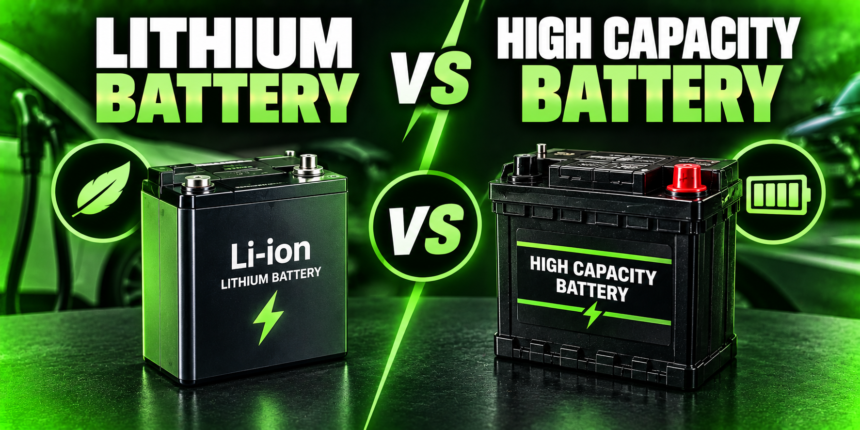
Neither one is simply better, because the two words describe different things. Lithium is a type of battery chemistry. High capacity describes how much energy a battery holds, no matter what it is made of. A battery can be lithium and high capacity at the same time. So the real question is one of two things: are you choosing between a bigger battery and a smaller one of the same kind, or between lithium and an older chemistry that happens to be sold as a high-capacity option? For most modern uses, lithium is the stronger pick, and the rest of this guide shows why and when.
- Why the question is a bit of a trick
- What “high capacity” actually means
- What “lithium” actually means
- The comparison people really want
- Side-by-side
- Is bigger always better?
- How to choose for your situation
- Conclusion
- Frequently asked questions
- Is a lithium battery the same as a high capacity battery?
- Does a higher capacity battery mean it is better?
- Why is lithium better than lead-acid for most uses?
- When is a lead-acid battery still the better choice?
- How do I know what capacity I need?
- Related Articles
Once you split the question that way, the answer gets easy to reason about. The sections below explain what each term means, put lithium head to head with the older batteries usually labeled high capacity, and give you a simple way to decide for your own setup.
Why the question is a bit of a trick
Capacity and chemistry live on different tracks. Capacity is how much energy is stored, measured in amp-hours (Ah) or, more usefully, watt-hours (Wh). Chemistry is what is inside, such as lithium, lead-acid, or nickel-based. Asking whether lithium or high capacity is better is a little like asking whether a car is better than a fast car. One describes the kind of thing; the other describes a quality it can have.
In practice, when a product is marketed as a high-capacity battery, it usually means one of three things: a physically bigger pack with more cells, a chemistry with high energy density (often lithium), or simply a marketing label slapped on a lead-acid or nickel battery. Knowing which one you are looking at is the whole game.
Quick way to cut through it: ignore the labels and look at two numbers, the watt-hours (how much energy) and the chemistry (what it is made of). Those two facts tell you almost everything the marketing does not.
What “high capacity” actually means
A high-capacity battery simply stores more energy than a standard one, so a device or system runs longer before it needs a recharge. That is genuinely useful for things like electric vehicles, solar storage, and gear that has to run all day.
The trade-off is size and weight. More stored energy usually means a bigger, heavier battery, and not every device is built to take one. There is a second catch too: a higher number on the label does not automatically mean better for you. The right capacity depends on how much energy your devices actually draw. Buying far more than you need adds cost, weight, and bulk with no real payoff.
One tip that saves confusion: compare batteries in watt-hours, not amp-hours. Amp-hours only tell the full story at the same voltage, and a 100Ah battery at 12 volts holds very different energy from a 100Ah battery at 24 volts. Watt-hours (volts multiplied by amp-hours) put every battery on the same scale, so you can compare a small pack and a large one honestly. Most quality batteries list this figure, and it is the single most useful number on the label.
What “lithium” actually means
Lithium refers to a family of chemistries, not a single battery. The two you will meet most often are lithium-ion (Li-ion), common in phones, laptops, power tools, drones, and many electric cars, and lithium iron phosphate (LiFePO4 or LFP), common in solar storage, RVs, and marine setups where long life and safety matter most.
What they share is high energy density, which means a lot of energy packed into a small, light package. They also last for many charge cycles and hold their charge well when idle. The main strings attached: lithium costs more up front, and it needs a battery management system (a small circuit that keeps the cells balanced and safe). Some chemistries, LFP in particular, are more thermally stable than others.
The comparison people really want
Most people asking this question are really weighing lithium against an older, cheaper chemistry that is being sold as high capacity, and in the vast majority of cases that means lead-acid. This is the comparison worth spelling out, because the differences are large and easy to measure.
Lithium stores far more energy for its weight. A typical lithium battery holds around 150 to 250 watt-hours per kilogram, while a lead-acid battery holds only about 30 to 50. That is roughly four to five times more energy for the same weight. If you want the raw specs, the Wikipedia entry for lead-acid batteries lists their energy density at the low end of that range, which is why lead-acid packs are such heavy bricks.
Lithium also lasts far longer. A lead-acid battery typically handles 300 to 500 charge cycles, while lithium chemistries run into the thousands, often 2,000 to 5,000 or more depending on the type. And there is a hidden gap in usable energy: you can safely draw around 85 percent or more from a lithium battery each cycle, but a lead-acid battery should not go below about half its rated capacity, or it wears out much faster. So a 100Ah lead-acid battery really only gives you about 50Ah of everyday use, while a 100Ah lithium battery gives you 85Ah or more.
Lead-acid keeps two advantages: it is cheaper to buy, and it is a simple, proven technology that tolerates rough treatment. Lithium costs more at the checkout, but because it lasts many times longer and gives you more usable energy per charge, it often works out cheaper over the life of a heavy-use system.
A rough example makes this concrete. Say a lead-acid battery lasts around 400 cycles and a comparable lithium battery lasts 3,000. If you cycle the battery most days, the lead-acid one might need replacing several times over the years it takes the lithium one to wear out. Even when lithium costs two to three times as much up front, replacing the cheaper battery again and again can cost more in the end, before you even count the extra usable energy lithium gives you each cycle. For a battery that sits mostly idle, though, that math flips, and the cheaper option holds up fine.
Side-by-side
Here is the short version of how the two stack up. The numbers are typical ranges, not exact figures, since they vary by design and quality.
| What you compare | Lithium (Li-ion / LiFePO4) | Lead-acid (often sold as “high capacity”) |
| Energy for its weight | About 150 to 250 Wh per kg | About 30 to 50 Wh per kg |
| Charge cycles | Roughly 2,000 to 5,000+ | Roughly 300 to 500 |
| Usable share of capacity | Around 85% or more per charge | About 50% before it wears faster |
| Upfront price | Higher to buy | Cheaper to buy |
| Weight and size | Light and compact | Heavy and bulky |
| Care needed | A battery management system, little upkeep | Simple, but some types need topping up |
Is bigger always better?
If instead you are comparing two batteries of the same chemistry, one standard and one high capacity, then more capacity means more runtime, plain and simple. A higher-capacity pack runs your device longer and can often handle more cycles before it fades. For an EV or an off-grid solar bank, that extra headroom is exactly what you want.
But bigger is not free. Higher-capacity batteries are larger and heavier, they cost more, and your device has to be designed to accept them. Some gear is built for a specific size and will not take an oversized pack. The smart move is to match the capacity to your real energy needs, with a little margin, rather than chasing the biggest number on the shelf.
Rule of thumb: size the capacity to your daily energy use plus a modest buffer. Pick the chemistry, usually lithium, based on how often you cycle it and how much weight and space you can spare.
How to choose for your situation
Start with what you are powering and how hard you use it. A few simple guidelines cover most cases:
- Frequent charging and discharging (solar, RV, daily tool use): lithium almost always wins, because it survives far more cycles and gives more usable energy each time.
- Tight on weight or space (boats, portable power, vehicles): lithium is the clear choice for the same energy in a lighter, smaller package.
- Lowest possible upfront cost, light or occasional use (a backup that rarely cycles): lead-acid can still make sense, since its price advantage is not eaten up by wear.
- Long service life matters most: lithium, especially LiFePO4, lasts years longer and is worth the higher starting price.
Then set the capacity. Add up the energy your devices use in a typical day, in watt-hours, and choose a battery that covers that with a sensible buffer. Check the voltage matches your system and that you have the physical space for it. Getting the chemistry and the capacity right together is what gives you a battery that actually fits your needs, rather than one that just has an impressive label.
Conclusion
Lithium versus high capacity is not a real either-or, because lithium is a chemistry and high capacity is a size, and a single battery can be both. The choice that matters is between lithium and older chemistries like lead-acid, and there lithium usually wins on weight, lifespan, and usable energy, while costing more up front. Pick the capacity that matches your daily energy needs, then choose lithium for anything you cycle often or need to keep light. A good result is a battery that fits both your workload and your space, not just the biggest number available.
Frequently asked questions
Is a lithium battery the same as a high capacity battery?
No. Lithium describes the chemistry, while high capacity describes how much energy the battery stores. A battery can be both at once. To compare fairly, look at the watt-hours for capacity and the chemistry for everything else.
Does a higher capacity battery mean it is better?
Not on its own. More capacity means more runtime, but also more size, weight, and cost. The best capacity is the one that matches your daily energy use, with a small buffer, not simply the largest number you can find.
Why is lithium better than lead-acid for most uses?
Lithium stores four to five times more energy for its weight, lasts thousands of cycles instead of hundreds, and lets you use around 85 percent of its capacity per charge. It costs more up front but usually less over a heavy-use lifetime.
When is a lead-acid battery still the better choice?
Lead-acid makes sense when upfront cost matters most and the battery rarely cycles, such as an occasional backup. Its low price is not eaten up by wear in light-use cases, and it tolerates rough handling well.
How do I know what capacity I need?
Add up the watt-hours your devices use in a typical day, then choose a battery that covers that with a modest margin. Check that the voltage suits your system and that you have room for the battery’s size and weight.
Related Articles
How to Make an Electromagnet’s Battery Stronger?
Why Is My Phone Battery Draining While Charging? Causes and Fixes