


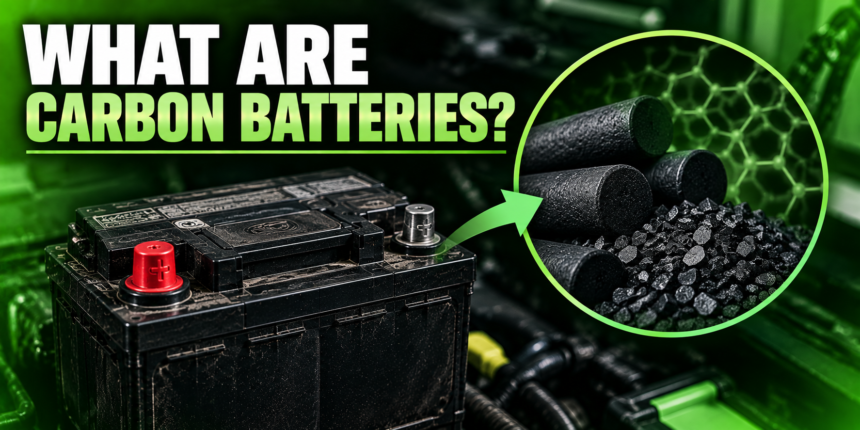
A carbon battery, in everyday use, means a zinc-carbon battery, the oldest and cheapest kind of disposable battery. It is the basic 1.5-volt cell you find in inexpensive AA and AAA packs, built around a zinc outer case, a carbon rod down the middle, and a paste of manganese dioxide and other chemicals.
- What a carbon (zinc-carbon) battery is made of
- How it works?
- A quick bit of history
- Carbon vs alkaline: which is better?
- Strengths, weaknesses, and where they are used
- A different ‘carbon battery’: dual-carbon
- Conclusion
- Frequently asked questions
- Are carbon batteries the same as zinc-carbon batteries?
- Are carbon batteries better than alkaline?
- Can I use a carbon battery in place of an alkaline one?
- Why do carbon batteries leak?
- What devices should use carbon batteries?
- Related Articles
The ‘carbon’ in the name comes from that central carbon rod. These batteries are single-use, low-cost, and best suited to gentle, low-power devices like wall clocks and TV remotes. They are not as long-lasting as alkaline batteries, which is the main trade-off. Here is a plain-English look at what they are, how they work, and when they make sense.
It is worth clearing up one point right away, because it causes confusion. Most of the time ‘carbon battery’ means the zinc-carbon dry cell above. There is also a newer, unrelated technology called a dual-carbon battery, which is a different thing entirely and rare outside research. This guide focuses on the common meaning first, then explains the difference near the end so you are not left wondering.
What a carbon (zinc-carbon) battery is made of
A zinc-carbon battery is simple, which is part of why it is so cheap. It has just a few parts working together:
- A zinc case, which forms the outer shell and acts as the negative terminal (the anode).
- A carbon rod down the center, which collects current and connects to the positive terminal. This is where the ‘carbon’ name comes from; the rod itself is not the main active ingredient.
- A paste of manganese dioxide mixed with carbon powder, packed around the rod, which is the positive side (the cathode).
- An electrolyte paste, usually ammonium chloride or zinc chloride, that lets the chemistry flow.
- A paper separator and a seal, keeping the parts apart and the paste inside.
Notice that the zinc does double duty as both the container and one of the electrodes. That clever, no-frills design keeps the cost down and is a big reason zinc-carbon batteries have stayed cheap for over a century.
How it works?
Like any battery, a zinc-carbon cell makes electricity through a chemical reaction between its two electrodes. The zinc case slowly reacts and gives up electrons, while the manganese dioxide on the other side takes them in, and that flow of electrons through your device is the current that powers it. The carbon rod’s job is mostly to carry that current out to the terminal, not to react itself. If you want the full chemistry, the overview at ScienceDirect lays out the exact reactions.
A fresh zinc-carbon cell puts out about 1.5 volts, the same nominal voltage as an alkaline AA, which is why the two are interchangeable in most devices. The catch is what happens under load: as a zinc-carbon battery works, its voltage sags fairly quickly and its zinc case gradually corrodes. That is why these batteries fade faster and, once spent, are more likely to leak than alkaline cells.
There is a practical wrinkle worth knowing. Zinc-carbon batteries do better with rest than with constant use. If you drain one steadily, its voltage drops off noticeably, but if you let it rest between bursts, some of its strength returns, which is why it copes fine with a remote you press now and then but poorly with a device left running.
You may also see ‘heavy-duty’ or ‘super heavy-duty’ labels on these batteries, which usually means a zinc chloride version of the same chemistry. It performs a bit better and leaks less than the basic ammonium chloride type, but it is still a zinc-carbon battery at heart and still well behind alkaline in capacity.
The name in one line: the ‘carbon’ refers to the central carbon rod that carries current. The real chemistry is zinc reacting against manganese dioxide, which is why it is properly called a zinc-carbon battery.
A quick bit of history
Carbon batteries are the direct descendants of the very first practical dry cell. The basic zinc-and-carbon design goes back to Georges Leclanche, who patented his cell in the 1860s, which is why zinc-carbon batteries are sometimes still called Leclanche cells. His early version used a liquid electrolyte, so it could spill.
The leap to the battery we know came a couple of decades later, when Carl Gassner worked out how to turn the electrolyte into a paste, creating a sealed, no-spill ‘dry’ cell that could be carried around and stored. That innovation launched the modern battery industry, and the zinc-carbon cell served as the basis for consumer batteries for much of the next century. Even today, with better chemistries available, its low cost keeps it in production worldwide.
Interestingly, most of the real improvements to zinc-carbon technology happened decades ago, roughly between the 1940s and 1960s, before alkaline batteries became widely available. Since then, the chemistry has changed little, and much of the engineering effort has gone into reducing corrosion and phasing out toxic additives like mercury rather than boosting performance.
That is why zinc-carbon remains a mature, low-cost commodity: it is a solved, cheap technology that fills a price niche, especially in regions and applications where keeping the upfront cost as low as possible matters more than squeezing out extra runtime.
Carbon vs alkaline: which is better?
This is the comparison most people actually want, since zinc-carbon and alkaline are the two common disposable batteries and look almost identical on the shelf. In most technical respects, alkaline wins, but zinc-carbon still has a niche. Here is how they stack up:
| Feature | Zinc-carbon (carbon) battery | Alkaline battery |
| Cost | Cheapest to buy | More expensive |
| Capacity / lifespan | Short; fades quickly under load | Much longer; up to several times more |
| High-drain devices | Struggles; drains fast | Handles them well |
| Shelf life | Shorter | Longer |
| Leak resistance | More prone to leaking when spent | Better sealed, leaks less |
| Best for | Low-drain items: clocks, remotes | Cameras, game controllers, toys |
The short answer: alkaline is the better performer, delivering far more capacity, especially in devices that draw a lot of power, along with a longer shelf life and better leak resistance. Zinc-carbon’s one real advantage is price. For a low-drain gadget you rarely think about, or for buying in bulk for one-time use, the cheaper carbon battery can make sense. For anything you use often or that demands steady power, alkaline is usually worth the extra cost.
Strengths, weaknesses, and where they are used
Zinc-carbon batteries earn their place through cost and simplicity, not performance. Their strengths are worth knowing:
- Very low cost, which makes them attractive for bulk buying and throwaway use.
- Simple, proven, and widely available, having been made for well over a hundred years.
- Fine for intermittent, low-power jobs where you do not need much current at once.
Their weaknesses are the flip side of that low price:
- Low capacity, so they run down quickly, particularly in demanding devices.
- A tendency to leak once they are drained, which can damage the device they are in.
- A shorter shelf life and a voltage that drops off faster as they discharge.
Because of this, zinc-carbon batteries are best matched to low-drain devices: wall clocks, simple remote controls, small flashlights, and basic toys. It is smart to take them out of a device you are storing for a while, since a forgotten, leaking cell can ruin the contacts. For a camera, a game controller, or anything power-hungry, reach for alkaline or a rechargeable instead.
A couple of practical habits make them work well. When you buy them, check that the packaging is not old, since a shorter shelf life means a cheap battery that has sat on a shelf for years may already be partly drained. Avoid mixing old and new cells, or carbon and alkaline cells, in the same device, because the weaker one gets dragged down and the odds of leaking go up.
When a carbon battery is spent, dispose of it responsibly through household battery recycling where that is offered; although modern versions have cut out the worst toxic metals, keeping any battery out of the regular trash is the better habit. None of this is demanding, but it is the difference between getting fair value from a cheap battery and finding a corroded mess in your remote a year later.
A different ‘carbon battery’: dual-carbon
To close the loop on the naming: there is a separate, much newer technology called a dual-carbon (or dual-graphite) battery, and it is not the same as the everyday zinc-carbon cell. In a dual-carbon battery, both electrodes are made of carbon or graphite, and it is a rechargeable design being explored as a possible alternative to lithium-ion, with interest in easier recycling and less reliance on scarce metals.
For now, dual-carbon batteries are mostly a research and development story rather than something you will buy for your remote. So if you came here after seeing ‘carbon battery’ on a cheap pack of AAs, the zinc-carbon cell described above is almost certainly what you have.
If you read about a cutting-edge ‘carbon battery’ for electric vehicles or grid storage, that is likely the dual-carbon type, a completely different technology that happens to share part of the name.
Conclusion
So, what are carbon batteries? In everyday terms, a carbon battery is a zinc-carbon dry cell, the cheapest and oldest disposable 1.5-volt battery, built around a zinc case and a central carbon rod. It works by zinc reacting against manganese dioxide, and it is best for low-drain devices like clocks and remotes, where its low cost outweighs its short lifespan.
Compared to alkaline, it is cheaper but weaker, so match it to gentle jobs and choose alkaline for power-hungry ones. And remember the newer dual-carbon battery is a separate technology. A good result is knowing exactly which battery you have and using it where its low cost actually pays off.
Frequently asked questions
Are carbon batteries the same as zinc-carbon batteries?
Yes. In everyday use, ‘carbon battery’ means a zinc-carbon (or carbon-zinc) dry cell, named for the carbon rod at its center. It is the cheapest common disposable battery. A separate, newer ‘dual-carbon’ battery is a different, unrelated technology.
Are carbon batteries better than alkaline?
Usually not. Alkaline batteries last much longer, handle high-drain devices better, and leak less, though they cost more. Carbon batteries win only on price, which suits low-drain gadgets like clocks and remotes or cheap bulk use.
Can I use a carbon battery in place of an alkaline one?
Yes, since both are 1.5 volts and the same size, so they are interchangeable in most devices. Just expect the carbon battery to run down faster, especially in anything power-hungry, where an alkaline would last considerably longer.
Why do carbon batteries leak?
As a zinc-carbon battery discharges, its zinc case gradually corrodes, which can let the internal paste escape once the cell is spent. Remove drained or old batteries promptly, and take them out of devices you plan to store for a while.
What devices should use carbon batteries?
Low-drain, low-power items are the best fit: wall clocks, basic TV remotes, small flashlights, and simple toys. For cameras, game controllers, and other demanding devices, alkaline or rechargeable batteries are a better, longer-lasting choice.
Related Articles
What Can Cause a Battery to Drain?