


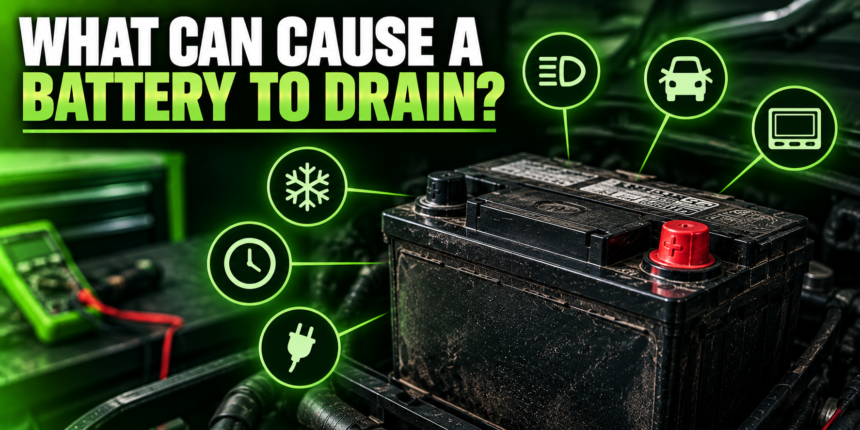
A car battery drains for a handful of common reasons: something left switched on, a parasitic draw that keeps pulling power after the engine is off, a failing alternator, loose or corroded terminals, extreme weather, or simply an old battery at the end of its life. Some of these are easy fixes you can spot in the driveway; others take a multimeter to track down. Here is each cause, how to recognize it, and what to do about it.
- Things left on
- Parasitic draw (the sneaky one)
- A failing alternator or charging system
- Loose or corroded terminals
- Extreme heat and cold
- An old or worn-out battery
- How to prevent a drained battery
- Conclusion
- Frequently asked questions
- Why does my car battery keep dying overnight?
- Can a car battery drain while the car is off?
- How do I know if it’s the battery or the alternator?
- Can a bad battery drain overnight on its own?
- Does cold weather drain a car battery?
- Related Articles
Things left on
The simplest cause is also the most common: something was left running while the engine was off. With the engine off, the alternator cannot recharge the battery, so anything still drawing power slowly empties it.
Headlights are the classic offender, but the list is longer than people expect: the dome light, glove box light, trunk light, even a vanity mirror light can flatten a battery overnight if it stays on. A door or trunk that is not fully latched keeps its light burning too. Many newer cars turn headlights off automatically after a while, but plenty do not, so it is worth a habit of a quick look before you walk away.
Quick check: Before leaving the car, switch off all lights and make sure the doors, trunk, and glove box are shut and latched. This alone prevents a big share of dead-battery mornings.
Parasitic draw (the sneaky one)
This is the cause that drives people crazy, because the car looks completely off and the battery still dies. Parasitic draw is the current that keeps flowing through the car’s electrical system after you shut everything down.
Every modern car has some parasitic draw by design. Computers that stay partly awake, the clock, the alarm, and the key-fob receiver all sip a little power. The question is whether yours is normal or too high. These are the rough thresholds:
| Parasitic draw (engine off) | What it means |
| Under 50 mA (older cars) | Normal |
| 50 to 85 mA (newer cars) | Normal for modern electronics |
| Around 100 mA | Upper edge of acceptable |
| Above 100 mA | Too high; can flatten the battery in a night or two |
A draw above roughly 100 milliamps can flatten a healthy battery in a night or two, faster in the cold. Common culprits are an aftermarket accessory wired to the wrong power source (a stereo, alarm, GPS, or remote starter), a relay or switch that never disconnects, a glovebox or under-hood light that stays lit, or a control module that fails to go to sleep. Even a chafed positive wire touching the chassis can do it.

Tracking it down takes a digital multimeter set to measure current, with the car off and everything closed up; you then pull fuses one at a time to see which circuit drops the draw. If that is beyond what you want to tackle, a shop can find it quickly. For a clear walk-through of the testing method, Battery Tender’s parasitic drain guide is a solid reference.
A failing alternator or charging system
If the battery keeps dying even though nothing is obviously left on, the problem may be that the battery is not being recharged properly while you drive. The alternator charges the battery as the engine runs, so a failing alternator leaves the battery slowly falling behind.
A worn voltage regulator can also under-charge the battery, so it never reaches a full charge and cannot start the car reliably. And a bad diode inside the alternator can let current leak backward out of the battery when the engine is off, acting like a parasitic draw. Warning signs include dim or flickering lights, a battery warning light, and a battery that tests fine yet keeps going flat. A shop can check charging output in a few minutes.
It is worth understanding the relationship here, because people often replace a perfectly good battery when the alternator is the real problem. The battery only stores energy; the alternator refills it. If the alternator is not doing its job, a brand-new battery will die just as fast as the old one, which is why a repeat failure after a new battery almost always points at the charging system rather than the battery itself.
Loose or corroded terminals
The connection between the battery and the car matters as much as the battery itself. The positive and negative terminals can work loose over time or build up a crusty layer of corrosion, and either one interferes with the flow of power.
A loose or corroded connection can stop the battery from charging fully and can make the car hard to start, and in some cases it drains or damages the battery. The good news is this is an easy one to spot and fix. Look for white, blue, or green crust on the terminals. Clean it off with a stiff brush, an old toothbrush works, and a mix of about one part baking soda to three parts water, then make sure the clamps are snug. Keep the baking soda mixture out of the battery cells.
Extreme heat and cold
Weather is harder on batteries than most people realize. Both freezing winters and blazing summers stress a car battery and shorten its life.
Cold thickens the engine oil and slows the chemical reaction inside the battery, so it has to work harder to start the car while delivering less power, which is why dead batteries spike on cold mornings. Heat is quietly worse in the long run: high temperatures speed up the internal wear and can evaporate fluid inside the battery, aging it faster. If your battery is already weak, extreme weather is often the thing that finally finishes it off.
This is why a battery that struggled a little at the end of summer can fail completely on the first hard frost. The heat did the hidden damage over the months before, and the cold simply exposed it. If you live somewhere with harsh winters or long, hot summers, it pays to have the battery tested before the season turns rather than discovering the weakness in a parking lot.
An old or worn-out battery
Sometimes nothing is wrong with the car at all, the battery has simply reached the end of its life. Car batteries typically last three to five years, and as they age they hold less and less charge until they cannot reliably start the engine.
An old battery may test okay when full but drain quickly, need frequent jump-starts, or crank the engine slowly in the morning. Once a battery is at that stage, cleaning terminals and chasing draws will not save it. If your battery is past the three-to-five-year mark and struggling, replacement is usually the real fix, and it saves you from being stranded. Many auto parts stores will test a battery for free and print out its condition, so you do not have to guess whether age is the culprit.
How to prevent a drained battery
Most dead-battery mornings are avoidable with a few simple habits. Build these in and you will rarely be reaching for jumper cables.
- Do a lights-and-doors check. Before you walk away, confirm all lights are off and every door, the trunk, and the glove box are latched.
- Drive it regularly. Short, infrequent trips do not fully recharge the battery. A longer drive now and then keeps it topped up, and a battery maintainer helps if the car sits for weeks.
- Keep terminals clean and tight. Check the connections now and then for corrosion or looseness, and clean them when needed.
- Unplug accessories when parked. Phone chargers, dash cams, and anything in a 12V outlet can keep drawing power. Unplug them if they stay live with the car off.
- Test the battery and charging system. If the car is near the three-to-five-year mark or dying often, have the battery and alternator tested rather than guessing.
Conclusion
A battery drains from things left on, a parasitic draw pulling power after shutdown, a failing alternator, corroded or loose terminals, extreme weather, or plain old age. Start with the easy checks, lights, doors, and terminals, then measure the parasitic draw and charging output if the battery keeps dying. Keep up simple habits like driving it regularly and checking the connections, and a healthy battery will start your car reliably for years.
Frequently asked questions
Why does my car battery keep dying overnight?
Usually a parasitic draw, current still flowing after the car is off, or something left on like a light. A draw above about 100 milliamps can flatten a battery in a night or two.
Can a car battery drain while the car is off?
Yes. Some draw is normal for computers, the clock, and the alarm. An abnormally high draw from a stuck relay, aftermarket accessory, or wiring fault will drain it fast.
How do I know if it’s the battery or the alternator?
If the battery tests fine but keeps going flat, or lights dim while driving, suspect the alternator or charging system. A shop can measure charging output in minutes to confirm.
Can a bad battery drain overnight on its own?
Yes. An old battery, typically past three to five years, loses its ability to hold charge and can go flat overnight even when nothing is left on. Replacement is the fix.
Does cold weather drain a car battery?
Cold does not drain a healthy battery so much as weaken it, slowing its chemistry and making starting harder. It often finishes off a battery that was already worn.
Related Articles
What Color Is Positive on a Battery? Red or Black