


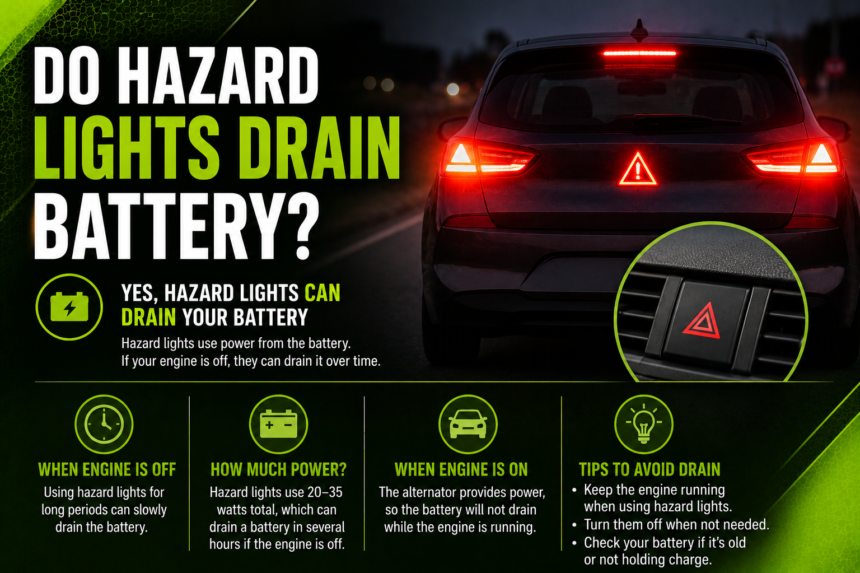
If you’ve ever pulled over on the side of the road, switched on your hazard lights, and then started worrying about your car battery, you’re not alone. It’s one of the most common questions drivers ask, especially during emergencies, traffic jams, or roadside breakdowns. So, do hazard lights drain battery power? The short answer is yes, but only if they’re left running for a long time. For short periods, hazard lights use very little electricity and are unlikely to cause any real damage to a healthy battery.
- What Are Hazard Lights?
- How Hazard Lights Work Electrically?
- Do Hazard Lights Drain the Battery? (Core Answer)
- How Long Can You Run Hazard Lights Before the Battery Dies?
- Factors That Affect Battery Drain
- Signs Your Battery Is Being Drained
- Tips to Prevent Battery Drain While Using Hazard Lights
- What to Do If Your Battery Dies from Hazard Lights
- Hazard Lights vs. Other Battery Drains (Comparison)
- Frequently Asked Questions (FAQ)
- Conclusion
- Related Articles
This matters more than most people realize. Whether you’re stuck in traffic, waiting for roadside assistance, or simply being cautious during bad weather, understanding how hazard lights interact with your car’s electrical system can save you from an unexpected dead battery. In this guide, we’ll break down exactly how hazard lights work, how much power they consume, how long you can safely run them, and what you can do to protect your battery when you need to use them.
What Are Hazard Lights?
Hazard lights, also known as hazard warning lights or “flashers,” are the amber lights that blink simultaneously on all four corners of your vehicle. They’re designed to alert other drivers that your car is stationary, moving slowly, or facing some kind of emergency situation.
Unlike turn signals, which only flash on one side of the vehicle to indicate a direction, hazard lights activate all four indicator lights at once. This creates a more noticeable, all-around warning signal that tells other drivers to proceed with caution around your vehicle.
Hazard lights draw their power from the same source as the rest of your car’s electrical components: the battery and, when the engine is running, the alternator. This shared power source is exactly why questions about battery drain come up so often.
How Hazard Lights Work Electrically?
To understand whether hazard lights drain your battery, it helps to know a bit about your car’s electrical system. Every vehicle has two main sources of electrical power: the battery, which stores energy, and the alternator, which generates electricity while the engine is running and simultaneously recharges the battery.
When your engine is on, the alternator supplies power to your hazard lights and other electronics, while also topping up the battery. In this scenario, hazard lights have almost no meaningful impact on battery life because the alternator is replenishing the energy being used.
However, when your engine is off, the hazard lights pull power directly from the battery with no replenishment happening. This is when drain becomes a real concern.
In terms of actual power draw, hazard lights are relatively low-consumption components. Most vehicles use somewhere between 3 to 5 amps per hour when hazards are flashing, though this can vary depending on whether your car uses traditional bulbs or more efficient LED lights. LED hazard lights consume significantly less power than incandescent bulbs, which is worth noting if you’re comparing older and newer vehicle models.
Do Hazard Lights Drain the Battery? (Core Answer)
Now to the central question: do hazard lights drain battery power in a way that should worry you? The answer depends heavily on two factors: how long they’re on, and whether your engine is running.
Short-term use (minutes to a few hours): If you’re using hazard lights for a short stop, such as pulling over briefly or signaling caution in traffic, the battery drain is minimal. A healthy, fully charged battery can handle several hours of hazard light use without any noticeable issues.
Long-term use (many hours): The situation changes if hazard lights are left on for an extended period, particularly overnight or for 12 hours or more with the engine off. Over time, this steady draw can significantly weaken or fully deplete the battery, especially in older vehicles.
The condition and age of your battery play a major role here too. A new, well-maintained battery can typically handle hazard lights for much longer than an old or already weakened one. If your battery is already on its last legs, even a couple of hours of hazard light use could be enough to leave you stranded.
How Long Can You Run Hazard Lights Before the Battery Dies?
There’s no single universal answer, since battery capacity, vehicle model, and battery age all play a role. That said, here are some general estimates:
| Battery Condition | Approximate Safe Duration |
|---|---|
| New, fully charged battery | 6–12+ hours |
| Moderately used battery (1–3 years old) | 4–8 hours |
| Old or weak battery | 1–3 hours or less |
| Very cold weather conditions | Reduce estimates by 20–30% |
These numbers are general guidelines rather than guarantees. Extreme temperatures, a battery nearing the end of its lifespan, or additional electronics running at the same time can all shorten these windows considerably.
Factors That Affect Battery Drain
Several variables influence how quickly hazard lights will drain your battery. Understanding these can help you make smarter decisions in real-world situations.
Battery age and condition: Batteries naturally lose capacity over time. A battery that’s several years old won’t hold as much charge as a brand-new one, making it more vulnerable to drain from continuous hazard light use.
Weather and temperature: Cold weather is particularly hard on car batteries. Low temperatures reduce a battery’s ability to hold and deliver charge, meaning hazard lights (and other electronics) will drain it faster in winter than in mild or warm conditions.
Other electronics running simultaneously: If you’re also running the radio, charging your phone, using interior lights, or running the air conditioning while your hazards are on and the engine is off, the combined power draw adds up much faster than hazard lights alone.
Engine running vs. engine off: As mentioned earlier, this is the single biggest factor. With the engine running, the alternator handles the electrical load and recharges the battery simultaneously. With the engine off, the battery is working alone with no way to recharge itself.
Signs Your Battery Is Being Drained
If you’ve had your hazard lights on for a while and you’re not sure whether your battery is taking a hit, watch for these warning signs:
- Dimming hazard lights or interior lights, which indicates the voltage is dropping.
- Difficulty starting the car, such as the engine cranking slower than usual.
- A clicking sound when you turn the key or press the start button, which often signals insufficient power reaching the starter motor.
- Dashboard warning lights flickering or behaving unusually.
If you notice any of these signs, it’s a good idea to turn off the hazard lights and any other non-essential electronics as soon as it’s safe to do so, in order to preserve whatever charge remains.
Tips to Prevent Battery Drain While Using Hazard Lights
There are several practical steps you can take to minimize the risk of a dead battery when you need to use your hazards for an extended period.
Keeping your engine running whenever it’s safe and legal to do so is the most effective solution, since it allows the alternator to power the hazard lights instead of relying solely on the battery. If leaving the engine on isn’t an option, try to avoid running other electronics like the radio, phone chargers, or air conditioning at the same time, since every additional device adds to the total drain.
Regular battery maintenance also makes a big difference. Getting your battery tested periodically, especially if it’s more than three years old, can help you understand how much reserve capacity it actually has before you’re relying on it in an emergency. It’s also worth keeping a portable jump starter or battery charger in your vehicle, since these compact devices can be lifesavers if your battery does end up drained.
What to Do If Your Battery Dies from Hazard Lights
If the worst happens and your battery does die after extended hazard light use, don’t panic. Here’s how to handle it:
- Check for a portable jump starter. If you have one in your car, this is often the quickest fix and doesn’t require another vehicle.
- Flag down another driver for a jump-start. If you have jumper cables, another vehicle can provide the charge needed to get your car running again.
- Call roadside assistance. Many insurance plans and auto clubs offer battery jump-start services as part of their coverage.
- Let your car run for a while afterward. Once your car starts again, let the engine run for at least 20–30 minutes to allow the alternator to recharge the battery.
- Get your battery checked. If this happens more than once, it may be a sign your battery is aging and needs replacement.
Hazard Lights vs. Other Battery Drains (Comparison)
To put hazard light power consumption into perspective, it helps to compare it with other common sources of battery drain when the engine is off.
| Component | Approximate Power Draw | Relative Drain Speed |
|---|---|---|
| Hazard lights | 3–5 amps/hour | Moderate |
| Interior dome light | 0.5–1 amp/hour | Low |
| Headlights | 8–10 amps/hour | High |
| Radio/infotainment system | 1–3 amps/hour | Low to Moderate |
| AC/heater (engine off) | 15–20+ amps/hour | Very High |
As the table shows, hazard lights sit in a moderate range. They’re far less demanding than headlights or climate control systems, but they still draw enough power that leaving them on for many hours without the engine running can eventually drain even a healthy battery.
Frequently Asked Questions (FAQ)
Can hazard lights kill a car battery overnight? Yes, it’s possible. If hazard lights are left on overnight with the engine off, especially in an older or weaker battery, there’s a real risk of the battery being fully drained by morning.
Is it safe to leave hazards on while parked? For short periods, yes. For extended parking, especially overnight, it’s better to avoid it unless necessary, since it does gradually drain the battery.
Do hazard lights use more power than headlights? No. Headlights generally draw more power than hazard lights, since they need to produce a brighter, more sustained beam of light.
Will hazards drain the battery with the engine running? Practically speaking, no. When the engine is running, the alternator supplies the power needed for hazard lights and simultaneously keeps the battery charged, so there’s essentially no net drain.
Conclusion
So, do hazard lights drain battery power? Yes, but only under specific circumstances. Used briefly, or with the engine running, hazard lights have a negligible effect on your car’s battery. The real risk comes from leaving them on for many hours, particularly overnight, with the engine turned off — especially if your battery is already older or weaker.
Understanding this balance can make a real difference the next time you’re stopped on the roadside. Keep an eye on how long your hazards have been running, try to keep the engine on when it’s safe to do so, and consider having your battery tested periodically so you know exactly what it can handle. A little awareness now can save you from an inconvenient — and avoidable — dead battery later.
Related Articles
Honda Battery Warranty Guide 2026: Coverage, Terms & Claim Process
Will a Trickle Charger Charge a Dead Battery? The Complete Guide
How to Replace a Garage Door Remote Battery – Easy Step-by-Step Guide
Will an Alternator Drain a Battery? Causes, Signs & Fixes Explained