


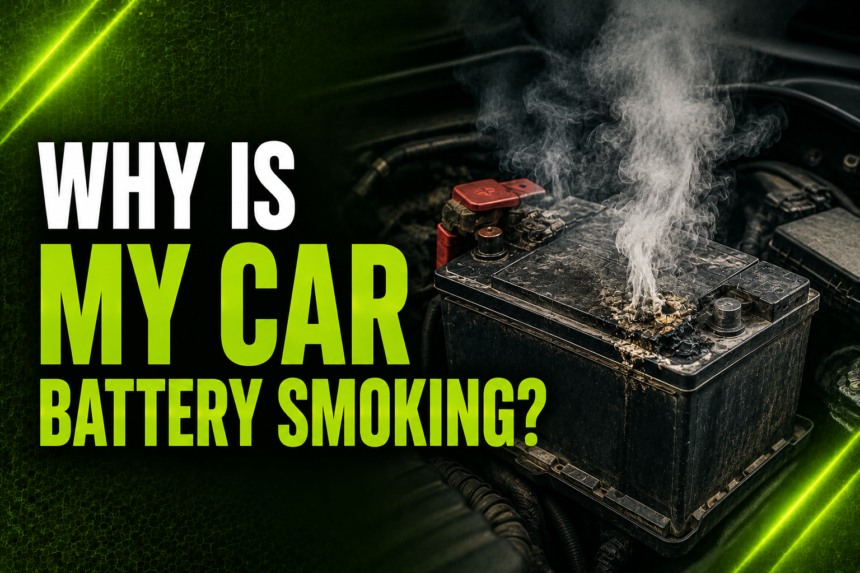
If you’ve popped the hood and seen smoke curling up from your battery, your instinct is probably right: something is wrong, and it needs your attention immediately. A car battery smoking is never just cosmetic — it’s a sign that the battery is overheating, off-gassing, or breaking down internally, and in a worst-case scenario it can lead to a fire or a small explosion. The good news is that once you understand what’s actually happening inside that plastic case, the cause is usually easy to pin down, and the fix is straightforward.
- What’s Actually in That Smoke?
- The 6 Most Common Causes of a Smoking Car Battery
- 1. Overcharging From a Faulty Alternator
- 2. An Unregulated or Malfunctioning Battery Charger
- 3. Internal Short Circuit
- 4. Extreme Heat or a Blocked Vent
- 5. Jump-Starting a Deeply Discharged Battery Too Aggressively
- 6. The Wrong Battery for Your Vehicle
- AGM, Flooded, and Hybrid 12V Batteries: Does the Cause Differ?
- What to Do the Moment You See or Smell Smoke
- Smoking While Driving vs. While Charging vs. During a Jump-Start
- How Much Will This Cost to Fix?
- Preventing a Repeat: A Simple Maintenance Checklist
- Is It Safe to Drive After a Battery Smoked?
- Safe Disposal of a Smoked Battery
- Frequently Asked Questions
- Related Articles
This guide walks through exactly what’s inside battery smoke, the six most common causes, what to do in the first two minutes after you spot it, and how to make sure it doesn’t happen again — whether you’re dealing with a standard flooded battery, an AGM battery, or the 12-volt battery in a hybrid.
What’s Actually in That Smoke?
Before you touch anything, it helps to know what you’re dealing with. A lead-acid car battery is filled with sulfuric acid electrolyte and generates hydrogen gas as a normal byproduct of charging. Under normal conditions, that gas escapes slowly and harmlessly through small vents. When a battery is stressed — overheated, overcharged, or physically damaged — it produces gas faster than it can vent safely, and the pressure forces out a visible haze along with:
- Hydrogen gas – colorless, highly flammable, and the main explosion risk near sparks or open flame
- Sulfuric acid mist – irritating to eyes, skin, and lungs
- Hydrogen sulfide – the “rotten egg” smell some drivers notice before they ever see smoke
That combination is why battery smoke is treated differently than, say, smoke from a hot exhaust manifold. It’s chemical, it’s flammable, and it can be actively venting under pressure.
The 6 Most Common Causes of a Smoking Car Battery
1. Overcharging From a Faulty Alternator
Your alternator should deliver somewhere around 13.7–14.7 volts to the battery while the engine is running. When a voltage regulator fails, the alternator can push well beyond that range, cooking the electrolyte inside the battery and forcing it to vent gas continuously. This is one of the most common real-world causes of a battery that starts smoking while you’re driving, and it usually won’t stop happening until the alternator or regulator is repaired — a new battery alone won’t fix it.
2. An Unregulated or Malfunctioning Battery Charger
Plugging a battery into a cheap charger — or leaving it hooked up too long on a high amperage setting — can push far more current into the battery than it can absorb. Chargers without microprocessor control simply keep dumping current in regardless of the battery’s state of charge, which is exactly how a battery ends up smoking on your garage floor overnight. This is the scenario most likely to happen while the car is parked and connected to a charger or jump box.
3. Internal Short Circuit
Inside every battery are stacked lead plates separated by thin insulators. Sulfation buildup, manufacturing defects, vibration damage, or simple old age can let plates touch. When that happens, current flows somewhere it shouldn’t, generating intense localized heat in one spot — often enough to melt the case or produce smoke almost instantly. Unlike overcharging, this can happen even with a perfectly healthy charging system, and it usually means the battery itself is done.
4. Extreme Heat or a Blocked Vent
Batteries mounted near the engine block, or vehicles parked in direct summer sun, can push electrolyte temperatures high enough that the liquid starts to boil and evaporate, building internal pressure. If the battery’s vent caps are corroded shut or blocked with grime, that pressure has nowhere controlled to go, so it forces its way out as visible vapor.
5. Jump-Starting a Deeply Discharged Battery Too Aggressively
Once a battery’s voltage drops below about 12.4 volts, sulfate crystals start forming on the plates, which makes the battery resist accepting charge normally. If you then hit it with a high-amperage charger or repeated jump-start attempts trying to force it back to life, that resistance turns into heat — and heat plus trapped gas equals smoke. This is a very common cause after a car has sat unused for weeks or months.
6. The Wrong Battery for Your Vehicle
Installing a battery with a lower cold-cranking-amp rating or the wrong group size than your vehicle’s charging system expects can cause it to be chronically overworked, run hotter than it should, and eventually vent. This is an easy cause to overlook because the battery itself may be brand new.
AGM, Flooded, and Hybrid 12V Batteries: Does the Cause Differ?
AGM (absorbed glass mat) batteries are sealed and generally more heat-resistant than traditional flooded batteries, but they are not immune — overcharging an AGM battery can still cause it to vent and permanently damage it, and because it’s sealed, you often won’t see fluid loss as an early warning sign. Hybrid and EV 12-volt auxiliary batteries behave similarly to a standard AGM battery in this respect: smoke from that battery points to a charging-system or regulator issue, not the high-voltage traction battery.
What to Do the Moment You See or Smell Smoke
Follow these steps in order — don’t skip ahead, and don’t try to diagnose the cause before you’ve made the situation safe.
- Turn off the engine immediately. If the charging system is force-feeding the battery, a running engine keeps the problem going.
- Get away from the vehicle and let the area ventilate. If you’re in a garage, open the door. Don’t lean over the battery to inspect it while it’s actively smoking.
- Kill every possible ignition source. No smoking, no phone flashlight sparking against metal, no tools touching the terminals, nothing that could ignite hydrogen gas.
- Do not open a sealed/maintenance-free battery or try to add water. If you have an older battery with removable vent caps and it has stopped smoking and cooled down, opening the caps can help release remaining pressure — but only once it’s no longer actively venting.
- Call for help if smoke is heavy, if you smell strong sulfur, or if the case looks swollen or cracked. A roadside assistance provider or tow service can move the vehicle safely; this isn’t a situation to improvise a fix in the moment.
- Once it’s cooled, don’t reconnect or reuse that battery. A battery that has vented or smoked has sustained internal damage that isn’t reversible, even if it seems to work afterward.
Smoking While Driving vs. While Charging vs. During a Jump-Start
The situation you’re in is actually a strong clue to the cause:
| When it happens | Most likely cause | What to check |
|---|---|---|
| While driving | Faulty alternator/voltage regulator | Have the charging system load-tested at a shop |
| While plugged into a home charger | Charger not regulating current properly | Switch to a microprocessor-controlled smart charger |
| During or right after a jump-start | Deeply sulfated battery reacting to high current | Use a lower amperage setting and monitor closely |
| Sitting parked, engine off, no charger attached | Internal short circuit or extreme heat exposure | Battery likely needs replacement regardless of charger |
How Much Will This Cost to Fix?
- Replacement battery: roughly $100–$300 for most passenger vehicles, depending on group size and AGM vs. flooded construction.
- Alternator/voltage regulator repair: typically $400–$900 installed, since labor is a bigger factor than parts on most vehicles.
- Smart charger (to prevent a repeat): $40–$120 for a quality microprocessor-controlled unit.
If the battery is under 3 years old and has never been deeply discharged or jumped repeatedly, it’s worth having the charging system tested before you assume the battery itself is defective — many “bad batteries” are actually victims of a bad alternator.
Preventing a Repeat: A Simple Maintenance Checklist
- Have your charging system’s output tested annually — a quick load test at most auto parts stores is often free.
- Only use smart/microprocessor-controlled chargers, especially for overnight or multi-day charging.
- Keep terminals clean and vent caps (on non-sealed batteries) free of corrosion so gas can escape normally.
- Avoid letting a battery sit fully discharged for weeks — a trickle maintainer is cheaper than a replacement battery.
- Replace batteries proactively around the 3–5 year mark rather than waiting for a failure.
- Confirm any replacement battery matches your vehicle’s specified group size and cold-cranking amps.
Is It Safe to Drive After a Battery Smoked?
No — even if the smoke has stopped and the engine restarts, don’t continue driving on that battery. Its internal structure has already been compromised, and it can fail without warning, including a total loss of electrical power while you’re on the road. Have it towed or, if it’s safe to do so briefly, drive directly to a shop for a battery and charging-system check rather than running errands on it.
Safe Disposal of a Smoked Battery
Never throw a damaged battery in household trash — it’s classified as hazardous waste in every US state due to the lead and sulfuric acid inside. Most auto parts retailers (AutoZone, O’Reilly, Advance Auto Parts, etc.) will accept a dead or damaged battery for recycling for free, and many will even give you a small core credit toward a new one.
Frequently Asked Questions
Is it dangerous to breathe car battery smoke? Yes. It can contain sulfuric acid mist and hydrogen sulfide gas, both of which irritate the eyes, throat, and lungs. Move away from the vehicle and let the area ventilate before approaching again.
Can a smoking car battery explode? It’s possible, though not the most common outcome. The hydrogen gas a stressed battery vents is flammable, and if it accumulates in an enclosed space near a spark or flame, it can ignite. This is why avoiding ignition sources near a smoking battery matters more than almost anything else.
Should I unplug or disconnect a smoking battery myself? Only if it has already stopped actively smoking and you can safely reach the terminals without leaning over the case. While it’s actively venting, keep your distance and let it vent out rather than working near it.
Can a smoking battery be recharged and reused? No. Once a battery has vented enough gas or heat to produce visible smoke, its internal components have sustained damage that doesn’t reverse. It should be replaced, not recharged.
Why does my battery only smoke when I try to jump-start my car? This usually means the battery was deeply discharged for a long period and has developed sulfation on its plates. The sudden high current from a jump-start or aggressive charger reacts with that buildup and generates heat faster than the battery can dissipate it.
Does a smoking battery always mean I need a new alternator? Not always. If the smoke happened while charging with an external charger or right after a jump-start, the alternator may be fine — the battery or charging method is the more likely culprit. If it happened while the engine was running under normal driving, the alternator or voltage regulator is the more likely suspect.
How do I know if the smoke is coming from the battery and not somewhere else under the hood? Battery smoke is usually paired with a strong sulfur or acidic smell and originates specifically from the top of the battery case near the vent caps or terminals, rather than from hoses, belts, or the exhaust area. If you’re unsure, don’t investigate closely while the engine is running — shut it off first, then look from a safe distance once things have cooled.
Related Articles
How Much Does a Car Battery Weigh? Complete Guide
How to Change Fire Detector Battery: A Complete Step-by-Step Guide
What Element Is Used in Batteries? A Complete Guide to Battery Materials