



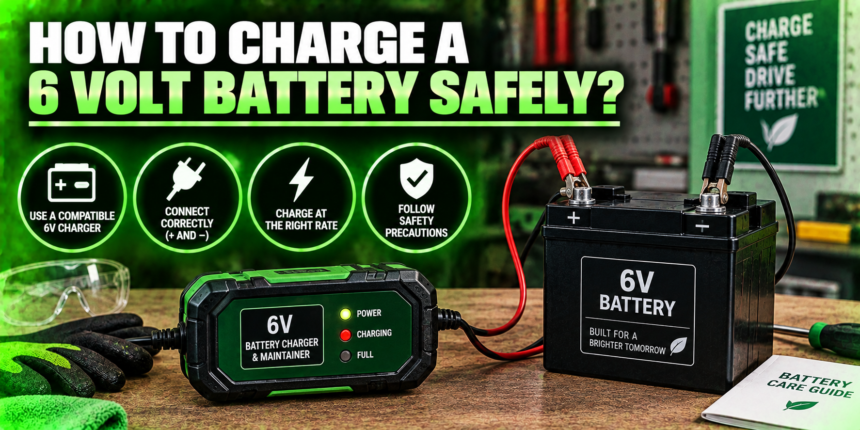
To charge a 6 volt battery, use a charger set to 6 volts, clip the red lead to the positive terminal and the black lead to the negative, choose a low current, and let it run until the battery reads a little over 6 volts. Most 6V lead-acid batteries take anywhere from about an hour on a fast setting to overnight on a trickle charge. The key is matching the charger to the battery and not rushing it. Here is the safe way to do it, start to finish.
What you need before you start?
Charging a 6V battery is a simple job with the right gear. Gather this first:
- A 6-volt charger. A charger with a 6V setting is the safe, correct tool. Many chargers switch between 6V and 12V, so check the dial before you connect anything.
- A multimeter. This lets you read the battery’s voltage before and after, so you know where you are starting and when you are done.
- Gloves and eye protection. Most 6V batteries are lead-acid and can vent a little gas and acid mist while charging.
- A ventilated space. Charging gives off small amounts of hydrogen gas, so work somewhere with airflow and away from sparks or flame.
- Distilled water, for flooded batteries. If your battery has removable caps, you may need to top up the cells so the plates stay covered.
Good to know: Almost all 6V batteries in cars, tractors, RVs, and lanterns are lead-acid. The steps below are written for that type. Small 6V lithium or NiMH packs need a charger made for that chemistry.
Step-by-step: charge a 6V battery
Follow these in order. The whole thing takes a couple of minutes to set up, then you wait.
- Check the battery first. Read the resting voltage with your multimeter. A healthy 6V battery sits around 6.3 to 6.4 volts at rest. If it is a flooded type, open the caps and make sure the electrolyte covers the plates; add distilled water if it does not.
- Set the charger to 6 volts. This is the step people skip. Confirm the charger is on its 6V setting and, if it has one, a low amp setting to start.
- Connect positive first. Clip the red (positive) lead to the battery’s positive terminal, marked with a plus sign.
- Connect negative second. Clip the black (negative) lead to the negative terminal. On a battery installed in a vehicle, clip the negative to a clean metal ground away from the battery instead, to keep any spark away from the gas the battery gives off.
- Switch on and pick your rate. Turn the charger on. A low current (1 to 2 amps) is gentlest and safest; a higher current is faster but runs warmer, so keep an eye on it.
- Let it charge and check progress. Leave it until the charger shows a full charge, or until the battery reads just over 6 volts at rest. A smart charger will taper off and stop on its own.
- Disconnect in reverse. Turn the charger off first, then remove the negative lead, then the positive. Powering down before unclipping avoids a spark at the terminal.
How long does it take?
Charge time depends on how flat the battery is and the current you use. Lower current is safer and kinder to the battery but takes longer. This table gives realistic ballparks for a typical 6V lead-acid battery.
| Charging current | Rough time from low to full | Best for |
| 1 to 2 amps (trickle) | 10 to 15 hours | Gentle, safe overnight charging |
| 4 to 6 amps (standard) | 4 to 8 hours | Everyday recharging |
| 10 amps (fast) | 1 to 3 hours | When you are in a hurry, with care |
| Maintainer / float | Indefinite | Keeping a stored battery topped up |
A deeply discharged battery takes longer than these figures, and a battery that is only a little low takes less. If you have the time, slower is almost always better for the battery’s health.
When is a 6V battery fully charged?
A 6V battery is not full at exactly 6.0 volts. Resting after a full charge, it reads a little above its nameplate, usually around 6.3 to 6.4 volts on the multimeter. That is why a 6V charger is built to push a bit higher, roughly 7 volts, while it works, so it can drive the battery all the way to full.
The reading matters most at rest. Take the battery off the charger, wait a few minutes for the surface charge to settle, then measure. A number a touch over 6 volts means done. If it climbs and holds there, you are good; if it will not get past the low 6s no matter how long you charge, the battery may be worn out.
It also helps to watch how the charge behaves near the end: a smart charger tapers the current down as the battery fills, so a charger that never seems to finish, or one whose battery gets hot while the voltage stays stuck, is a sign something is wrong with the cell rather than the charger.
Can you use a 12V charger on a 6V battery?
No, not directly. A 12V charger pushes about twice the voltage a 6V battery is built to accept, and that mismatch is where the damage happens. A 6V battery is designed to take a gentle flow. Force 12 volts into it and the plates cannot absorb the energy fast enough, so the excess turns into heat.
That heat is the real danger. It can boil the electrolyte, warp the lead plates, swell or deform the case, and in a bad case trigger thermal runaway, which is a runaway heating that can vent, leak, or worse. People sometimes touch a 12V charger to a dead 6V battery just to nudge it awake for a jump, but it is never a safe way to fully charge one. Even when nothing dramatic happens, the hidden cost is permanent capacity loss: the battery survives the session but holds less charge afterward and dies sooner than it should.
If a 6V charger is all you lack, the safe workaround is a small step-down device called a buck converter, set to output about 6.8 to 7 volts, sitting between the 12V charger and the battery. It regulates the flow so the battery sees a safe charging voltage. For a plain-language walk-through of why the voltage gap causes trouble, Impact Battery’s guide covers it well. The simplest answer, though, is to use a proper 6V charger.
Charging two 6V batteries in series
Lots of RVs, golf carts, and classic cars run two 6V batteries wired in series to make 12 volts. This is the one case where a 12V charger is correct, because the pair together is a 12V system.
If the batteries are healthy and only moderately discharged, you can charge them as a 12V pack: connect the 12V charger across the two outer terminals of the series pair and let it top them up. But if they are deeply run down, or if one is weaker than the other, they charge more evenly one at a time.
Disconnect them, set your charger to 6V, and charge each battery on its own. It takes longer, but both cells end up at a matched, full charge, which helps the pair last. Mismatched batteries in a series pair drag each other down over time, since the weaker one is always working harder, so the extra hour or two spent charging them individually pays off in how long the set survives.
Keeping a 6V battery charged in storage
A lead-acid battery slowly self-discharges when it sits, and letting it stay flat causes sulfation, a buildup that permanently cuts capacity. If your 6V battery powers something seasonal, like a classic car or a mower, keep it topped up over the off-season.
The easy way is a maintainer, sometimes called a float charger or trickle charger, set to 6 volts. It holds the battery full without overcharging, so you can leave it connected for months. If you would rather not leave anything plugged in, give the battery a full charge every few weeks instead. Store it somewhere cool and dry, off a cold concrete floor, and check the electrolyte level on flooded types.
Heat is what ages a stored battery fastest, so a cool corner of a garage beats a hot shed. Before you put the battery back into service in spring, give it a full charge and a quick voltage check so you are not caught out by a cell that quietly died over the winter.
Conclusion
Charging a 6 volt battery comes down to a few rules: use a charger set to 6 volts, match positive to positive, start with a low current, and stop when the battery rests a little above 6 volts. Skip the 12V charger unless you are charging two 6V batteries in series as a 12V pack. Go slow, keep it ventilated, and a healthy 6V battery will charge safely and last for years.
Frequently asked questions
What voltage should a 6V battery charge to?
A fully charged 6V lead-acid battery rests at about 6.3 to 6.4 volts. The charger itself outputs around 7 volts while working so it can drive the battery all the way to full.
How long does it take to charge a 6V battery?
Roughly 1 to 3 hours at 10 amps, or 10 to 15 hours on a 1 to 2 amp trickle. A deeply flat battery takes longer, and slower charging is gentler on it.
Can I charge a 6V battery with a 12V charger?
Not directly, it can overheat and damage the battery. Use a 6V charger, or a buck converter set to about 6.8 volts between a 12V charger and the battery.
Can I charge two 6V batteries with a 12V charger?
Yes, if they are wired in series to form a 12V system. For deeply discharged or mismatched batteries, charge each one separately at 6V for a more even result.
How do I know if my 6V battery is dead?
Charge it fully, then rest and measure. If it will not hold above the low 6-volt range or drops quickly under load, the battery is likely worn out and due for replacement.
Related Articles
How to Remove Hot Glue From a Battery Safely?
How Do I Clean Battery Acid? Safe Steps