


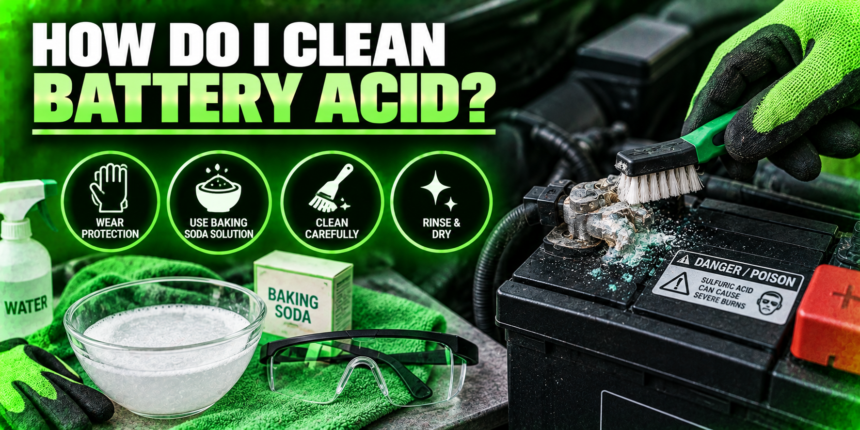
How you clean battery acid depends on the kind of battery, and getting that right is the whole job. For a car or other lead-acid battery, the leak is sulfuric acid, and you neutralize it with baking soda mixed with water. For a household alkaline battery (the AA, AAA, C, and D cells in remotes and toys), the leak is actually a base, not an acid, so you neutralize it with a mild acid like white vinegar or lemon juice.
- First, identify the battery (it changes everything)
- Gear up: safety before you start
- Cleaning a car (lead-acid) battery leak
- Cleaning a household (alkaline) battery leak
- If acid gets on your skin or in your eyes
- Disposal and the lithium-ion warning
- Conclusion
- Frequently asked questions
- What neutralizes battery acid?
- Can I use baking soda on an alkaline battery leak?
- Is battery corrosion dangerous to touch?
- What should I do if battery acid gets on my skin?
- How do I dispose of a leaked battery?
- Related Articles
Always wear gloves and eye protection, and, crucially, if any battery fluid gets on your skin or in your eyes, flush it with plenty of water first rather than reaching for a neutralizer. Here is how to identify what you are dealing with and clean it up safely.
The single most important step is matching the neutralizer to the battery, because acids and bases are chemical opposites and the wrong choice does not work, and can make things worse. The sections below explain how to tell the two apart, the safety gear to have on, exact steps for both a car battery and a leaking household device, what to do if the fluid touches you, and how to dispose of the mess safely.
First, identify the battery (it changes everything)
Before you clean anything, work out which type of battery leaked, because it determines the neutralizer you use. The two common cases are chemical opposites:
| Battery type | What leaks out | Neutralize with |
| Car / lead-acid (also NiCd) | Sulfuric acid (acidic) | Baking soda mixed with water |
| Household alkaline (AA, AAA, C, D) | Potassium hydroxide (a base) | White vinegar or lemon juice |
| Lithium-ion (phones, laptops) | Flammable electrolyte; fire risk | Do not neutralize; call a professional |
The logic is simple chemistry. Car battery acid is acidic, so you neutralize it with a base (baking soda). Alkaline battery leakage is basic, or alkaline, despite people calling it ‘battery acid,’ so you neutralize it with a mild acid (vinegar or lemon juice).
The white or greenish crust around a leaking battery is the residue of that chemistry. Using baking soda on an alkaline leak does very little, because you would be adding a base to a base, which is exactly the mistake this guide helps you avoid. Match the neutralizer to the battery and the cleanup is easy and effective.
Telling the two apart is usually easy in practice, because it comes down to where the battery is. If it is the big, heavy battery under your car’s hood, or a similar sealed block in a mobility scooter, alarm system, or backup power unit, it is a lead-acid battery leaking sulfuric acid, so reach for baking soda.
More EV News
If it is one of the small cylindrical cells from a TV remote, wall clock, flashlight, kids’ toy, or smoke alarm, it is an alkaline battery, and its slippery white crust is potassium hydroxide, so reach for vinegar.
The word ‘acid’ in the phrase ‘battery acid’ throws people off with alkaline cells, but the leak from a AA is chemically a base, which is why an acid neutralizes it. When you are genuinely unsure, the location and size of the battery are the quickest tell.
The core rule: baking soda for car (lead-acid) leaks, which are acidic; vinegar or lemon juice for household alkaline leaks, which are basic. They are opposites, so the wrong neutralizer simply will not work.
Gear up: safety before you start
Both types of leak can irritate or burn skin and eyes and give off fumes, so protect yourself before touching anything:
- Wear acid-resistant gloves (nitrile, rubber, or latex) and safety goggles. This is the most important precaution.
- Work in a well-ventilated area, and avoid breathing in fumes or the powdery residue.
- For a device, turn it off and remove the battery first. For a car, the engine should be off.
- Have paper towels or rags, a plastic tub for waste, and a soft brush (a plastic-bristle brush or old toothbrush, never a metal one) ready.
Keep the work contained to a small area and avoid letting any fluid or neutralizer touch surfaces you are not cleaning, especially car paint, which acid can damage. With gloves and goggles on and the right neutralizer chosen, you are ready to start.
Cleaning a car (lead-acid) battery leak
Car battery corrosion, the white, blue, or greenish powder around the terminals, and any leaked acid are neutralized with baking soda. Here is the safe method:
- Mix the neutralizer. Stir about one tablespoon of baking soda into roughly two cups of water until it dissolves. For a larger spill, use more, up to about a pound of baking soda per gallon of water.
- Disconnect the battery if you are cleaning the terminals, negative cable first, to work safely.
- Apply the solution with a brush. Dip a plastic-bristle brush or old toothbrush and scrub the terminals, the top, and anywhere you see corrosion. It will fizz as it neutralizes the acid; keep going until the fizzing stops.
- Keep it out of the cells. If your battery has removable caps, do not let the baking soda solution get inside, since it weakens the acid the battery needs to work.
- Rinse and dry. Wipe and rinse with a little clean water, then dry the battery and terminals thoroughly with paper towels. Wipe, do not dump water everywhere.
- Protect the terminals. A thin coat of petroleum jelly or dielectric grease on the clean terminals helps prevent corrosion coming back.
If any solution or acid splashes onto other parts of the car, flush it off with plenty of water right away. Once everything is clean and dry, reconnect the battery (positive first, then negative) and you are done.
Cleaning a household (alkaline) battery leak
For a leaking AA, AAA, C, or D battery in a device, the residue is alkaline, so vinegar or lemon juice is your neutralizer, and the technique is gentler because you are working around electronics:
- Remove the batteries and power. Take out the leaking battery (wearing gloves) and unplug the device so you are not cleaning around live power.
- Do not pour liquids. Instead, dip a cotton swab or an old toothbrush in white vinegar or lemon juice, so it is damp but not dripping.
- Dab it onto the residue. Apply the vinegar to the white crusty leakage on the contacts and in the compartment. It will fizz as it neutralizes the alkaline residue. Let it work for a minute, then gently scrub.
- Wipe away the residue. Use a damp cloth or fresh swab to remove the loosened crust, working it off the metal contacts.
- Dry it thoroughly. Wipe with a dry cloth, and a swab of isopropyl (rubbing) alcohol helps the contacts dry fast and clean before you put fresh batteries in.
Take care not to soak the device or let liquid run into its internals, which is why you use a lightly moistened swab rather than pouring anything. If the contacts are badly corroded, a little gentle scraping with a non-metal tool can restore the connection once the residue is neutralized.
If acid gets on your skin or in your eyes
This is the part to get exactly right, because the intuitive move is wrong. If battery fluid contacts your skin or eyes, flush the area immediately with plenty of cool, running water, and keep flushing for at least 15 to 20 minutes. Do not try to neutralize it on yourself with baking soda, vinegar, or anything else. Mixing a neutralizer directly on your skin causes a chemical reaction that generates heat and can make the burn worse. Water first, always.
While rinsing, remove any contaminated clothing or jewelry, and do not rub the area, which pushes the chemical deeper. For eye exposure, hold the eye open and flush continuously with water and seek immediate medical attention.
For any significant skin exposure, or if irritation continues after flushing, get medical help and consider calling your local poison control center for guidance. These are simple rules, but they genuinely matter: water first, no neutralizer on skin or eyes, and medical help for anything beyond minor irritation.
First-aid rule that saves harm: flush skin or eyes with lots of water for 15+ minutes. Never put baking soda or vinegar on your skin or in your eyes to ‘neutralize’ a burn, the reaction makes heat and worsens it. Water first, then medical help.
Disposal and the lithium-ion warning
Clean up the waste responsibly. Put the leaked battery, used towels, gloves, and swabs into a sealed plastic bag. A leaked household alkaline battery is generally safe to throw away in the regular trash once cleaned up, but car (lead-acid) batteries must be recycled as hazardous waste, and most auto parts stores take them. When in doubt, take batteries to a proper recycling or hazardous waste collection point rather than the bin.
One important exception: lithium-ion batteries (in phones, laptops, and power tools) are different and more dangerous. If one is leaking, swelling, hot, or giving off a sweet chemical smell, do not try to neutralize or clean it, as the electrolyte is flammable and it can catch fire. Isolate it somewhere non-flammable and take it to hazardous waste disposal; the U.S. EPA advises keeping lithium batteries out of the household trash. If there is any sign of fire or intense heat, call emergency services.
Conclusion
So, how do you clean battery acid? Match the neutralizer to the battery: baking soda and water for car (lead-acid) leaks, which are acidic, and vinegar or lemon juice for household alkaline leaks, which are basic. Wear gloves and goggles, work in a ventilated space, wipe rather than dump, and keep neutralizer out of a car battery’s cells.
If fluid touches your skin or eyes, flush with plenty of water for 15 minutes and never neutralize on yourself. Dispose of the waste properly, recycle car batteries, and never try to clean a leaking or swollen lithium-ion battery. A good result is a clean, corrosion-free battery or device, handled safely from start to finish.
Frequently asked questions
What neutralizes battery acid?
It depends on the battery. Baking soda mixed with water neutralizes acidic car (lead-acid) battery leaks. Vinegar or lemon juice neutralizes household alkaline battery leaks, which are actually basic. Using the wrong one does not work, since acids and bases are opposites.
Can I use baking soda on an alkaline battery leak?
No, it does little good. Alkaline leakage is already basic, and baking soda is also a base, so they do not neutralize each other. Use a mild acid like white vinegar or lemon juice on alkaline (AA, AAA) battery leaks instead.
Is battery corrosion dangerous to touch?
It can irritate or burn skin and eyes, so always wear gloves and goggles and avoid breathing the powder. It is not usually a severe hazard in small amounts, but treat it with care and wash your hands well afterward. Flush any skin contact with water.
What should I do if battery acid gets on my skin?
Flush the area with plenty of cool water for at least 15 to 20 minutes, and remove contaminated clothing while rinsing. Do not apply baking soda or vinegar to your skin, as the reaction creates heat. Seek medical help for anything beyond minor irritation.
How do I dispose of a leaked battery?
Seal it and the cleanup materials in a plastic bag. A cleaned household alkaline battery can usually go in the trash, but car (lead-acid) and lithium-ion batteries must be recycled as hazardous waste at a collection point or auto parts store, never the regular bin.
Related Articles
Is a Car Battery AC or DC Voltage? DC, and Here Is Why
How to Tighten a Battery Terminal? (The Right Way)