


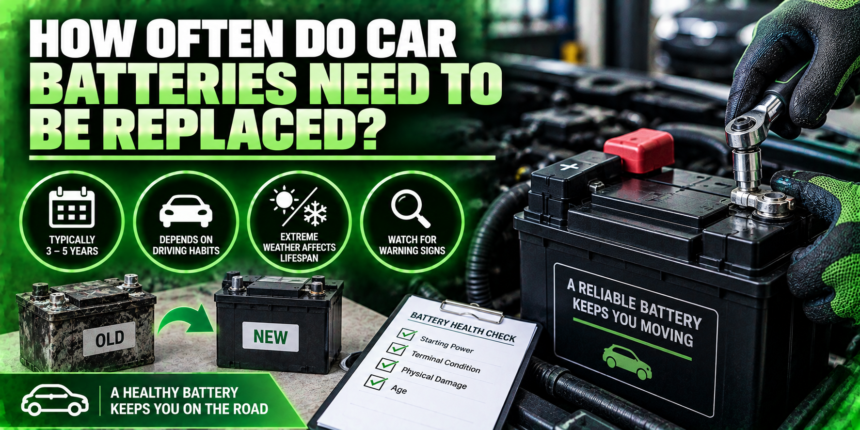
Every three to five years is the standard answer, and it is a reasonable place to start. But that range is wide enough to be almost useless if you are trying to decide whether your four-year-old battery will get you through the winter.
- Heat is what kills batteries, not cold
- The other two factors: time and vibration
- What else shortens the interval
- Does the battery type change the interval?
- Do not guess: test on a schedule
- Signs you are already past due
- How to get to the top of your range
- Buying the replacement
- Conclusion
- Frequently asked questions
- How often should you replace a car battery?
- Should I replace a five-year-old car battery?
- Does cold weather or hot weather kill car batteries?
- How do I know if my car battery needs replacing?
- Can a car battery last 10 years?
- Related Articles
The useful version is more precise. AAA’s own figures put average battery life at 58 months or more in the far northern United States, and under 41 months in the deep south. That is a difference of nearly a year and a half, and it comes down almost entirely to heat.
So the honest answer is that where you live sets your replacement interval, and testing tells you when you have reached it.
Heat is what kills batteries, not cold
This catches almost everyone out, because batteries fail on cold mornings.
Cold is when the failure shows up. It is not what caused it. Low temperatures thicken the oil and reduce the current a battery can deliver, so a weakened battery finally cannot turn the engine. But the weakening happened months earlier, in July.
Heat accelerates the chemical reactions inside a battery, including the ones that degrade it. It also evaporates electrolyte and speeds up internal corrosion. And it is worse than the air temperature suggests, because the battery lives in an engine bay where, as AAA notes, temperatures can exceed 200 degrees Fahrenheit in hot weather.
The scale of it shows up in breakdown data. AAA reported responding to 1.8 million battery-related service calls in the summer of 2018 alone, which is not the season most drivers associate with flat batteries.
The damage is cumulative and permanent. A battery that spent three summers in Phoenix has less capacity than an identical battery that spent three summers in Minnesota, and no amount of charging brings it back.
Manufacturers have responded to this in ways worth noticing. Some now mount the battery away from engine heat, under a rear seat or in the boot, or fit a heat shield over it. Some flooded batteries are even sold in regional versions: northern ones emphasise cold cranking power, southern ones use a higher electrolyte-to-lead ratio to survive heat.
The other two factors: time and vibration
AAA names three primary influences on battery life, and heat is only one of them.
Time is unavoidable. Even in ideal conditions and with perfect care, a lead-acid battery gradually loses its ability to start an engine. Nothing you do stops the clock, though plenty of things speed it up.
Vibration is the one nobody thinks about. Constant shaking breaks down the internal structure of the plates. The fix costs nothing: the battery hold-down bracket exists specifically to stop the battery moving, and a missing or loose hold-down significantly shortens battery life. If yours has ever been removed and refitted casually, it is worth checking that the clamp is actually tight.
What else shortens the interval
Several habits and faults will pull your battery well below the regional average.
Short trips. A journey of a few minutes takes more out of the battery starting the engine than the alternator puts back before you switch off. Do that daily and the battery lives in a permanent partial state of charge, which causes sulfation and permanent capacity loss.
Long periods parked. A battery left standing self-discharges, and modern cars keep drawing a small current for alarms, modules and keyless systems even when locked. A few weeks unused can put a battery below the level where damage begins.
Deep discharges. Letting a battery go completely flat, even once, significantly shortens its life afterwards, even if it recharges and goes back into service. Leaving the lights on overnight is not a free mistake.
A charging fault. Persistent undercharging or overcharging accelerates ageing considerably. If a battery dies early, have the charging system checked before assuming you bought a bad one.
More electronics than the battery was designed for. Modern cars ask far more of a 12-volt battery than cars of twenty years ago, which is part of why real-world life has drifted towards the lower end of the three-to-five-year range.
Does the battery type change the interval?
Yes, and it is worth knowing which one you have.
A conventional flooded battery, the traditional type, sits in the three to five year band described above. An AGM battery, where the electrolyte is held in glass matting, generally runs longer, commonly four to seven years, and tolerates being deeply discharged far better. Most cars with engine stop-start are fitted with AGM from the factory because those systems cycle the battery much harder.
Heat still applies to both. AGM batteries perform well in high-temperature life testing, but they lose water in the heat like any lead-acid battery, and because they are sealed there is no way to put it back. A flooded battery in the same conditions can sometimes be topped up with distilled water and given more service life.
The practical point is not to change type when you replace. The charging system is configured for what the car came with.
Do not guess: test on a schedule
Because the failure is gradual and mostly invisible, the sensible approach is not to count years but to start testing at a set point and keep testing.
Consumer Reports’ lead battery tester recommends a specific schedule that accounts for climate: have the battery load tested annually once it is two years old if you live somewhere warm, or once it is four years old if you live somewhere cold. AAA suggests testing yearly after three years, which sits between the two.
The word that matters is “load”. A voltage check tells you the state of charge, not the state of health, and a battery that has lost half its capacity can still read a healthy 12.6 volts on a warm afternoon. A load test or a conductance test measures whether it can actually deliver current. Most parts shops and garages will do one free in a couple of minutes.
Once a battery starts failing a test, replace it on your schedule rather than the weather’s.
Signs you are already past due
If you are seeing these, the decision has largely been made for you.
- The engine cranks slowly, especially on cold mornings
- Headlights dim noticeably at idle and brighten when you rev
- You have needed a jump start, particularly more than once
- The battery or charging warning light comes on
- The battery case is bulging or swollen
- There is a rotten-egg or sulphurous smell around the battery
- The battery is more than three years old and you do not know its history
A swollen case or a sulphurous smell means stop using it and replace it now. Those indicate overheating or overcharging, and a battery in that state can vent hydrogen or leak acid.
How to get to the top of your range
None of this stops the clock, but several habits reliably move you towards five years rather than three.
- Park in the shade or a garage where you can. Reducing peak under-bonnet temperature is the single most effective thing available to you.
- Take a longer drive weekly. Thirty minutes or so lets the alternator actually replace what short trips take out.
- Use a maintainer if the car sits. Anything over a few weeks parked is worth plugging in, and it costs less than one replacement battery.
- Keep the terminals clean and tight. Corrosion adds resistance, which means the battery charges less effectively than it should.
- Check the hold-down clamp. Two minutes, no cost, and it addresses one of the three primary causes of early failure.
- Do not leave it flat. If you do drain it, recharge it properly with a charger rather than relying on a drive to bring it back.
Buying the replacement
Three things matter more than brand.
The date code. Batteries age on the shelf. The manufacture date is on a sticker on the top or side, usually as a letter for the month and a digit for the year, so October 2018 reads as K-8 or 10-8, with the letter I skipped. Consumer Reports advises buying one less than six months old, and preferably three months or newer. Buy from somewhere with high turnover.
The right type, group and rating. The group number determines physical fit, terminal positions and clearance. The cold cranking amps figure must meet or exceed what your car specifies. And AAA’s advice is to replace with the same type the car came with, because the charging system is tuned for it. Fitting a flooded battery where an AGM belongs, or the reverse, causes problems that show up later.
Whether the car needs to be told. This is new and catches DIYers out. Several manufacturers, including Audi, BMW, Ford and Mercedes-Benz, require a replacement battery to be registered with the vehicle using a scan tool, so the charging system can adjust to a new battery rather than continuing to charge as if the old one were still fitted. Skip that step and the new battery may be systematically undercharged. Check whether yours needs it before you buy the tools to do the job at home.
One more point on warranties. Look for an extended full-replacement period, typically three years or more, and read what happens after it. A warranty that switches quickly to pro-rated coverage means you pay a share of the replacement, which is worth considerably less than it appears.
Conclusion
Plan on three to five years, and use your climate to place yourself in that range: nearer five in the north, nearer three and a half in the south. Heat does the damage, cold merely exposes it, so a hot summer matters more than a cold snap. Start load testing at two years in a warm climate or four in a cold one, replace on a test result rather than a breakdown, and when you buy, check the date code and whether your car needs the new battery registered.
Frequently asked questions
How often should you replace a car battery?
Every three to five years for most drivers. Average life runs to 58 months or more in the northern United States and under 41 months in the deep south, so climate is the biggest single variable. Test annually rather than replacing purely on age.
Should I replace a five-year-old car battery?
At five years a battery is at the end of its expected life, so it is reasonable to replace it proactively, particularly before winter. Have it load tested first: if it passes comfortably you can wait, and if it is marginal you have avoided a breakdown.
Does cold weather or hot weather kill car batteries?
Heat does the damage and cold reveals it. High temperatures accelerate internal degradation and evaporate electrolyte, permanently reducing capacity. Cold simply increases the current needed to start the engine, which is when an already weakened battery finally fails.
How do I know if my car battery needs replacing?
Slow cranking, dimming headlights at idle, needing a jump start, or a battery warning light. A load test at a garage or parts shop settles it in minutes, and is far more reliable than a voltage reading, which only shows the state of charge.
Can a car battery last 10 years?
It is very unusual. Most are engineered for three to five years of service, and even in ideal conditions capacity declines steadily. A battery still working at eight or ten years is an outlier rather than something to plan around.
Related Articles
Can a Battery Be Too Dead to Jump? When a Jump Works and When It Won’t
Are Super Start Batteries Good? An Honest Look